


by FilmInk Staff
Going Country is a new two-part ABC TV series from filmmaker Kriv Stenders.
Like Stenders’ other musical explorations Right Here: The Go-Betweens and Slim & I, Going Country is surprising and inventive.
Presented by Justine Clarke, it’s a ride through the long tradition of Australian Country Music, exploring its roots in White Settlement and the influence of Indigenous Cultures. Part road trip, part song book, the show travels to the home of Aussie Country Music, Tamworth and to inner-city pubs where a young generation have ditched their Nirvana t-shirts and pedals for acoustic guitars and press-stud shirts.
In between, there are stop overs to places like Kempsey, Blackheath, and Little River… each one a tile in the mosaic that makes up Australian Country Music.
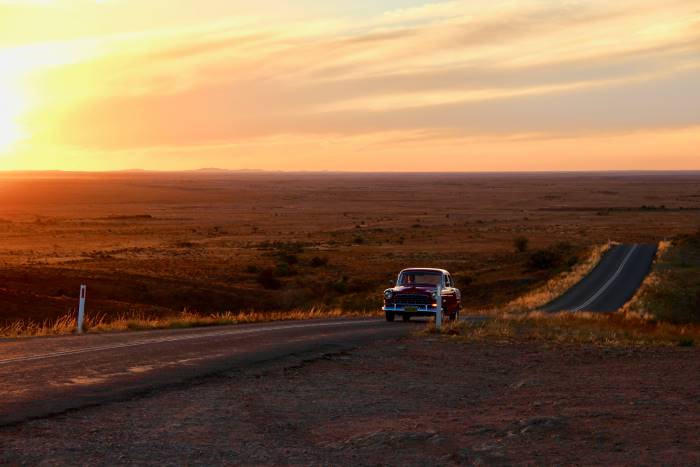
Shot, suitably, in warm and welcoming colours by cinematographer Kevin Scott, the two hours of screen time is filled with lush images and beautiful songs, much of it performed with a guest list of famed performers including Kasey Chambers, Paul Kelly, Fanny Lumsden, Briggs, and Troy Cassar-Daley. Even Clarke, who, it turns out, has a great set of pipes, gets a turn at the mic!
On the eve of the show’s debut on ABC TV, we spoke to Kriv Stenders about trying to cram a century+ of music history into two hours.
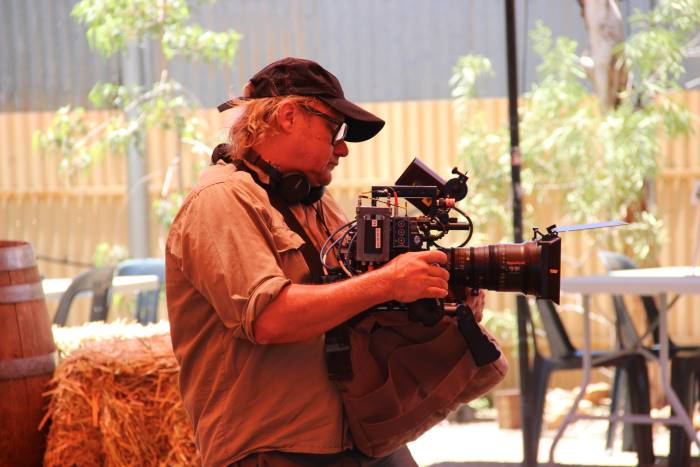
Last year your feature documentary Slim & I, about great Australian country stars Joy McKean and Slim Dusty was released. You mentioned when we last spoke that Going Country grew out of that?
“Absolutely! Originally Going Country was to be three parts and linear [in structure]. Then it was cut to two parts, and I thought, ‘gosh we can’t tell everything in two parts!’”
It was more ‘Ken Burns’ or ‘Nat Geo’ than what it is now, which is more anecdotal and impressionistic… it’s history, but it’s history as storytelling, not lecturing.
“Yeah, it is. I think we were trying to demystify or de-‘dagify’ country music. There’s a lot of prejudice about it. But ultimately it’s incredibly powerful music.”
What’s that prejudice about? The interviews and anecdotes keep coming back to that throughout the two hours…
“It does get ghettoised. It’s maligned. Misunderstood. It was [dubbed] redneck music. Bogan music. Low brow. Working class.”

But the show demonstrates brilliantly that it is a form that has depth, scope, many dimensions. As someone says in the show, there are songs here that change ‘history and hearts’, giving a voice to people who are not normally heard…
“We say that it’s an art form. Like all great art forms, it has a deceptive simplicity to it. I found that amazing… to write a simple song is actually fucking hard. To have a song that lasts for decades and becomes a part of the culture is quite an extraordinary thing. It’s resilient. It doesn’t date. It comes from a place of story and human experience. It’s not about fashion or style. I think the whole point of the show is to surprise people… [have them] decode it [so they can say] this music is for everyone.”
Country Music traditionally has had a large following amongst Australia’s First Nations Peoples but obviously there’s a tension there between Colonial and Indigenous Traditions.
“We wanted to make that tension really transparent, and the ABC was really supportive of that.”

Outside of mainstream popular culture media Country has its proper place. Which is to say it’s huge!
“Yeah! What I didn’t realise until I worked on the Slim Dusty doc was that apparently Australian Country Music outsold America Country Music in the 1970s.”
One of the things that is dealt with in a clever way is the difference between American Country and Australian Country. You don’t make it central to the story, but we can hear the difference for ourselves. The former is angst-ridden but covered in irony. Australian Country you demonstrate is very direct. Emotional.
“There’s a universality to Country, but as you say there’s a very big difference in sensibility between us and the States. [Early on] we decided to lock onto looking at the evolution of Australian Country; what makes Australian Country, Country… as opposed to what makes it different to American Country.”

That comes over very strong in the sequence where Paul Kelly interprets Slim Dusty’s ‘When the Rain Tumbles Down in July’, which was first recorded in 1948.
“Yeah! Slim Dusty and people like Slim were the key that unlocked [what was special about Australian Country]. These were people who were obviously influenced by American Country but ended up singing about their own landscape, in their own accent. That was the starting point. We do talk about American cultural influence. But Australian Country carved out its own thing. There is a unique – not sound – but strand, here.”

Let’s talk about the way the show is designed around certain important Australian Country songs.
“Well, once we were cut down from three hours to two, we inverted the original concept [and focused on] a series of songs that were uniquely Australian and could never be American [to tell the story]. We were using the songs as markers. That was the focus, instead of eras. Things like The Dingoes’ ‘Way Out West’ (1973), ‘True Blue’ (John Williamson,1982), ‘Not Pretty Enough’ (Kasey Chambers, 2001), though, that is maybe a bit more universal.”
How did you select the songs?
“We started with about thirty songs. The ones we picked were always front runners. We let the song guide us – we’d pick a song and ask why is this song important? Who does this song speak to? It was trying to tell history through themes rather than facts. I had to fight for ‘Wild Colonial Boy’ (original, not the Cold Chisel song).”
Throughout, you have people performing live on-camera. There’s a great moment where Emily Wurramara sings Bob Randall’s 1970 tune ‘My Brown Skin Baby They Take Him Away’, another of the tunes heavily featured as crucial the history of Australian Country.
“That [live aspect] was key to the whole show. To me, there’s an alchemy that happens when you are in a room with a musician playing a song; there’s something magical when they are playing it directly to you. I can’t put it into words, but there is a real power and electricity that happens and that’s what I wanted to capture.”

The settings you use for the musical scenes tell their own story; a paddock, a hall.
“That’s the beauty about this music. You can play it anywhere. It doesn’t have to have a twenty-piece orchestra. It’s a bit like punk – you just do it.”
Visually the show is quite adventurous.
“Well, these days everything just seems to blend in… Like in crime shows, you have the ubiquitous shot of the tape recorder. I think it’s important to remind audiences that they are watching something unique to its subject that isn’t generic.”
The talking heads here are very stylised.
“They are a bit like close ups in a fictional film. It makes the cast really come alive.”
Do you think the basic approach of documentary – especially in music docs – has grown tired?
“I think the form is changing. That’s why I like it. I can meld my filmmaking experience with factual. It’s a great way to experiment.”
Going Country screens on ABC and ABC iview from November 2, 2021