



by Nick Backstrom
An actor’s last film isn’t always the great fade-out that their past work deserves…but even if the film is a negligible one, and the performance is far from perfect, the importance of a final work can never be understated…
Every actor has their last movie. Whether an actor dies, is forgotten, or simply retires, there will be that one time, whether they realise it or not, when they have heard a director say, “Cut!” for the final time. An actor’s last movie can be just another role in their career, a trivia question at a pub quiz, or it can be a last triumph, the glorious sunset before night, or, by the same token, a sad commentary on the trajectory of their careers. For these actors, their last movie would often be justly forgotten, but for the fact that it contains the last performance by one of the greats, and so is dragged out from time to time. Such are the vagaries of fame.
So, here is a list of great last films, and terrible last films. Naturally, it is limited and subjective, and there are some guidelines: this collection includes only films that were made for the big screen; features only actors with long careers (ruling out, for example, River Phoenix or Heath Ledger); and takes in only films where the actor has a major role…although this is fudged quite a bit.
“LAST HURRAHS”
JAMES MASON…THE SHOOTING PARTY (1984)
A group of aristocrats gather on the estate of Sir Randolph Nettleby (James Mason) for a shooting party in 1913; the group is played by a fantastic ensemble cast including John Gielgud, Edward Fox, Robert Hardy, Gordon Jackson, Dorothy Tutin and Judi Bowker. This is an elegant film, set in the twilight of the Edwardian era. Mason’s dignified and sympathetic aristocrat, as courteous to his staff as to his guests, is shown in contrast to the careless selfish Edward Fox. There is a beautiful scene between Mason and Gielgud’s character, an anti-hunt activist, where Mason tries hard to understand the other man’s point of view, but cannot quite get there, but both men leave with respect for each other. Tensions among the shooting party lead to an act of great violence. The Shooting Party is largely forgotten today, but it was a critical hit at the time, and did well at the box office. Considering Mason’s incredible body of work, it’s a quiet end, but a curiously fascinating and dignified one.
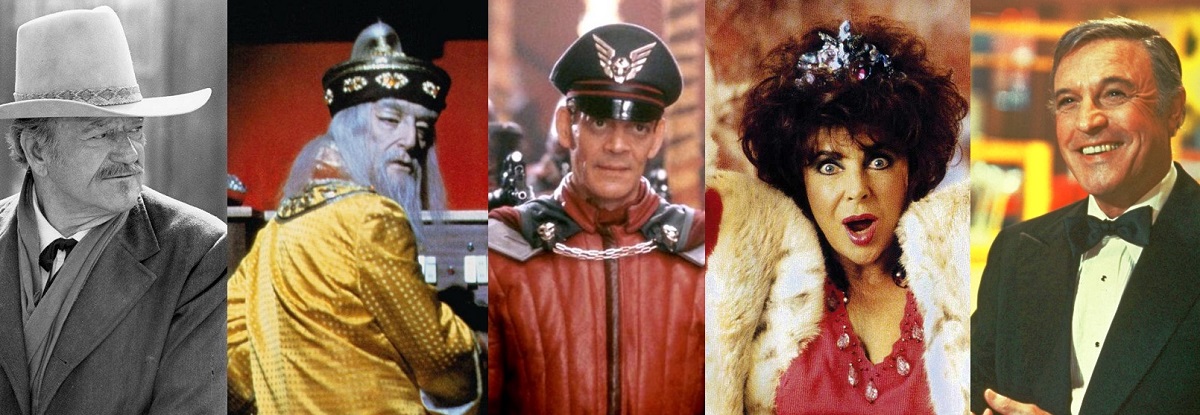
JOHN WAYNE…THE SHOOTIST (1976)
John Wayne won an Oscar for his role as Rooster Cogburn in 1969’s True Grit, which was seen as a recognition for his body of work and his remarkable career as one of Hollywood’s great stars. It’s a good performance in a good film but Don Siegel’s The Shootist is better. Wayne is JB Brooks, a sheriff turned gunfighter (we are given a retrospective of Brooks’ life through clips of Wayne’s earlier films) told by his doctor (James Stewart) that he has only weeks to live. His doctor tells him his death from cancer will be painful, and it is not the death he would choose. Brooks is living in a boarding house run by widow Bond Rogers (Lauren Bacall) whose son Gillom (Ron Howard) is in awe of the legendary gunman. Brooks’ attempt to control his death forms the body of the film, and that death, and Gillom’s reaction to it, presage the end to an era of American frontier history. Wayne combines masculinity with honour, and the vulnerability of a dying man (he was dying in real life), which makes his romance with Bond, and his fatherly attitude towards Gillom, both believable and affecting. It’s a quality Western, and a more than fitting way for Wayne to go out; not quite in the saddle, nor with gun in hand, but close enough.
LILLIAN GISH…THE WHALES OF AUGUST (1987)
Like John Wayne, Lillian Gish’s career lasted from silent movies until late into the 20th Century. Unlike Wayne, Gish was a star in silent films. The Whales of August director Lindsay Anderson complimented Gish on a close-up, saying it was perfect. Co-star Bette Davis said, “It should be. She invented the fucking things.” Which is more or less true. Two elderly sisters are spending their summer in a house in Maine, as they have done for decades. They reflect on their lives, and their relationship, which has not always been close. There is a sense that this is their last chance to make that different. Vincent Price plays a Russian expatriate whose attentions to the sisters may or may not be sincere, while Ann Southern plays their friend of many decades. The main interest of this film is its actors. It’s quite light, and in the wrong hands, this could have been a snooze. But Gish is a revelation, as she always was on-screen. She is the softer of the two sisters, and her face is so open you can almost read her thoughts and emotions. Ann Southern won the Best Supporting Actress Oscar for her work. She was a great actor, if never quite a star, with a long, impressive career, and this was her last film as well. You just never know…
SIR RALPH RICHARDSON…GREYSTOKE: THE LEGEND OF TARZAN, LORD OF THE APES (1984)
This is not about the lead actor: Tarzan is played by then unknown French actor Christopher Lambert. This version is the most faithful of the many, many adaptations of Edgar Rice Burroughs’ original novel, about the heir to a British title and his son who are lost in the African jungle. Ralph Richardson plays Lord Greystoke, who has been searching for his lost son and grandson for a long time, and is overjoyed to have his grandson back, even in this wild figure of a stranger. He does not appear until late in the movie and it is a beautiful, Oscar-nominated performance. The reclusive Greystoke has been mourning for years, and allows himself be changed by this wild man, and to have a last burst of life. Richardson was never as big a star as contemporaries and close friends, Laurence Olivier or John Gieldgud, but his reputation as an actor rivalled them both. On screen, there was an unpredictability to him, a twinkle in the eye denoting a true eccentric. As an end to his screen career as a character actor, this is a superb send-off. Richardson is profoundly moving as a sad, lonely man finding joy again, and his death scene, which he suggested, is also suitable for a man who loved motorbikes and once set off fireworks in Olivier’s loungeroom.
BURT LANCASTER…FIELD OF DREAMS (1989)
Sports films tend to appeal mainly to fans of that sport. Phil Alden Robinson’s Field of Dreams is beloved by people who have never been near a baseball diamond. Why? Because it is about family, mainly fathers and sons, and following dreams, and second chances, in a mix of fantasy, drama, and comedy that really strikes a chord to this day. It has a strong cast with Kevin Costner at the peak of his stardom, Ray Liotta, Amy Madigan and James Earl Jones. But again, this is about a supporting role. Hollywood giant Burt Lancaster appears as Archie “Moonlight” Graham, a baseball player who only played one innings in one game, without a chance to bat, and then became a doctor. By the time they track him down, he is dead. But Costner’s Ray Kinsella, in a magical night, meets with Doc Graham. It is a star performance without unbalancing the scene or the movie. 76-year-old Lancaster still has the charm, the smile, even the athletic grace that characterised his work. He turns down the call to adventure, you might say, but in such a way that you, along with Ray, accept it. That he comes back is a pleasant surprise. His second scene is short, simple and perfect. He fades away in the film in a fitting end to his career.
“FORGOTTEN, NOT FORGIVEN.”
PETER SELLERS…THE FIENDISH PLOT OF DR FU MANCHU (1980)
Piers Haggard was one director, Richard Quine was director in preproduction, and Peter Sellers himself did the reshoots. Not surprisingly, the film doesn’t work. It commits the ultimate sin of art – it is dull. It is hard to care about anyone or what is happening at any moment. There are some laughs to be had, but not many. All the Sellers gifts are there – the voice work, the physical comedy, the expressive eyes, the astonishing contrast between multiple characters – but all in the service of a script that doesn’t work. And with the actor in yellowface, it just adds to the discomfort. And did so in 1980, according to the critics. Peter Sellers was once compared to Olivier in terms of versatility. On film, he is better. But as someone once said, he lacked the talent to handle the talent. He made disastrous choices in his work, both the vehicles he chose and how he went about working on them. He alienated crew, actors and directors by being so difficult to work with. Like the little girl with the curl, when he is bad, he is rotten. Sadly, his second last film was the superb Being There. He should have stopped there. This is also the last film of John le Mesurier. As with Sellers, he was in bad health before the film started shooting, and died soon after.
RAUL JULIA…STREET FIGHTER (1994)
If it is difficult to make a sports film that appeals to nonfans of the sport, surely making a movie based on a video game is even more so. In Steven E de Souza’s much maligned 1994 sci-fi actioner Street Fighter, action star Jean-Claude van Damme is Colonel Guile who, to cut a long and not very interesting story short, is trying to bring down the regime and evil schemes of General Bison, played by Raul Julia, resplendent in red leather, ludicrous military cap, and cape, in his last movie. Raul Julia was a huge star, from Kiss Of The Spiderwoman to Presumed Innocent to The Addams Family. Fans were shocked by his appearance in this film, with sunken cheeks and eyes. Raul Julia, at only 54, was suffering from terminal cancer, and made this film for the enjoyment, he said, of his children, who were fans of the game. They very likely loved what he did. It is a great performance, grand and bold without being over the top. He relishes playing literally a cartoon villain, and that dialogue… “For you, the day Bison graced your village was the most important day of your life. But for me, it was Tuesday.” It is a joy to behold. The ending suggests a sequel, which did happen, but sadly without Julia.
GENE KELLY…XANADU (1980)
What. A. Dud. A story without an antagonist driven by a craze that would have been over before the first draft was finished. Xanadu is a vehicle for Olivia Newton-John, who plays the muse Terpsichore, who comes to Earth calling herself Kira, to inspire a struggling artist Sonny (Michael Beck) to fulfil his dream of opening a roller-skating themed disco. The building that he thinks would be great is owned by Danny Maguire, played by Gene Kelly, who is a construction giant, a corporate warlord, a king of capitalism. You think he might object to it, but nope, he loves the idea. He used to be a clarinettist in a big band, and he was in love with Kira, in another guise, in another time. The film is terrible, and quite dull…although the soundtrack is good. Olivia Newton-John and Gene Kelly share a lovely duet, including a tap number. Kelly is as charming as he ever was, the million-dollar smile still in place, and still with the moves. At nearly 70 years old, Kelly still embodies the joy of music and dance. Given the back story with the Kira character, and the definite chemistry between the two actors, perhaps there could have been the hint of a love triangle, despite the age gap. Kelly said the film was made by people who had no idea how to make a musical, and he would know. Somehow, he bows out with his dignity intact.
CLAUDE RAINS…THE GREATEST STORY EVER TOLD (1965)
In this George Stevens yawn-fest telling of The Bible, Swedish actor Max Von Sydow plays Jesus (a Swede playing a Middle-Eastern Jew – is there even a name for that?), and actually gives a good performance. George Stevens tries to instil every scene with a sense of awe (there’s a good John Wayne joke about that) making it far too reverent and polite to be good. It is jam-packed with actors and stars – Charlton Heston, Telly Savalas, Dorothy Maguire, Ed Wynn, Sydney Poiter, Jamie Farr – and features the final performance, in a minor role, of a major actor…the great Claude Rains. From his debut as The Invisible Man, to Major Renault in Casablanca (one of the most beloved characters on film), Prince John in the Errol Flynn Robin Hood, and the sympathetic spy in Notorious, Claude Rains was one of the most respected actors of his generation, a star, and had one of the most beautiful speaking voices on screen. In The Greatest Story Ever Told, Claude Rains plays Herod The Great, who orders a massacre of the newborn, for only a few short scenes. In another villainous role, he is terrific. He looks the decrepit debauchee, a weak and frightened man, yet a man to be feared. The moment when he asks the Three Kings to let him know where this new baby is born is quite chilling. Though hardly a fitting end, it is impressive work from Claude Rains.
ELIZABETH TAYLOR…THE FLINTSTONES (1994)
This live-action version of the long-running popular animated sitcom was highly anticipated, with John Goodman as Fred Flintstone. A major reason for the anticipation was the return of screen queen Elizabeth Taylor to the cinema. Liz plays Fred’s mother-in-law, Pearl Slaghoople, and it was stunt casting of the best kind. Taylor had a remarkable career, but she gave it all away, and her later years were marked by her work as an activist, particularly for AIDS, inspired by her friendship with the first celebrity victim of that terrible disease, Rock Hudson. A lesser person would have kept their distance, perhaps sent a message of support behind the scenes, but not Taylor. She was up front, forthright, and demanding attention – and funding – be paid. In The Flintstones, Liz Taylor plays into her image of being rich, spoiled and demanding, all of which she could be. She nails the classic movie mother-in-law role, making life hell for her son-in-law while being overprotective of her daughter. And she matches the big energy of Goodman; if a showdown came between her and Fred, despite his physical advantage, you might back her. Taylor has a ball on the screen, and we have one with her. Her scenes are full of energy and life, much like the actor. It’s a terrible film, but great way to bow out. And Elizabeth Taylor did it on her own terms: the money from the premiere went to her AIDS foundation.
———————-
There’s five of each, and others readily pop to mind, both kinds: Oliver Reed in Gladiator, Marty Feldman in Yellowbeard, Spencer Tracy in Guess Who’s Coming to Dinner, just to name a few. With rare exception, it goes to show that no matter how big a star, or how good an actor, the last movie is as unpredictable and uncontrollable as any other part of an actor’s career…
Like this story? Check out our special features on feuding actors, actors who got sacked, directors who got sacked, more directors who got sacked, directors who dropped out of films, tyrannical filmmakers and people who played themselves on screen. Enjoy them as much as we had putting them together.
