



By Julian Wood
It would be fair to say that, of the most important contemporary British film directors, Terence Davies is still one who can divide opinion. His films, which are so lyrical and heartfelt, can seem too leisurely to some, even self-indulgent perhaps. But no one seriously doubts that Davies has now put together a body of work which will last as long as cinema is written about. His 1988 classic about working class life in Liverpool, Distant Voices, Still Lives, has a personal quality and a depth of emotion that is unique.
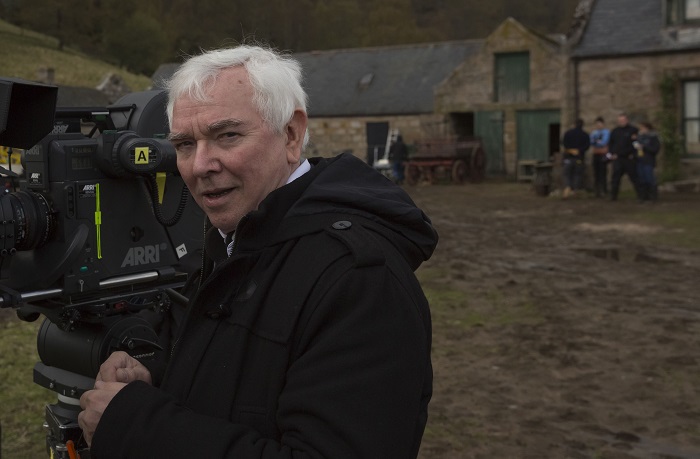
FilmInk spoke to the 71-year-old director while he was in Australia as a guest of The Melbourne International Film Festival. FilmInk wondered if Davies’ minders knew that they were looking after a “national treasure”? Davies has a wonderfully self-deprecating laugh, and he is keen to scotch that rumour. “Oh God, don’t call me that,” the director says. “It makes me sound like The Albert Hall! Imagine going around with that label hanging off you for the next few decades! I couldn’t face it!”
He has also never been in Australia before and, from his eyrie on the 47th floor of a swanky hotel, he rather likes what he sees. “Oh, it’s very impressive…it’s a bit like Manhattan,” Davies says. “The hotel is incredibly stylish, and it is obviously a wealthy city. I am in this incredible hotel with a huge atrium…it’s rather spectacular.”
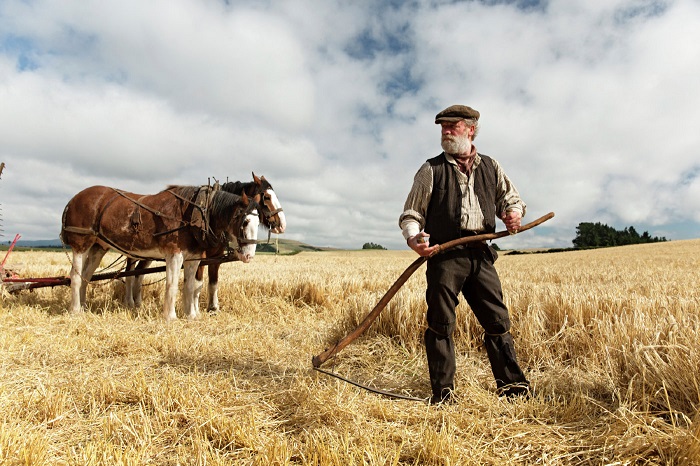
FilmInk suggests that he has a job waiting as a tourism ambassador with that level of enthusiasm. Davies’ new film, Sunset Song (adapted from Lewis Grassic Gibbon’s novel), is a sweeping historical drama set in The Scottish Highlands around the time of WW1, with its focus on a farming family lorded over by brutal, abusive patriarch, John Guthrie (Peter Mullan). Why, one wonders, make the film now. “It’s just one of those great stories that you fall in love with,” Davies replies. “When I was a young man, I saw the BBC do a version in their classics series, and they dramatised it so memorably. Most people in Scotland read the novel at school, but it hadn’t really travelled beyond Scotland, so it wasn’t well known. After seeing that show, I went and bought the book, which is actually quite difficult, but it is worth it. I just loved the story. In those days, I was just an accountant never thinking that I would one day film it. It is written in dialect and so on. But it is probably the greatest novel to come out of Scotland.”
The film certainly is Scottish…about as Scottish as a haggis in a kilt. But what about the Scottish accents? Could that present a problem for some audiences? Davies has thought about this, and, after all, he comes from a regional part of England, and his own films can be heavily accented. “Yes, for people who are not used to the accent, it could be difficult,” the director admits. “We actually made it a sort of generic Scottish accent partly for that reason. But in America, it will be subtitled for sure,” the director laughs.
The film has several key performances, with the most noticeable being from veteran actor, Peter Mullan (My Name Is Joe, Tyrannosaur). He is one of the most intense and real actors in British cinema, so intense that he is almost frightening. Davies clearly enjoys praising this friend and collaborator. “He is one of the few great cinema actors in this country,” he says. “Some are just too mannered, but he is just wonderful. What he brought to the role was the tenderness, and the caressing quality of his voice in the early scenes. He uses the bottom register of the voice, and that was his idea, not mine. And so when he turns, it is all the more shocking.”
But does Davies find him a bit scary? The answer is a bit surprising. “He also has a great sense of humour which is what you need,” the director reveals. “He is very funny, and like me, incidentally, he’s a fierce anti-Royalist. He has a lovely sense of humour. It’s been especially fun working with him.”
There is a scene where Mullan ritually flogs his grown up son, Will (Jack Greenless), in the farm’s barn, and FilmInk wanted to know about the dynamic there. “What is so heart breaking is that you know that this has happened repeatedly because they go through the ritual of the taking off of the shirt, and so forth,” Davies offers. “You know that it’s been done to him before. I said to Jack, ‘You will refuse to cry in front of him – your character would not give him that satisfaction.’ So he cries in his sister’s arms in the next scene. There are things that actors think of that you don’t think of. I said, ‘Let the scene run until he actually gets out of the barn.’ As he gets to the barn door, he steadies himself on the wall, and it is so moving. That was Jack, not me. It was his touch. And when you see something like that on a big screen, it has a lot of significance. Those fleeting moments can be very important.”
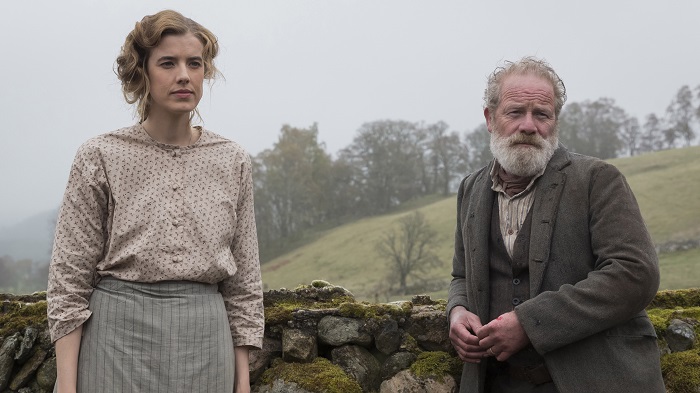
The other central performance is that of the heroine – John’s adored and increasingly independent daughter, Chris – played by relative newcomer, Agyness Deyn. Davies had not previously worked with her but, sure enough, there was a classic casting story there. “I have a casting agent, and they sent this woman to audition,” he begins. She was a top model apparently, but I didn’t really know or care about that…all that pop culture stuff. Anyway, she was the first in, and I turned to my producer and said, ‘We have found her.’ I just knew.” Deyn has a handsome face that looks good from many angles. Davies agrees. “She also has these exquisite, graceful long hands. I said to her, ‘The reason why the performance is so pure and beautiful is because you are.”
FilmInk noticed that Davies – somewhat unusually – has Deyn involved in a love scene in the film. How did that go? The director points out that being a model means that one is not shy. “Well, I guess that as a model she is used to it. There were costume changes all the time, and that was routine. She was very sanguine about it. And so was [actor] Kevin Guthrie [who plays Chris’ lover, Ewan]…they were very professional about it. As you can imagine, I wouldn’t put anything like that in the film for salacious reasons. It’s got a narrative function. And of course, it’s just before he goes off to war.”
Still, nudity and sex scenes could be a challenge. Davies laughingly turns this around. “Well, I wouldn’t do it? Would you? Sorry, I am too old for that! I’ve got bits falling off! If I was in their shoes, I wouldn’t agree to it. Still, they did it with tenderness as well. And that is what it is all about.”
Sunset Song is released in cinemas on September 1.
