


by FilmInk Staff
Everyone who has ever tried to make a movie knows it’s hard. Not only is it hard to get started, but sometimes it’s harder to get the thing finished and in front of an audience.
Writer/director Cameron McCulloch says he knows the feeling. It’s taken twenty years to get lock-off for his debut feature. “It’s a trip, getting in touch with the cast, now,” he told FilmInk. “No one thought we would ever get it done!”
Made in Melbourne in the summer of 2001, Scam would join the thousands of almost-done movies that rattle, locked away in the virtual closets of filmmakers the world over. Or so McCullough thought…
Inspired, like so many of his generation, by the then new digital technology and off-the-grid-out-of-the-system success of Wes Anderson and Robert Rodriguez, Scam was made as a fan film.
Destined for Grindhouse midnight movie glamour (as opposed to Art House acceptance), Scam was shot dirt-cheap, and is not flash, tasteful, or ‘deep’…but it is goofy fun.
McCulloch’s love for guns, blood, penis-gags, and cringe comedy may scream ‘Film Student c. 2001’ (almost all involved, he says, were just starting their careers or were still undergrads.) Still, Scam has its own weird off-kilter anything-can-happen atmosphere. The rough edges, (and there’s quite a few) are part of Scam’s charm.
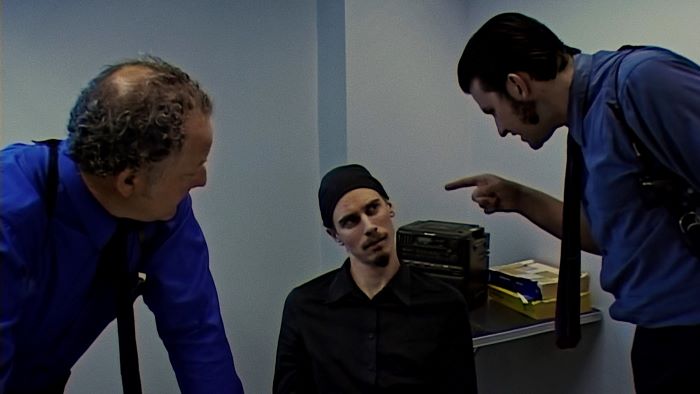
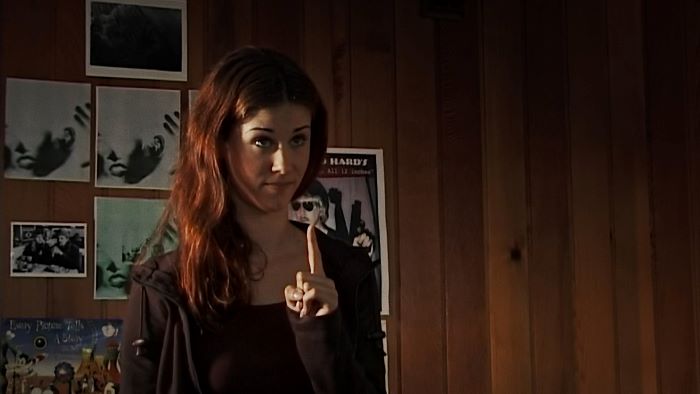
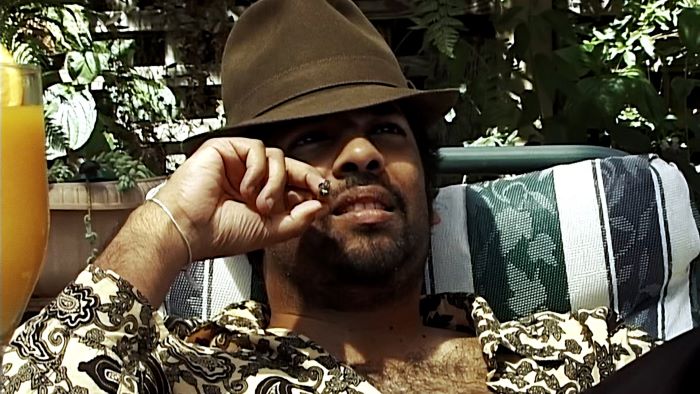
The ensemble cast includes Kestie Morassi (Wolf Creek) as a pickpocket who wants to improve her career opportunities in crime. The plot entangles her with hit men, a crime boss (Mark Jensen, excellent) and an ensemble of nutty walk-ons.
On the eve of Scam’s World Premiere, we spoke to writer/director Cameron McCulloch from his home in Melbourne, where he now works as a film professional.
You have said that, in a way, you were goaded into making Scam, by one of your teachers. Tell us about that?
“Yeah! I was at Deakin University in Melbourne. Twenty years ago. Studying acting and filmmaking.
“I had been making films since I was thirteen. I started by borrowing one of my father’s friend’s cameras. I shot a short. I edited it between two VCRs. When I watched it back, I thought, ‘I wanna do this for the rest of my life’.
“I kept making films on Super VHS, Super 8 and then 16mm at film school. So, by the time Uni [and Scam] came along, I had been making films for close to ten years.
“One day I had a bit of an interesting experience with a lecturer. They told me I would never make a feature… So, I thought, ‘I’ll write a feature and shoot it over the summer break.’ That was between my first and third year at Uni. That was January 2001.”
Well, you are not the first person in the world to be challenged by a teacher… but it sounds kind of confrontational, all the same…
“[Laughs] I was a cocky young guy! I was twenty-one! I thought, ‘I could take on the world.’ I think the lecturer was trying to put me in my place. They were telling me, to complete a feature, ‘you need this’ and ‘you need that’.
“My heroes were the DIY filmmakers. So, I thought, ‘Well you don’t need funding. You don’t need money’, you just get a bunch of actors together and make a movie. And that’s what we did.”
You managed to pull together a very strong cast. Kestie Morassi (Wolf Creek) had already done Neighbours and it was just before her breakout performance in Dirty Deeds (2002).
“At that time, Melbourne had a really cool independent low budget/no budget film scene. Nick Levy (Scam producer) had just made Radio Samurai (2002). We all had worked on that. I was a camera assistant on it, and I got to know the cast. I used a lot of … Samurai actors on Scam.”
Was Tarantino an influence?
“I was never much of a Tarantino fan. I know it’s not obvious [from looking at Scam], but my favourite director is Wong Kar-wai. In those days, you were in the Tarantino Camp or the Rodriguez Camp… and I was with Rodriguez.
“I made every cast member watch El Mariachi (Robert Rodriguez, 1992). I gave a copy of Rebel Without a Crew to every cast member. I told everyone, ‘We want to do something cool like this’… for 5,000 dollars.”
How did you manage to stretch the dollar on a film that has guns, effects, stunts, explosions, blood, dozens of locations and many, many speaking roles?
“We made it go a long way shooting on digital. The digital revolution came with the mini DV (we used a Sony). There were a couple of films made in the format. There was Chuck n Buck (Miguel Arteta, 2000). 28 Days Later (Danny Boyle, 2002) was shot on a camera similar to the one we used on Scam. There was a bit of a legitimacy to shooting digital back in the day. We were able to shoot widescreen as opposed to 4 x 3.
“I wrote the script using locations I knew [required no fees] and that I could get access to. I was working behind a bar. The owner of the bar allowed me to stage the shootout in one of his two bars. My mother worked in a factory, so we shot there; the ‘hero house’ was my house. The scene where the couple breakup at the beginning of the film is Kestie’s bedroom!
“The film was shot in twelve days and two of those days we did all the action. The fx were done by Paul Moder (S.N.A.K. 2000; Wentworth) who brought in an armourer, Lennon Steele.”
Where did the budget come from?
“My parents kicked in. But I saved the budget working part-time jobs. Mum did the catering. When you are not paying anyone and you don’t have good food, you get anarchy. We spent $1500 on food!”
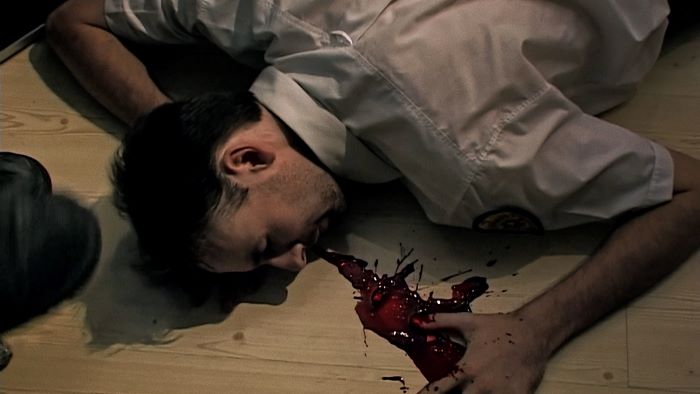
Part of the fun of the film is that it is so unashamed to be rude, crude and fearlessly Melbourne and pay homage to a lot of other films… but it works!
“Oh, look the script was just me at twenty writing a film that I wanted to see. When you are at that age and at film school… people were making these really dark and depressing art house films and I was doing these silly comedies, action movies…
“My fave filmmakers were never people like Truffaut. I liked Spielberg; Hong Kong action cinema. John Woo.
“The plot derived from urban legends I heard growing up. The characters were like fictionalised versions of shady people [my friends knew].”
It uses title cards like Tarantino did in Pulp Fiction.
“The chapter headings were a necessity. They [filled in] the missing footage. They set up what we were about to see.
“I had to shoot establishing shots on my phone because the originals were lost…”
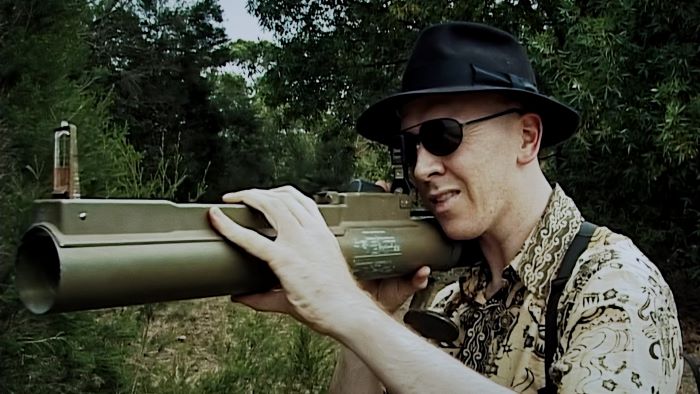
How did Scam disappear for twenty years?
“[DV Cam uses tapes, like audio cassettes]. I split the cut fifty/fifty with an editor. The editor had a house fire. There was major damage to half of the house. [The edit was safe, but the house was a re-build].
“His tapes ended up in storage. Over time, he kept discovering tapes every time he dipped into the container! Five or six years had passed, and I had a box of thirty tapes, and I wrote an entire new script based on the material we had. I tried to create a whole different film out of it. but it was all too hard. I was working full time in post-production.
“Then lockdown happened. Nathan Hill – he plays a gunman in the film, now a filmmaker – wanted to see the tapes. When I handed over the camera logs – they were at my parents’ place – I found two more tapes! He called six months later and said, ‘I think we might have a film here’.”
How do you feel looking at it after all this time?
“Now we have got something… it’s a bizarre feeing. It’s not as if it’s a lost classic. It’s got some cheesy performances, mainly mine [McCulloch plays a lead role after one of his actors dropped out at the last minute]. I think people will be keen to see this Ozploitation film lost for twenty years… even if they have never heard of it!”
Scam makes its World Premiere at Monsterfest in Melbourne on 9 December.
