



by Nataliia Serebriakova
Worth: $13.60
FilmInk rates movies out of $20 — the score indicates the amount we believe a ticket to the movie to be worth
Cast:
Isabelle Huppert, Lars Eidinger, Birgit Minichmayr, Thomas Schubert, Conchita Wurst
Intro:
… a stylised masquerade that invites the viewer to surrender to its strange, campy logic.
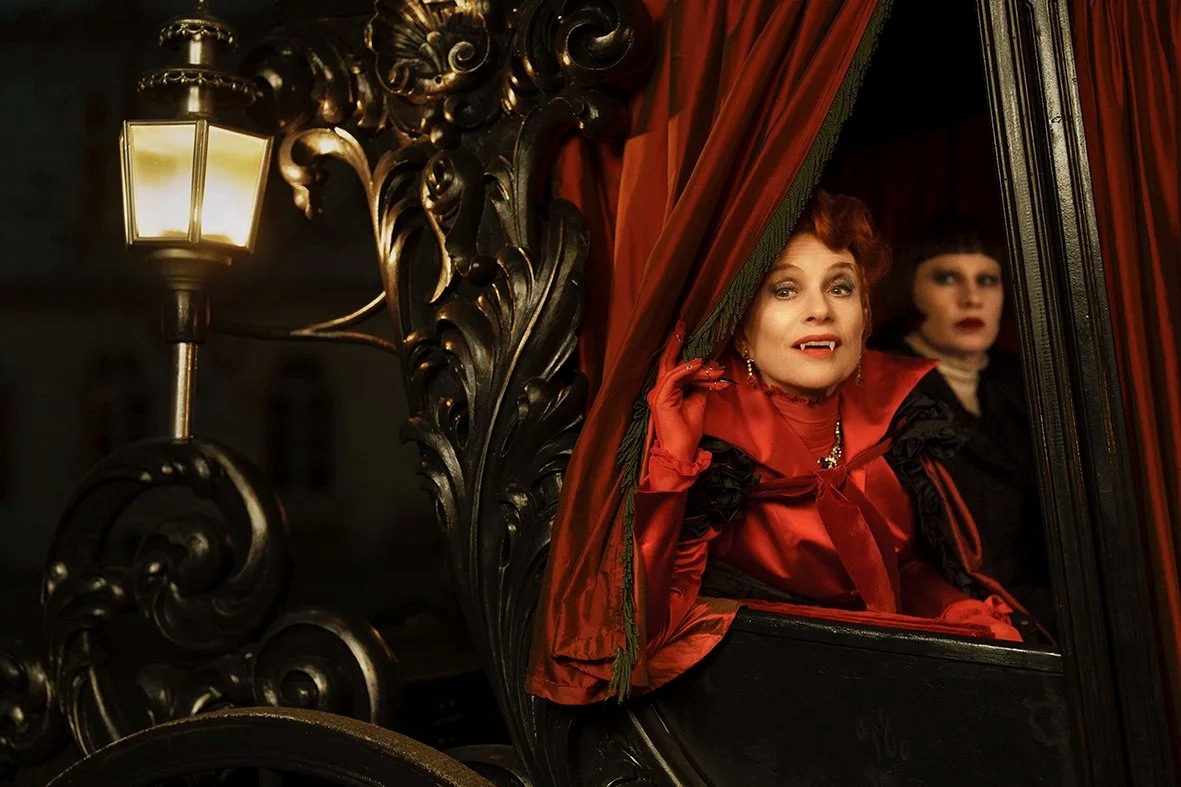
The plot of the new film by German cinema legend Ulrike Ottinger, The Blood Countess, revolves around another legend — Countess Báthory (Isabelle Huppert), the Hungarian aristocrat and one of history’s most notorious serial killers, believed to have murdered more than one hundred and fifty young girls and women.
Ottinger, however, freely reimagines the story of the real-life murderer, turning her into a vampire. In Ottinger’s version, Countess Báthory awakens from her beauty sleep in Vienna and reunites with her loyal maid. After a successful hunt in the subway, she returns to her hotel, only to find herself pursued by a pair of elderly vampirologists searching for a book that threatens the very existence of vampires.
The Countess also has a red-haired nephew, dressed entirely in green like it’s St. Patrick’s Day, and his psychotherapist (Lars Eidinger), who firmly believes that vampires do not exist.
Ottinger last presented a film at the Berlin International Film Festival in 2020 with Paris Calligrammes, a documentary woven from personal memories of the director’s Paris years, featuring Fanny Ardant and archival footage of Simone de Beauvoir. The new film, screened out of competition at the Berlin festival, is based on a novel by Elfriede Jelinek, who is credited as co-screenwriter, but in fact merely advised her longtime friend during the writing process.
The Blood Countess is a decidedly old-fashioned film, at times resembling a lavish New Year’s pageant. Isabelle Huppert wears ballroom gowns of extravagant architectural design — quite literally so, as in the opening scene the train of her crimson dress is shaped like a gondola cabin. She speaks in her remarkably beautiful voice, sprinkling in Russian words such as golubushka and dushenka, while also invoking Lenin, Stalin, and Mao. All this verbal “klukva” is framed in Fassbinder-like archetypes and interiors. Spiritually, the film feels like a cross between The Bitter Tears of Petra von Kant by Rainer Werner Fassbinder and the lesser-known Berlin werewolf tale Tenderness of the Wolves by his protégé Ulli Lommel.
Yet Ottinger is not quite as old-school as her late German colleague and even incorporates a digitally animated 3D bat. In the vampire ball sequence, where Austrian pop diva and Eurovision winner Conchita Wurst once again demonstrates her knowledge of Russian words, the spectacle turns into something akin to a kapustnik set to Strauss — a genre reminiscent of Soviet vaudeville. And whatever absurdities unfold on screen, the film remains easy and genuinely fun to watch.
It is a large-scale directorial work featuring major stars, likely to find its audience among those who appreciate kitsch presented in a fairly mainstream key.
And yet, for all its flamboyance and excess, the film is not nearly as misguided as it might first appear. Beneath the layers of theatricality lies a playful self-awareness: Ottinger clearly understands the artificiality she is staging and leans into it with mischievous confidence. The performances are committed rather than ironic, the production design meticulously crafted, and the film’s baroque absurdity gradually reveals a sly commentary on myth, power, and the persistence of cultural fantasies. What may initially seem like pure extravagance begins to feel deliberate — a stylised masquerade that invites the viewer to surrender to its strange, campy logic.
