



by Jo Stubbings
Worth: $17.00
FilmInk rates movies out of $20 — the score indicates the amount we believe a ticket to the movie to be worth
Cast:
Chen Emilie Yan, Alev Irmak, Kotbong Yang, Arnd Klawitter, Julia Jentsch, Sebastian Urzendowsky
Intro:
… lingers through its chilly precision and quiet menace.
You know you’re onto a good thriller when just about every night scene – and there are many in Faraz Shariat’s Prosecution – has you holding your breath, waiting for a gunshot, a kidnapping, or a punch-up at the very least. That this rarely comes to pass, sets this film apart from your regular hero versus villain scenario and shows one of this director’s many original approaches.
The hero in question is Seyo Kim (Chen Emilie Yan), a young German–Korean – “call me German,” she insists. Seyo has landed a job as a state prosecutor for a fictional East German town. When she asks a defendant in court to cover his pro-Nazi t-shirt, she triggers a string of dramatic events, starting with her near immolation at the hands of two neo-Nazis.
When the crime against her is road-blocked by the very people she works for, including slimy Chief Prosecutor Forch (Arnd Klawitter), Seyo realises that the enemy is greater than a couple of right-wing nutters. It’s a state that’s corrupt, a legal system that’s flawed and a society nostalgic for their pre-immigration past.
The original film title, Staatsschutz, means “state protection” in German; it’s a shame the irony is lost in the English translation, “Prosecution”.
As Seyo investigates her own case alongside others that the state has buried, she uncovers a broader pattern of racist violence and institutional cover-up. Joining the dots, one right-wing extremist to the next, has her hanging by a thread in her new job. Even sympathetic colleagues like Ayten Alican (Alev Irmak) tend to be browned off by Seyo’s modus operandi.
The character of Seyo makes the film. Her metamorphosis from hopeful newbie to scheming warrior is fascinating if not exaggerated. Early scenes indicate some dragon-parent influence as her father, by video link, encourages her to be ambitious in her new role (then asks for money to be sent home). Seyo works hard, dresses conservatively – note the crisp white shirt – and feels pretty good about herself.
Until she’s set on fire.
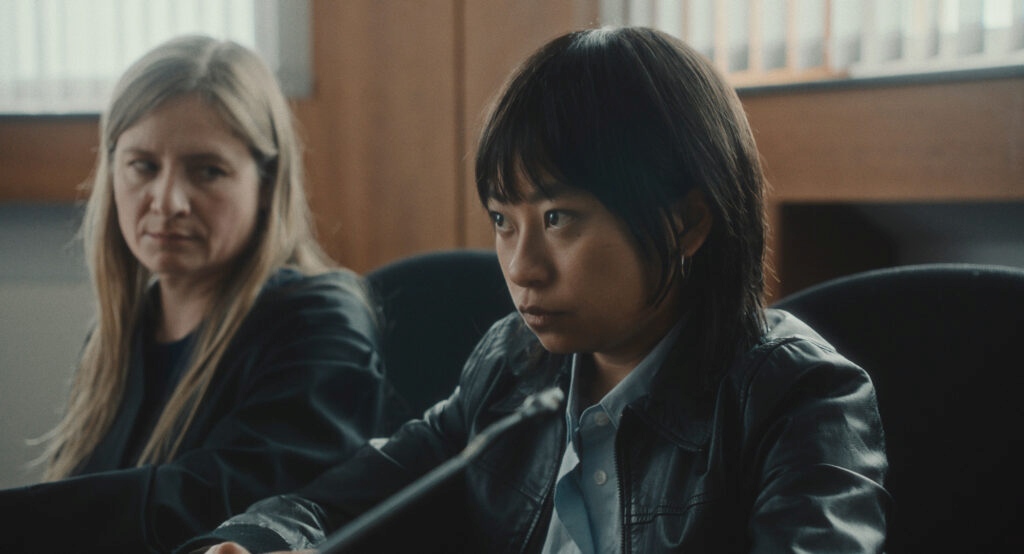
Post attack, she rocks a mullet, dresses in black, totes a gun – and never looks happy again. Seyo is now a self-styled sleuth, all the while showing a soft side with queer lover Min-su (Kotbong Yang) and her colleague’s young daughter. Yan excels in maintaining a po-faced demeanour with the occasional killer look. Such control makes her full-blooded scream toward the end of the film especially shocking.
Shariat maintains the “control” meme in a simple yet stunning way. Apart from court scenes, most other scenes play out between two characters only, in close-up, often in profile. Kudos to screenwriter, Claudia Schaefer, too. This is real, spare, slow dialogue that draws us right into each character. Every word feels loaded.
Prosecution is visually striking in that it perfectly captures the mood of widespread menace. From the top, we’re confronted with a black screen broken only by the opening of a door to let in the light. As the camera backs up, a courtroom is brought into focus and the setting clarified. This is a common device – be it car, bar or apartment interior. Again, we’re blind to what’s going on literally until light is shed on the scene.
Black and white hues dominate apart from the heavy brown panels of the courtroom’s interior and the muting of other colours, rendering the world of authority as clinical and soulless. The black suits and hoodies worn by just about everyone extend this sense of power and foreboding. When Seyo wins her case and rips down the evidence board she’d curiously stuck to the windows of her apartment, the imagery is complete. Let there be light! (Note to self – doesn’t anyone close curtains in films anymore?!)
Prosecution lingers through its chilly precision and quiet menace.
