


by Sophie Terakes
Worth: $15.50
FilmInk rates movies out of $20 — the score indicates the amount we believe a ticket to the movie to be worth
Cast:
Angelina Jolie, Alba Rohrwacher, Pierfrancesco Favino, Haluk Bilginer, Kodi Smit-McPhee, Stephen Ashfield
Intro:
Though Larraín’s film fails to present a deep, fully-fleshed Maria, the ghost it offers instead proves, in her grief, a grimly enthralling figure.
For all its blazing arias, Parisian sunsets and chestnut panelled interiors, Maria is a remarkably cool film. The third in Pablo Larraín’s trilogy of biopics about glamorous, broken 20th century women (succeeding 2016’s magnificent Jackie and 2021’s Spencer), the elegiac character study follows Greek opera soprano, Maria Callas (Angelina Jolie), through the final week of her life.
Larraín provides several spectacular glimpses into Maria’s opera career which, as captured by Edward Lachman’s opulent cinematography, illuminate the film. Midway through Maria, a dreamy flashback to her prime shows the diva performing as Anna Bolena. Here, in the centre of the stage, Maria is a dramatic, fleshy figure. Her voice (a technologically produced mixture of Jolie’s and Callas’) burns with primal passion and fury. The coarse texture of Lachman’s Super 8mm film causes the stage lights to blur so that the theatre appears to flicker and bleed at the edges of the frame. It is an utterly rousing scene, one that suggests La Callas could set the room alight with her flaming crescendo.
However, this is not the version of the star that the film will centre upon. Ailed by her failing health and emotionally eviscerated by the loss of her once-legendary voice, Larraín’s Maria is an icy shell. Without opera, we learn, Maria is only ever a partial presence. Cared for by her two kindly housekeepers, she has entombed herself in her quiet, mausoleum-like Paris apartment. During her drug-addled last days in September 1977, Maria briefly ventures out to retrain with an accompanist and, under the influence of the hypnotic sedative Mandrax, partake in a bizarre, hallucinated interview.
While Jolie gives a strong, precise performance, her character is frustratingly unknowable. Maria plays the demanding prima donna with flair, making outlandish requests, seeking the adulation of her fans and arguing with her doctor, but what is truly left of herself is always tightly concealed behind Jolie’s ever-frosty expression.
Steven Knight’s haughty, rather affected script exacerbates Maria’s emptiness. Speaking almost exclusively in contrived quips, she is forever stiffening her thin, imperious form, as if to prevent her hollow frame from collapsing in.
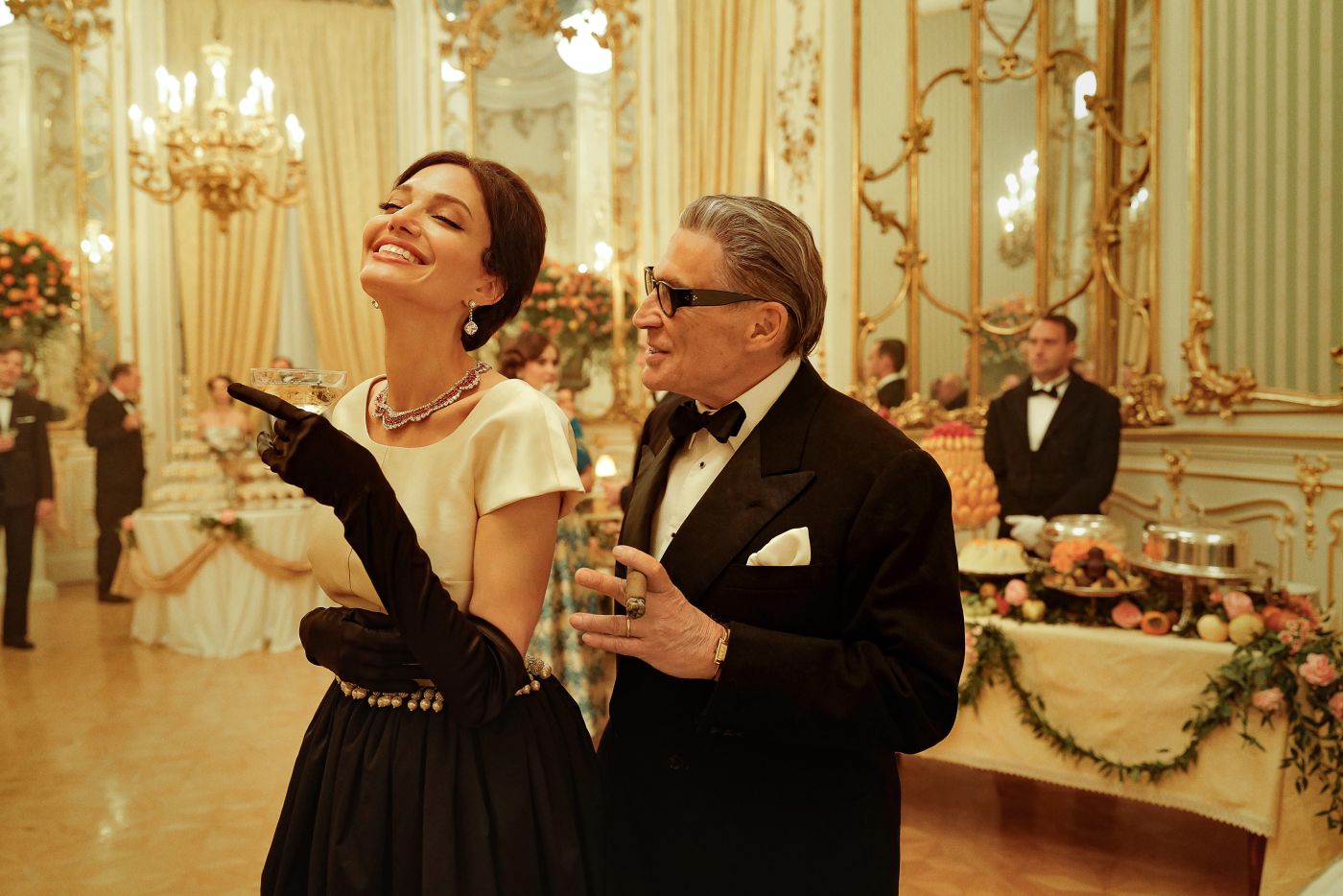
A collage of flashbacks to Maria’s past provides some shading to her character. They present her youth in Nazi-occupied Greece, her turbulent love affair with shipping magnate, Aristotle Onassis (Haluk Bilginer), and the devastating effect of his marriage to Jacqueline Kennedy. Yet these snippets, shot in lavish black and white, endow Maria with an otherworldly elegance that ultimately distances her from viewers. While ever she is offstage, whether floating through a cocktail party or wandering wraith-like around her dressing room, Maria is supremely aloof.
Though Larraín’s film fails to present a deep, fully-fleshed Maria, the ghost it offers instead proves, in her grief, a grimly enthralling figure. With poise and affection, Larraín limns a flawed but haunting portrait of a woman confronting disaster, heartbreak, and the loss of the part of herself she loved most.
