



by Cain Noble-Davies
Worth: $16.50
FilmInk rates movies out of $20 — the score indicates the amount we believe a ticket to the movie to be worth
Cast:
Jessica Gabriel’s Ujah, Amanda Oruh, Tinuade Jemiseye
Intro:
… intense and well-rounded …
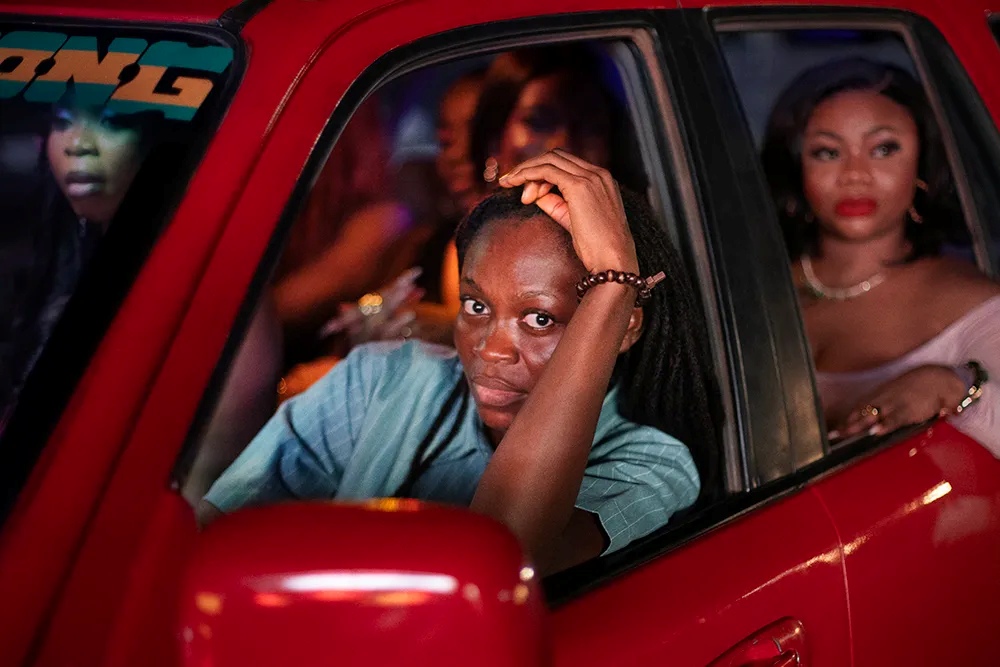
The titular Lady, a Lagosian cab driver played by Jessica Gabriel’s Ujah, is as stuck in her surroundings as both her and her car frequently are on the highway. Introduced in childhood through an inverted establishing shot, her environment of broiling upheaval, as protests intensify over fuel subsidies, have her pining for somewhere else to lay down roots. But during the course of saving every kobo to afford to relocate to Freetown, Sierra Leone, her childhood friend Pinky (Amanda Oruh) convinces her to, reluctantly, work as transport for her and her fellow sex workers, a decision that leads Lady to confront not only her surroundings, but trauma that has chased her since childhood.
The depiction of the socioeconomic reality of Lagos, Nigeria, is a bleak one but grounded with a vivid interior perspective. From the (lack of) prioritising of Black women within this society, to the fizzing discontent with government, all the way back to official involvement in the Atlantic slave trade (a morbidly refreshing inclusion, given its far-too-frequent invoking in Western discourse purely to hand-wave White involvement), the setting is actively hostile to its own people, women in particular. And when the people are left to fend for themselves, all work becomes viable.
From there, through its varied perspectives both within and without sex work, it balances a fine line between acknowledging the very real reasons why Lady and so many others wish to leave this place, but also understanding that mistreatment isn’t unique to this area. Whether it be Freetown or Paris or California, systemic disregard follows. Lady avoids turning Lagos into a place that only exists to escape from, and in so doing disrespect those who remain (for a more mainstream example of this mistake in action, look no further than JD Vance’s hick horror humble brag Hillbilly Elegy); it is still a home, just one that needs reworking.
Of course, when you’re in Lady’s position, where work is a matter of survival above all else, ideas of revolution become luxuries. That itself is usually part of the point – keep the people focused on persevering moment by moment so they don’t have the space to look at the root of the problem, but it’s an understanding that tempers Lady’s own turmoil. Lady herself is a very flawed character, and Ujah excels at making every flash of personal resolve and psychological scarring as empathetic as each other, and it’s through her eyes that everything tumbles together into a radicalising moment.
Lady is an intense and well-rounded feminist piece. Simply as a story about Nigerian women told by Nigerian women, it’s worth experiencing. But the way it gives a concrete sense of place within its setting, refusing to kowtow to stereotypes or easy cliches, is eye-opening and makes Lagos itself as much a living, breathing character as anyone else on-screen.
