


by Cain Noble-Davies
Worth: $18.50
FilmInk rates movies out of $20 — the score indicates the amount we believe a ticket to the movie to be worth
Intro:
… a poem so powerful, it doesn’t even need words.
One of the bigger surprises to come out of the 97th Academy Awards was the winner for Best Animated Feature Film. Up against the likes of Adam Elliot’s Memoir of a Snail, and Dreamworks’ in-house swan song The Wild Robot, the trophy ultimately went to an independent Latvian production Flow. While the narrative around a film has a habit of overshadowing the film itself, it is worth highlighting the legitimate victory that the win represented, and it’s something reinforced by the themes of the film proper.
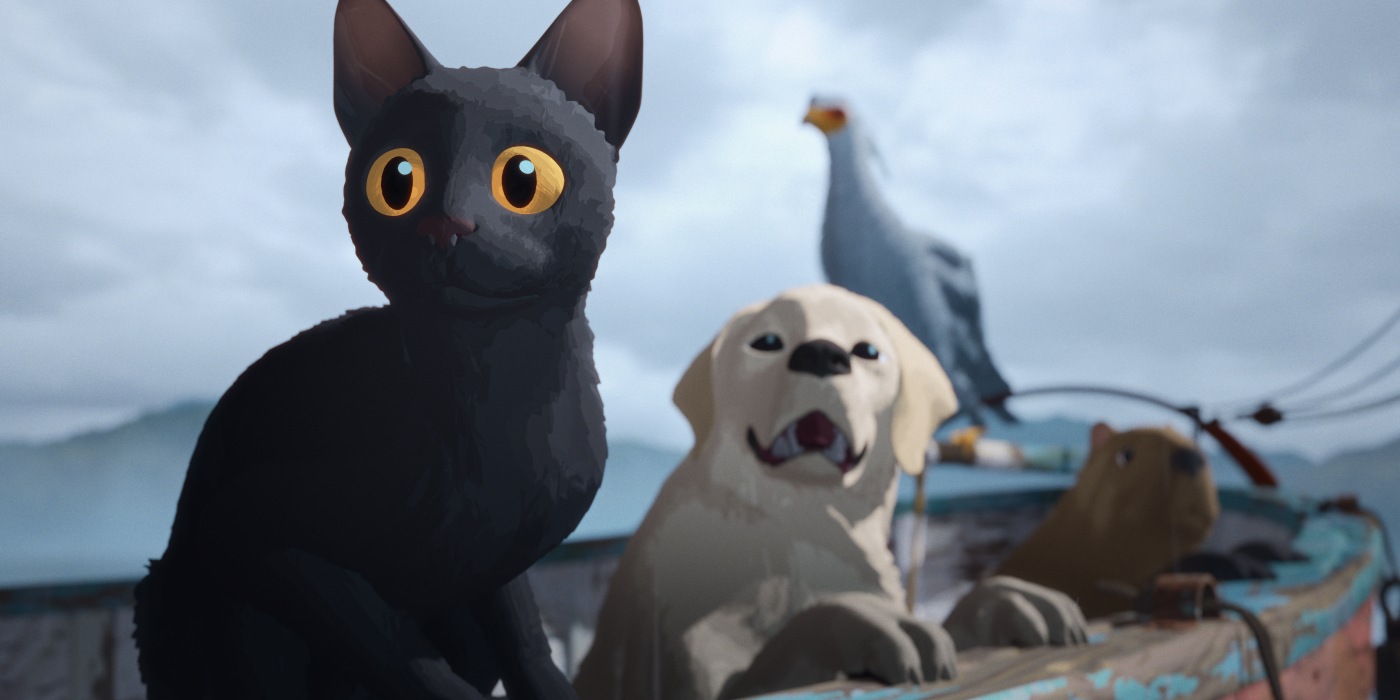
Influenced by the works of French mime auteur Jacques Tati, Flow is the rare modern animated film starring animals that doesn’t feature any dialogue. The camera follows a cat in the midst of a colossal tidal wave that floods just about everything in sight, forcing it to team-up with other animals in order to stay afloat. The texture quality on the individual animals is a bit rough to look at, but it’s quite remarkable how much of a non-issue that is. It actually turns out quite refreshing, as it doesn’t play into the informed behaviour that decades of repeated humorous observations have convinced most of us as the reality of how animals behave (cats always landing on their feet, that kind of thing), but instead conveys a level of realism that just banking on photorealism wouldn’t have been able to capture. If you’re a cat owner (or, to be more accurate, if a cat owns you), you’ll be right at home here.
It helps that the environment around these adorable critters is stunning. Quite a bit of it is used as storytelling texture, like hints at the cat’s homelife prior to the flood, but there’s an overwhelming ethereal quality to it that emphasises that this is a story being told through the perspective of creatures who really aren’t capable of comprehending what is happening around them. There are touches of abstract mysticism in pockets, but for the most part, it’s quite grounded in its depiction of animals at varying points in the food chain needing to cooperate just to survive. It invokes a similar sensation to early Don Bluth in how willingly the filmmakers put the main characters into actual peril, keeping the tension high but without it overriding the nerves. It is somehow both incredibly chill and mindful, and unsettling in a nuanced, existential fashion.
What makes all this that much more impressive, especially with director Gints Zilbalodis wearing so many hats behind the scenes, is that this is all being done through Blender. The free-and-open-source software that has been the entry point for whole swathes of hobbyist animators, including the YouTube animation scene, is capable of something that not only actively bested some of the biggest studios working today, but contains so much passion and mood all to itself.
For a film all about creatures at the ground level trying to make the most of what they have at hand, it’s fitting that Flow’s own production would serve as a shining example of just how much can be accomplished on those terms. It wouldn’t be surprising if this turned into its own source of inspiration for the next generation of budding animators.
Flow is a poem so powerful, it doesn’t even need words. Despite its digital construction, its ethos is closer to that of stop-motion in how it utilises the medium of animation to commune with the natural environment, showing the resonant power of being able to see ourselves in the world around us. As its own animated work, its calls for empathy and collaboration are so gentle as to wash over the audience like water at a perfect skin temperature, yet crash with such impact as to cause the audience to create their own miniature rainfalls. But as a larger artistic statement, as a champion for independently-funded animation and just independent cinema in general, its rousing success, both in its art and in its recognition as such, could be the swell that leads to a Spider-Verse-sized paradigm shift for the mainstream. At a time when the big names and their fixation on live-action remakes are revealing just how much they undervalue the potency of animation, this is a Flow we could all benefit from going forward.
