


by Alireza Hatamvand
Worth: $18.00
FilmInk rates movies out of $20 — the score indicates the amount we believe a ticket to the movie to be worth
Cast:
Ia Sukhitashvili, Kakha Kintsurashvili, Merab Ninidze
Intro:
… lingers long after it ends.
Five years ago, Georgian director Dea Kulumbegashvili’s debut film, Beginning showed that she’s not afraid to delve into the hidden pain, anxieties, and violence of modern life. Now, with April, she’s back and looking to cement her place in world cinema.
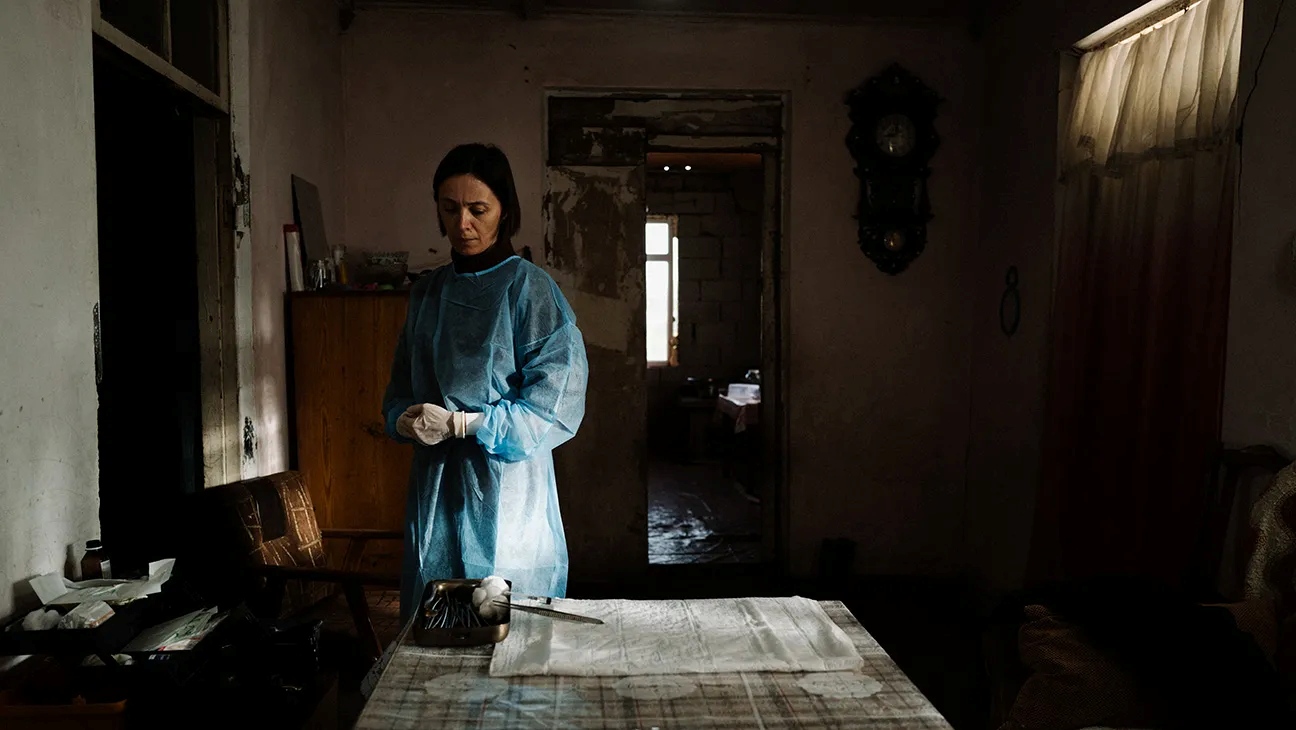
April follows Nina, a gynecologist who delivers a child that dies only minutes after birth. Was she negligent—or, even worse, deliberate? The lawsuit filed by the child’s father soon uncovers another side of Nina’s life: despite the risks to her career, she secretly teaches poor village women about contraception and even performs illegal abortions for them.
Before unpacking the screenplay, it helps to pause and consider Kulumbegashvili’s directorial world. Long, unbroken shots with a fixed camera are her trademark. She dares to stretch them far beyond what most audiences expect, testing patience and forcing the viewer to actively endure. Her takes are so extended that you find yourself scanning the frame again and again, asking why the scene refuses to end. In that restless space, you may land exactly where she wants you to.
On a technical level, she knows this approach intimately and handles it with assurance.
Sacrificing edits and camera movement means that every frame has to carry weight. The compositions are carefully coloured, striking, and always loaded with suggestion. As in her debut, she shoots in the 4:3 ratio. But with the help of her seasoned cinematographer, Arseni Khachatruan, she fills the space with energy and detail, creating images that compensate for the lack of cuts and give her style a stage to display its force.
And importantly, she doesn’t choose subjects at random for these long takes. April opens with an actual, single-shot natural childbirth – a scene that is both painful and life-giving. And thanks to Kulumbegashvili’s long and bold take, the audience is condemned to share in the pain, like Alex in Clockwork Orange, without blinking. This is cinema at its most essential: technique serving form, and form lifting the theme to a rare intensity.
But let’s put aside the question of framing and camera work for a moment. What is April really about? With so many images of abortion, childbirth, pregnancy, and motherhood — shown inside a rigidly patriarchal world — it’s easy for a hasty viewer to assume that the film is only about those themes. They are important, of course, but the deeper current running through the story is something else: the act of helping, or more precisely, the courage that it takes to help.
The film begins with the sight of a grotesque, wrinkled figure that slowly disappears into the dark. Over this image, we hear two children talking — one of them is Nina. A few scenes later, Nina tells a stranger about a memory from childhood: her sister was sinking into a muddy bog, and she, frozen with fear, couldn’t move to help. She claims — truthfully or not — that her sister survived, but admits that what haunted her was not the danger itself, but the shame of her paralysis. Isn’t that opening scene of two children already pointing us here? Much of what Nina does later, all her quiet and puzzling choices, circle back to that memory. As a child, she failed to act; now she wants to live the opposite way, showing real bravery by helping those who need it, no matter the cost.
And still the film leaves us with another lingering question: what is that strange creature, and how does it belong to Nina’s story? It never speaks and barely appears, yet it feels tied to her. Is it the shape of her buried guilt? Or perhaps, how she is seen by others, who don’t understand her? Nina herself is so taciturn and mysterious, and occasionally surprises us with her strange actions, such as offering oral sex to a random passerby, that it is not easy to get to the core of her personality and her relationship with that creature.
April is the kind of film that lingers long after it ends. You want to talk about it with others, to test your own reading against someone else’s, to see what hidden angles they found in this strange tale. That is something Dea Kulumbegashvili can already take pride in — and it hints that, this early in her career, she may come back with work that is even more powerful.
