




by Karl Rozemeyer
In a career that spanned over seventy years in show business as an actor, singer, director, producer and screenwriter, Arkin received a slew of nominations and awards, for roles both dramatic and comedic. And yet, he remained primarily a character actor who avoided the spotlight and the paparazzi patrol.
Born in Brooklyn, New York, Arkin took to the stage in the 1950s as a singer and guitarist in the folk group, The Tarriers. He later achieved moderate fame as a member of Chicago’s Second City comedy troupe. But when Norman Jewison cast him in the Cold War spoof The Russians Are Coming, The Russians Are Coming (1966), success was instant.
Arkin was catapulted into a rarified class of movie star royalty with his nomination for an Academy Award for Best Actor, along with Richard Burton, Michael Caine, Paul Scofield and Steve McQueen. (Scofield took the prize for his role as Sir Thomas More in A Man for All Seasons.) Two years later, Arkin would be nominated again for the same award for his role as a deaf-mute in The Heart Is A Lonely Hunter. He did not win.
Forty-four years later, Arkin received his final nomination for playing an unscrupulous Hollywood producer in Ben Affleck’s Oscar-winning Argo. (That year Christoph Waltz took home the award for his role in Django Unchained.) In the years between his first and last Academy Award nominations, some of his many memorable films included Catch 22 (1970), Edward Scissorhands (1990), Glengarry Glen Ross (1992) and Thirteen Conversations About One Thing (2001).
But for many filmgoers, Alan Arkin will be best remembered for the role which earned him his only Academy Award. In 2006’s Little Miss Sunshine, a satirical dramedy – that at the time upended notions of the beloved American family road trip comedy genre – Arkin shone among a highly talented ensemble cast as a heroin-snorting, foulmouthed grandfather.
“It’s a brilliant script. It’s totally unpredictable,” Arkin enthused, when promoting the film in New York in 2006. “I just loved everything about it. I loved the character. I loved the sensibilities. I love the fact that you didn’t know if it was a comedy or a tragedy. You didn’t know which way it was going to go. It was totally organic and heartfelt. I just felt like I had to do it,” he continued: “There is a lot of hysterically funny stuff in it, but it comes out of enormous pain and seriousness, and everybody was deep into their character. There wasn’t a lot of cracking jokes and hilarity. It’s not something we talked about, but everybody took it very seriously.”
While recognising its dark humour, Arkin and his co-stars leaned into the script’s solemn and heartbreaking moments: “My experience has been that actors tend to think on the colouration of the tone of the script that they are working on, and this is a serious script.”
Arkin’s character is a 70-something who has recently been kicked out of his retirement home and is bundled into the backseat of a yellow Volkswagen bus on a road trip from Albuquerque to Redondo Beach along with his grandchildren, seven-year-old Olive (Abigail Breslin), a bespectacled, slightly overweight aspiring beauty queen contestant and Dwayne (Paul Dano), her angry and sullen teenage brother whose guiding light is Nietzche. They are joined by their middle-aged uncle (Steve Carrell), a scholar of Proust who has recently been released from hospital following a suicide attempt in the wake of being jilted by his younger gay lover. The dysfunctional Hoover family is rounded out by parents Richard (Greg Kinnear), an infuriatingly glass-is-always-half-full motivational speaker in the Tony Robbins mould, and Sheryl (Toni Collette), the constantly exhausted glue of the family unit.
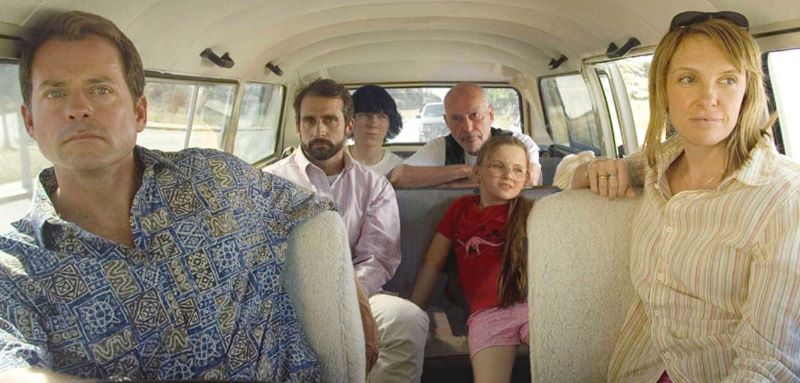
During the long road trip, Olive prepares for her performance in the Little Miss Sunshine beauty pageant in Redondo Beach. With the rest of her family preoccupied or too self-absorbed to care, it falls to Arkin’s outspoken grandpa – a self-proclaimed drug addict and porn aficionado – to guide Olive through her choreography, including her selection of Rick James’ explicit “Super Freak” as her dance number.
Arkin had no qualms about using the dirty language required of his character – except in front of his then nine-year-old co-star, Abigail Breslin. “When we were in the van,” he recalled, “I just insisted that: ‘The only way I can do it is if she’s got her earphones on and she’s listening to something else’. But that was in a way ridiculous because she’d read the script. And she’s seen the movie half a dozen times. But I was more comfortable in not subjecting her to it at the moment. To me, it was important that she either not be in the van or be distracted in some way, so that I could hold forth without (her) being subjected to it.”
Arkin’s affection for the character of Grandpa was palpable. “I love characters like that,” he mused. “I played a character in a movie called Joshua Then & Now who could have been this guy’s brother.” In that 1985 drama from Canadian director Ted Kotcheff, Arkin played Reuben, a former boxer and a small-time gangster with a particular passion for the Bible, who tries to instill all that he knows about fighting, foreplay and religion in his teenage son. “I just love disreputable, loudmouthed guys; guys who know everything and don’t know anything.” Asked what would draw him to such characters, Arkin didn’t miss a beat: “I guess I must feel that way about myself to a certain extent. I’m not shy,” he said, before adding: “I can shoot my mouth off pretty good.”
To understand his character even more deeply, Arkin developed his own backstory for Grandpa. “I had a picture of what he had done for most of his life. I felt like he played sax in a strip joint.” Arkin hypothesized that his character was frequently fired from his various gigs because he wasn’t a very good musician and because he was constantly pursuing the strippers and female clientele. “I think he was on the road a lot trying to get jobs in strip joints and gambling away his money when he wasn’t working.”
Toward the end of Little Miss Sunshine, Grandpa dies.
Despite his character’s heroin habit, Arkin was quick to dispel any suggestion that Grandpa’s death was the result of a drug overdose. The actor had a more nuanced, almost philosophical take on why he departed this life: “He was very happy in the (retirement) home, for obvious reasons, given the ratio of men. I think he probably died of his whole life. I don’t think he took care of himself. He smoked. He drank. Drugs. He was not a chicken either,” he asserted. “He was an elderly guy. I think it’s a miracle he lasted as long as he did.”
