


by FilmInk Staff
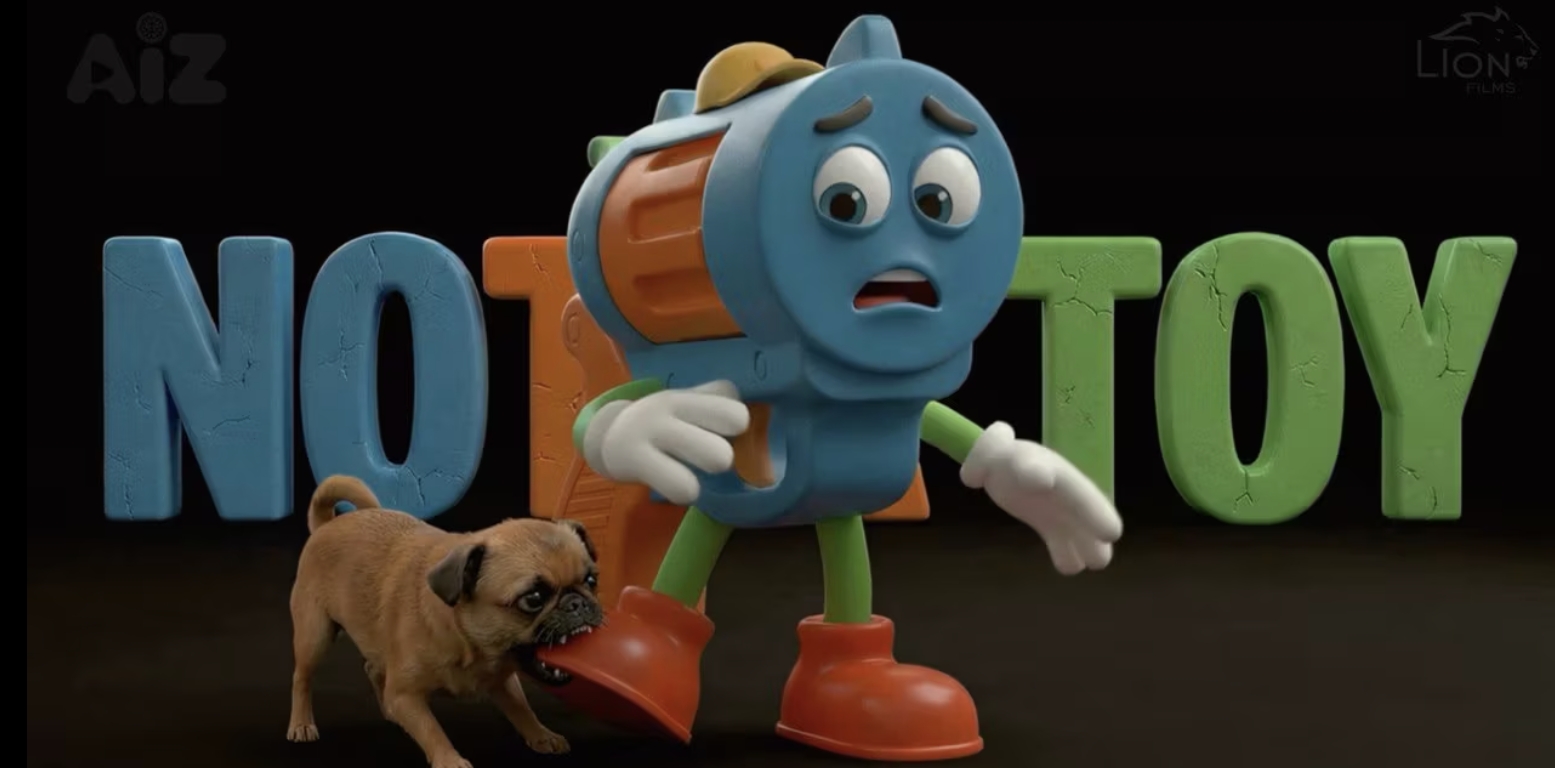
The short film Not A Toy has been completed. The project was created entirely using artificial intelligence and is a joint production by the AI boutique AiZ and the production company Lion Films. The film was written and directed by Anton Zimin. Production took approximately six weeks and involved a team of four people. The film was developed for submission to the 1Billion Summit AI Awards, a festival with strict limitations on production tools, allowing only AI services provided by Google.
The screenplay was developed for the competition category “The Hidden Life of Ordinary Things.” According to the director, the starting point was a simple question: what might a toy gun be thinking? What if it does not want to be a weapon at all, but instead dreams of being just a toy? This idea led to the creation of the main character, a neurotic toy gun who lives in constant fear of firing by accident.
At its core, Not A Toy is about how difficult it is to be something different in a world where violence has become the norm. It follows a character who does not fit into a reality built on destruction and, as a result, finds himself in conflict both with the surrounding world and with his own nature.
The production pipeline followed a classical filmmaking structure. The team moved from script and storyboards to key visuals and then to animated scenes. For each scene, the director prepared a detailed brief describing camera behaviour and visual references, while key frames served as the foundation for video generation.
Animated scenes were created using Veo 3.1, while key visuals were produced in Nano Banana. Additional tools included Flow, Whisk, Gemini, and API-based workflows inside Adobe Photoshop. AI specialists Evgeny Kryzhnev and Sergey Saprykin developed custom applications that integrated Nano Banana via API, significantly accelerating the creation of consistent key frames, one of the most technically challenging aspects of generative video production.
Image quality required particular attention. Wide shots generated in Veo often lacked sufficient detail, so a multi-stage upscaling process was integrated into the pipeline using different models, including Topaz and SeedVR. In some cases, shots could be enhanced in a single pass, while others required moving between models and working with the image layer by layer. Editing and colour grading were completed in DaVinci Resolve.
Creative producer Kirill Abakumov notes that the film serves as a practical response to scepticism surrounding AI-generated content. In his view, artificial intelligence can significantly reduce production time and budgets, but it does not replace film professionals such as writers, directors, cinematographers, and artists, whose expertise is built through years of experience. AI remains a tool rather than a source of creative intent.
According to the director, it is unlikely that neural networks will fully replace traditional film production in the near future. At the same time, they can give creative professionals the opportunity to realise their ideas without depending on large budgets or major studios. This represents a time of new possibilities, but also new challenges, as creators now compete not only with each other, but with computational systems as well.
The executive producer describes Not A Toy as both an artistic and production experiment, demonstrating how complete films can already be made using AI tools while still relying on classical cinematic principles. AI should not be seen, at least for now, as a full replacement for live-action filmmaking. However, it clearly offers the ability to significantly increase a project’s overall value while reducing both costs and production timelines.
A co-production of and AiZ and Lion Films
Written by Anton Zimin
Directed by Anton Zimin
Executive Producer
Victoria Sankina
Creative Producer
Kirill Abakumov
AI Artists
Anton Zimin
Kirill Abakumov
Sergey Saprykin
Evgeny Kryzhnev
Editing
Anton Zimin
Maxim Bragin
