



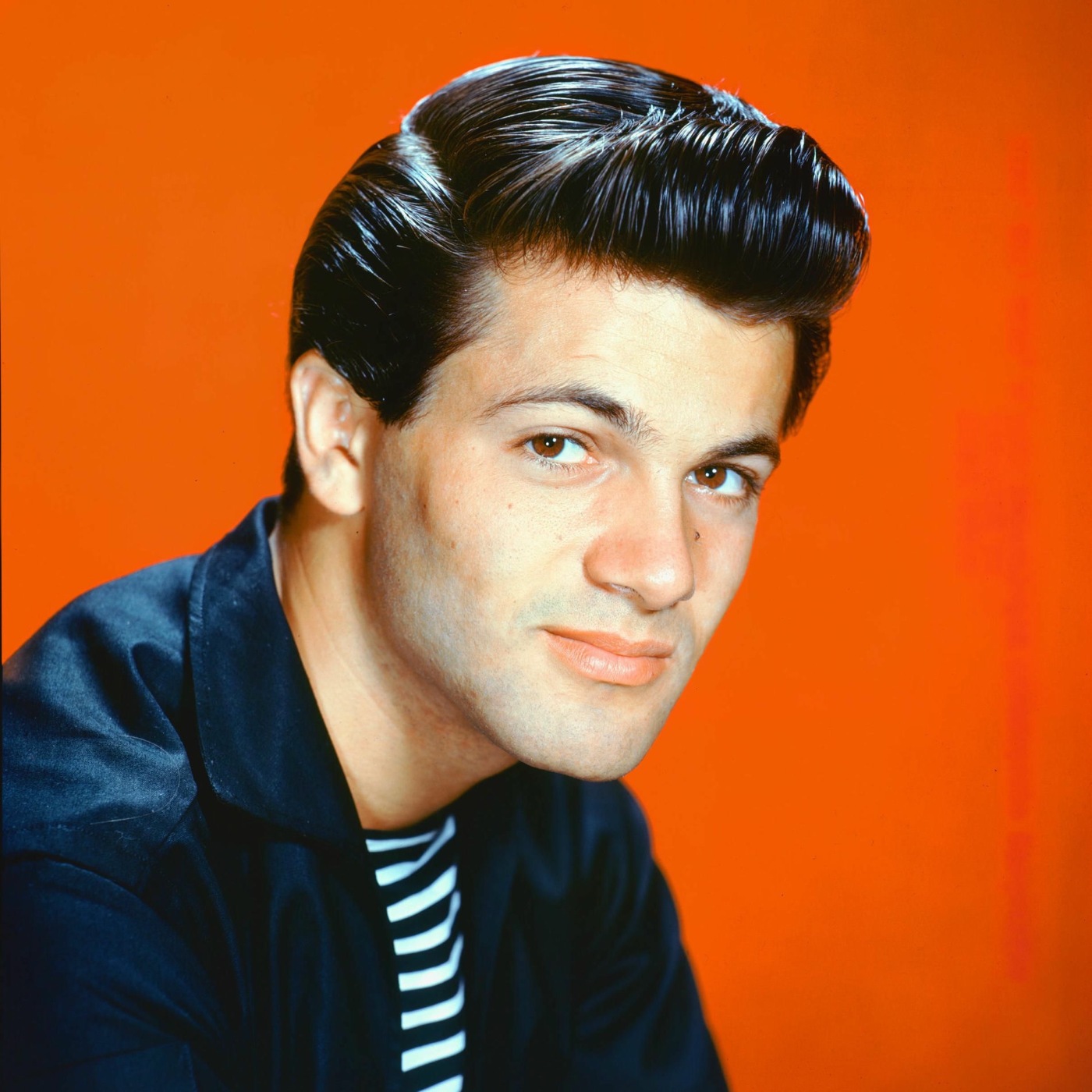
by Stephen Vagg
The huge popularity of Elvis Presley in movies in the 1950s saw film studios constantly searching for the next Elvis. Any teen idol with a hit single or two (you only needed two) found themselves shoved in front of the camera: Pat Boone, Ricky Nelson, Fabian, Frankie Avalon, Bobby Rydell, etc. (Likewise, a lot of teen idol movie stars found themselves thrust behind a microphone, eg Tab Hunter, James Darren, Anthony Perkins). Tommy Sands never quite made it as a movie star, but he had a few goes and his cinematic legacy is not without interest.
Sands was born in 1937 and began performing as a child (both parents were musicians). He was only fifteen years old when Elvis’ future manger, Colonel Tom Parker, signed the young singer to a record contract. Sands was far from an instant success – his initial releases did not do well, and he soon found his fame eclipsed by Parker’s other client, Elvis. But Parker stuck at it, and when things happened, they happened very quickly: Sands was cast as a rock singer in a 1957 TV play called The Singing Idol, which combined elements of Presley’s real life story with the plot of The Jazz Singer. Sands acquitted himself quite well in the role – he wasn’t a great actor but he wasn’t bad, it was a fantastic part, and he could sing. Response was hugely positive, and Sands became nationally famous overnight: a song from the play, “Teenage Crush”, became a hit and he was launched as a teen idol.
Twentieth Century Fox, who’d made the first movie for both Elvis (Love Me Tender) and Pat Boone (Bernadine), offered Sands a multi-picture movie contract, starting off with a big screen remake of The Singing Idol called Sing Boy Sing (1958). Orson Welles at one stage looked like directing (he was going to play the singer’s manager), but the job went to writer-producer Henry Ephron (Nora’s dad). Sands was very good in the movie, but the film itself was poor – slackly directed and written, far less effective than the television version, with too much emphasis placed on a part played by Nick Adams, and key characters introduced too late. It was a shame, since Sands gave a fine performance; it wasn’t his fault that the film flopped. We wonder what the Orson Welles version would have been like (he had some experience with musicals, notably directing Cole Porter’s version of Around the World in Eighty Days on Broadway).
Fox pivoted and cast Sands in support of Pat Boone in Mardi Gras (1958), alongside another young crooner it hoped would become a star, Gary Crosby; the movie was an amiable musical about three soldiers on the town. Sands isn’t bad in a support role – he’s a bit sleazy, but it suits his character and bounces off well against squeaky clean Boone. Again, it wasn’t his fault that this wasn’t much of a film.
Sands started guest starring on TV dramas like Studio One, often playing a singer, and he sung the title track of the movies The James Dean Story (1957) and The Parent Trap (1961). The shelf life of late ‘50s pop idols was traditionally not long and Sands was no exception – by 1959, his record sales were down and Fox was shifting its attention to Fabian (Hound-Dog Man). Sands managed to keep in the public eye through constant touring and a 1960 marriage to Nancy Sinatra, son of the legendary Frank.
Paramount cast Sands in the lead of Love in a Goldfish Bowl (1961) alongside Fabian, playing the (possibly asexual) friend of Toby Michaels; the filmmakers dyed Sands’ hair blonde so it wouldn’t clash with Fabian’s. Disney then cast him as Annette Funicello’s co-star in the expensive children’s musical Babes in Toyland (1961); he was full of bounce and energy, and if he didn’t have the warmth of say, Tommy Kirk, who was in a support role, again it wasn’t due to him that the movie wasn’t better. Still, like Mardi Gras, these movies were always on television when we were growing up.
Fox used Sands in The Longest Day (1962), one of several teen idols playing US Rangers (Fabian, Paul Anka, Jeffrey Hunter). Frank Sinatra wanted Sands cast as his younger brother in the big screen adaptation of Neil Simon’s Come Blow Your Horn (1963), but it didn’t happen – we’ve heard that Sands turned down the role, not wanting to accept a handout, and also that the director overruled his star (which seems more likely); Tony Bill played the part instead.
Sands unsuccessfully auditioned for the lead in Elia Kazan’s America America (1963) (the mind boggles) and had earlier been rejected for a part in Marjorie Morningstar (1958). In 1963, he announced that he had written a script called ‘The Jasmine Tree’, which he hoped to produce and direct as well as star in, but it was never made, despite him pushing it for almost a decade.
Sands continued to regularly guest star on TV shows such as Wagon Train and The US Steel Hour, and had a key support in Ensign Pulver (1964), that sequel to Mister Roberts no one seemed to like, best remembered for featuring future stars in the cast like Jack Nicholson, Walter Matthau and Larry Hagman; the lead role was played by non-star Robert Walker Jnr. Sands had a meaty role, as a sailor who learns that his child has died, goes mad and tries to kill the captain (Burl Ives), but no one much liked the final movie.
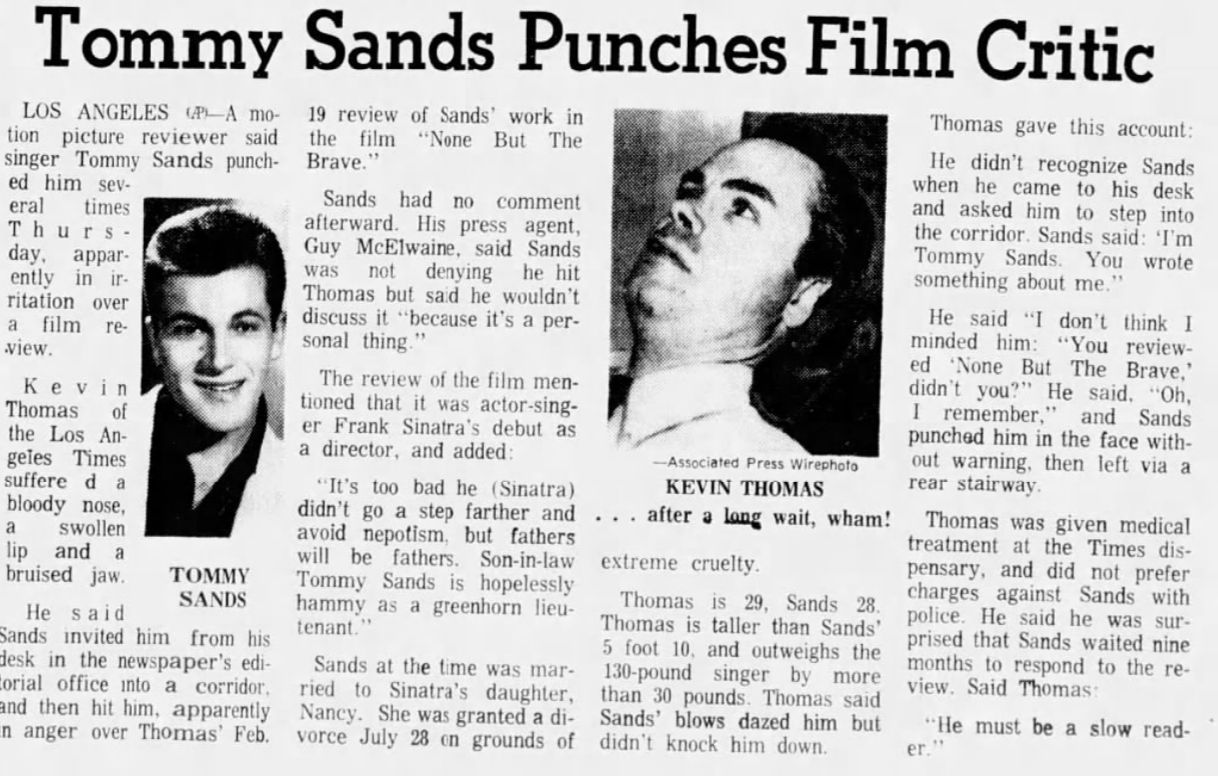
Sands decided to embrace nepotism and appear in a film directed by and starring his father-in-law, the war movie None but the Brave (1965). This movie is best remembered for Sinatra almost drowning while swimming on his day off (Brad Dexter saved his life); it’s actually not a bad picture, surprisingly anti-war and sympathetic to the Japanese (Clint Walker has the lead more than Sinatra), but Sands’ performance is dreadful – he made a decision to play it with a broad accent and too much emphasis. We’re not sure why this happened, if it was Sinatra’s direction, or a choice from Sands that first-time director Sinatra felt he couldn’t overrule – Sands’ acting in other productions was absolutely fine. Reviews of None but the Brave singled out Sands for criticism, such as Kevin Thomas of The Los Angeles Times who called the actor hammy and blamed Sands’ casting on nepotism; Thomas’ words upset Sands so much that he the actor-singer drove out to the offices of the Times (albeit months after the review came out) and punched Thomas in the face. That’s one way to deal with critics, we guess. But this incident made the papers and turned Sands into more of a joke.
 In mitigation, there was a lot going on in Sands’ life at the time. He had developed an addiction to prescription drugs, the Beatles invasion had happened, and in 1965, he walked out on Nancy Sinatra. Nancy’s career thrived in Sands’ absence – she appeared in a series of movies, including AIP’s The Wild Angels, had a string of hits, notably ‘These Boots Are Made for Walking’ (which was reportedly inspired by Sands) and remarried happily.
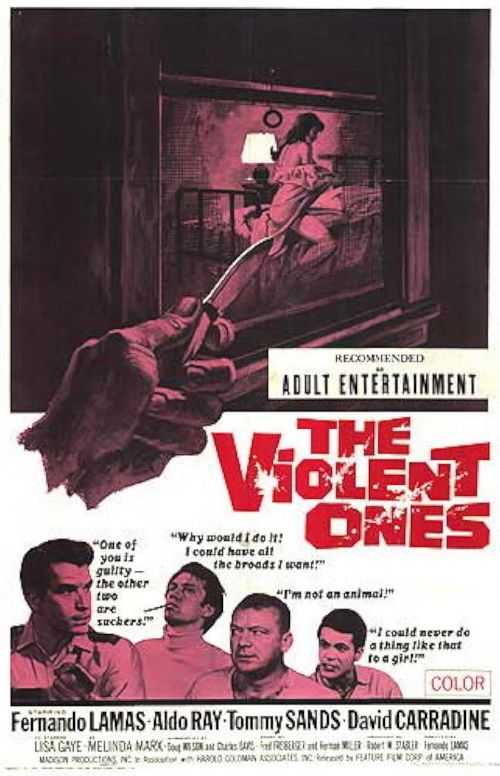
Sands found jobs harder to come by. He appeared in a Fernando Lamas vigilante drama called The Violent Ones (1967), co-starring David Carradine, who later wrote in his memoirs that all the cast seemed to be drunk and/or on drugs (Aldo Ray was in it as well); he also mentioned that Sands kept writing songs during the shoot.
Sands moved to Hawaii where he did a variety of things – attending college, bludging on the beach, making the occasional return to performing, getting remarried and having a child, doing an office job, finding Jesus, doing the odd guest spot on television. Looking back at his career, Sands observed, accurately enough, that his television work was better quality than his film work, saying that every movie “they gave me (as a contract player) was some frivolous film no one took seriously.” As mentioned in the introduction, Sands’ acting career is of some interest – a classic (The Longest Day), some cheerful musical-comedies (Babes in Toyland, Mardi Gras, Love in a Goldfish Bowl), Frank Sinatra’s one directorial effort (None but the Brave), a solid list of television credits. That’s nothing to be ashamed of.
