


by Stephen Vagg
Our series on actors who never quite became movie stars looks at ‘50s British starlet Maureen Swanson.
Legendary cricket player Greg Chappell had a philosophy that underpinned his mediocre reign as a test selector: “if a player doesn’t remind you of somebody, he probably won’t be somebody.” It’s a very restrictive line of thought – after all, aren’t the greatest players unique? – but the attitude is rampant among movie executives, who are (or, rather, were) forever promoting new stars on the basis that they are fresh versions of old stars.
The British film industry of the 1950s was particularly susceptible to this. Every time it discovered a new star, it seemed that the studios would breed back up versions – there were imitation Dirk Bogardes (Michael Craig), James Masons (Dennis Price), Stewart Grangers (John McCallum, Dermot Walsh, Maxwell Reed), Margaret Lockwoods (Jean Kent), Joan Collinses (Barbara Steele) and Dinah Sheridans (Belinda Lee).
Maureen Swanson was beautiful and spirited, with a tremendous screen presence, but we think the main reason that the Rank Organisation pushed her as a star in 1956-57 was that she looked like Vivien Leigh. They both had the same raven hair, pointed features, and petite build, plus an emotional, kitten-ish persona that made them ideal for playing flirtatious vixens. Nonetheless, Swanson was immensely watchable on screen, and might have had a very strong career had her personal life not intervened.
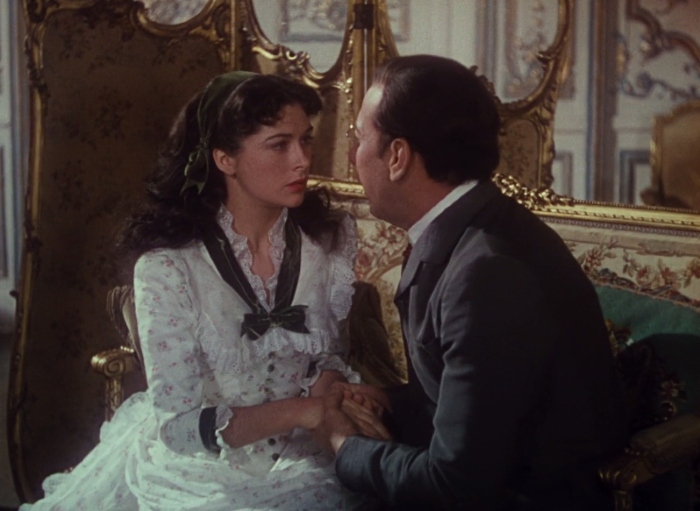 She was born in Glasgow in 1932 and originally trained as a ballerina, hoping to be the next Margaret Fonteyn, before moving into commercial theatre, appearing in a London production of Carousel. Swanson’s first movie break came quite early – the makers of Moulin Rogue (1952) (the John Huston one, almost fifty years before Baz) were looking for someone to play an aristocrat who rejects Henri de Toulouse-Lautrec (José Ferrer). Swanson got the gig, was effective in her brief appearance, and the film was a big hit.
She was cast as The Girl in a Welsh-focused comedy drama Valley of Song (1952), then had another small but key part in a Hollywood financed blockbuster, MGM’s Knights of the Round Table (1954) as Elaine, the woman hopelessly in love with Lancelot (Robert Taylor). That was also a financial success, despite the epic miscasting of Taylor and Mel Ferrer (Arthur). Swanson’s subplot is actually one of the best bits of the (not very good) movie.
Most female starlets in the 1950s British movie industry found themselves playing a pretty girl in a comedy and/or the female glamour in a Hammer noir starring a B list American – Swanson did both with Orders are Orders (1954) and Third Party Risk (1954) respectively. She also appeared in an episode of the TV series The Vise, which was theatrically released as One Just Man (1954).
The Rank Organisation were sufficiently impressed by all of this – and the aforementioned Vivien Leigh similarities – to sign Swanson to a long-term contract. They put her in supporting roles in four films, all quite high profile: A Town Like Alice (1956), as a flirtatious POW, who eventually goes off with a Japanese officer; Jacqueline (1956), romancing Tony Wright; Up in the World (1956), the leading lady for Norman Wisdom; and The Spanish Gardener (1956), as Dirk Bogarde’s love interest. In December 1955, Rank announced Swanson as one of their stars of the future along with Jill Adams, Susan Beaumont, Beverly Brooks, Michael Craig, Philip Gilbert, Josephine Griffin, Jill Ireland, Gerda Larsen, Terence Longdon, Ann Paige and Tony Wright.
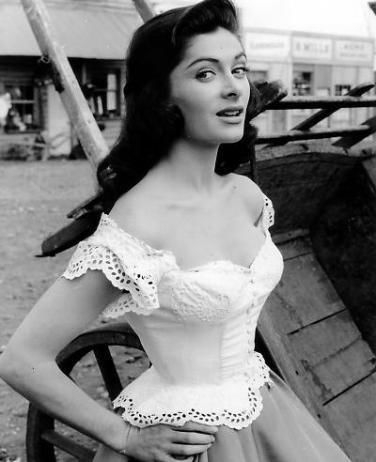 At first, things went well. When the Rank films were released, A Town Like Alice, Up in the World and The Spanish Gardener all performed strongly at the box office – Swanson made a particularly noticeable splash in A Town Like Alice, effectively contrasting with the “sensible girl” persona of star Virginia McKenna (it’s a great pity that they were never re-teamed, they could’ve made a wonderful double act). In October 1956, John Davis, managing director of Rank, declared Swanson was one of the actors under contract who Davis thought would become an international star. She was given probably the best part in a big movie for the studio: Robbery Under Arms (1957), playing the spirited lass who seeks vengeance on Ronald Lewis. The film wasn’t much but Swanson was excellent.
And then… that was kind of it. No more films for Swanson for Rank.
She did some theatre, a little bit of television, but no more movies for the studio, who dropped her from their books in late 1958.
It wasn’t as though Rank didn’t have parts for her to play, either.
There were plenty, at least over the next few years.
Indeed, Anne Heywood, an actress who looked a little like Maureen Swanson, became very busy at Rank playing a series of roles that it’s easy to imagine Swanson doing: Dangerous Exile, Violent Playground, The Heart of a Man, Floods of Fear, Upstairs and Downstairs.
What happened?
To be honest, we’re not sure.
But we can guess.
We do know that in July 1957, Swanson was named in a divorce suit brought by the wife of South African businessman John Schlesinger. The charge against Swanson was eventually dropped, but not until May 1958. And this brought a lot of publicity.
Swanson also began a romance with a married English aristocrat, William Ward, aka Viscount Ednam, which was mentioned in various gossip columns. He divorced his wife in 1960 and married Swanson the following year. (Incidentally, one of Swanson’s earlier boyfriends had been Stephen Ward, of Profumo Affair fame.)
Around this time, Rank also had to deal with the dramas of another one of their contract players, Belinda Lee who, despite being married, was having an affair with a married Italian noble and attempting suicide when he would not leave his wife, and having to be smuggled into South Africa to finish filming on Nor the Moon by Night.
Now, the Rank Organisation could have leaned in to all this exciting off-screen drama and cast these actresses in roles which exploited their scandalous private lives – the way canny Hollywood producers did in the late 1950s with, say, Elizabeth Taylor and Lana Turner. And Italian film producers would eventually do with Belinda Lee.
But Rank was a conservative studio, and we think that they found all the drama too much. And so, it stopped casting Maureen Swanson in movies and eventually dropped her from their books – just as they did with Belinda Lee.
Swanson did some more theatre and television, appeared in an entertaining B, The Malpas Mystery (1960), then got married in 1961 and retired from acting.
Swanson’s life remained colourful. She was a doyen of high society and hung out with royals, had seven children (one still born), was robbed of jewels at knifepoint, fought a number of libel actions against newspapers over allegations concerning her private life, and was briefly separated from her husband, whose niece was Rachel Ward. She died in 2011. It was a rich, fascinating life.
Still, it was a shame that she didn’t do more movies. Because Maureen Swanson had tremendous potential as a star. She was vivacious, gorgeous and had charisma. Watch something like A Town Like Alice or Robbery Under Arms and your eyes are drawn to her. Yes, her acting ability was raw but the basic material was there: accessibility, warmth, the ability to convey emotion. She could have been a serious contender.
Still, being an aristocrat isn’t a bad consolation prize.
