



by Stephen Vagg
 Every now and then, an actor will come along – almost always white, young and male – who Hollywood gaslights itself into believing is a movie star. Richard Beymer, who we did a piece on earlier, was one such name. Another, the subject of this article, is John Kerr.
Now, when Australians hear that name, they typically think “Whitlam 1975, serious head of hair” – but we are talking about John Kerr the actor, who in the mid-fifties was going to be a movie star, until he came undone by the fact that he simply didn’t have It.
Kerr was born in 1931, the son of two actors: Britisher Geoffrey Kerr (also a writer) and American June Walker. Since Geoffrey Kerr’s father Frederick was also an actor, it was natural that little Johnny would follow the family tradition – indeed mum, who mostly raised John on her own, actively encouraged it to bring in some extra money. John Kerr did some summer stock and acting at college, and he grew up handsome enough (it always helps). Not long after graduation, Kerr was cast in the Broadway show Bernadine, playing the role later essayed by Pat Boone in the 1957 film version. It happened for him that quickly – no bartending jobs for our John.
Kerr’s status as a promising young male actor was confirmed when Elia Kazan, the leading director on Broadway at the time (if not in all history), cast him in Robert Anderson’s stage play Tea and Sympathy (1953), opposite Deborah Kerr (unrelated, and the surnames were pronounced differently). Tea and Sympathy was about a prep school student (played by Kerr) whose interest in artistic matters and non-macho ways leads him being branded as gay, so the headmaster’s wife (Kerr) roots him. If this seems a pretty ripe storyline, well, it at least acknowledged homosexuality, and its exploration of masculinity was progressive for the time. Incidentally according to Kerr’s son Michael, the chemistry between his dad and Deborah Ker was a little flat during rehearsal, so Kazan ordered Deborah (who was married) to seduce her co-star, which she duly did.
Tea and Sympathy turned out to have the perfect amount of “edge” for 1953 Broadway, and was a critical and commercial smash, making Kerr the hottest star on Broadway. He began appearing on various live TV dramas shot in New York at the time, including one where he played Jesse James opposite James Dean’s Bob Ford. (Dean had unsuccessfully auditioned for the Tea and Sympathy part, incidentally.)
Producer Leland Hayward and director Billy Wilder were making a movie of Charles Lindbergh’s flight across the Atlantic, called The Spirit of St Louis. They wanted a young unknown all-American type to play the lead role and offered it to Kerr. In early 1954, Hayward reported that Kerr turned down the part of Lindbergh. The common reason given was that Kerr disliked the flyer’s pro-Nazi views (Kerry was politically very liberal) but in early 1954, Hayward told the press that the reason Kerr said no was that he didn’t want to make his film debut with a story that rested entirely on his shoulders and was worried he would be identified with the part of Lindbergh for the rest of his career. (This isn’t inconsistent with disliking Lindbergh’s politics, incidentally). James Stewart stepped in to play Lindbergh, despite being far too old, and the resulting 1957 movie became a favourite of many and a flop at the box office – most likely because even Wilder struggled to dramatise a person sitting in a cockpit. But still, to turn down Billy Wilder in 1954…
In early 1954, Hayward also said that he offered Kerr another film part – that of Ensign Pulver in the movie adaptation of the stage hit Mister Roberts. We’re not sure if Kerr turned this down or if there was a schedule clash, but for whatever reason, he didn’t wind up appearing in the 1955 movie (from which John Ford was famously fired) – Jack Lemmon played Pulver instead, becoming a star and winning an Oscar for his performance.
Kerr did make his movie debut in The Cobweb (1955), a Vincente Minnelli drama at MGM about the patients and staff of a mental hospital; Kerr played a sensitive patient, a role turned down by James Dean (who wanted to do it but there was a clash over money). Incidentally, when it briefly looked like Dean mightn’t do Rebel without a Cause, Kerr was mooted as a possible replacement (along with Tab Hunter and Robert Wagner). And Kerr went on to star in The Corn is Green (1956) on television – a role that Dean had agreed to play shortly before that actor’s death in a car crash.
Anyway, back to The Cobweb: the film eventually flopped but before it came out, Dore Schary at MGM was excited enough by Kerr’s work to offer the actor a two-picture contract. His first movie was Gaby (1956), a remake of Waterloo Road, with Leslie Caron. To do this, Kerr turned down an offer from William Wyler to play Gary Cooper’s son in Friendly Persuasion (1956) – apparently because the part in Gaby was the lead. Tony Perkins, who had replaced Kerr on stage in Tea and Sympathy, took the Friendly Persuasion part instead and it made him a movie star. Gaby was a flop and little wonder – it’s not a very good movie, with a stupid script (why have a happy ending? Why not make it clear Caron is a prostitute?), the leads have no chemistry or heat (maybe Caron needed to seduce Kerr during the shoot!), and Kerr’s golly-gee-whiz performance is adequate but feels half-hearted. In his defence, he lacks a decent character to play, but it’s also clear that he doesn’t have what, say, James Dean or Paul Newman had: the charisma to carry a nothing role.
At least Kerr followed it with the (censored) film version of Tea and Sympathy (1956), also directed by Minnelli. The movie brought in viewers and everyone was fine, though it lacked a little magic – one wonders what it was like on stage as directed by Kazan.
MGM tried again with a crime drama, The Vintage (1957), where Kerr appeared alongside Mel Ferrer and Pier Angeli; reviews were hostile, the film was a big flop, and John Kerr became another in the long, long line of actors picked by Dore Schary to become a star at MGM, who didn’t make it (others include Dean Jones, Vic Damone, Don Burnett, Jeff Richards and John Ericson). Kerr was then cast in a huge movie: the film of South Pacific (1958), playing Lt Cable (his singing voice was dubbed). It was a big hit, but reviews were hostile (director Josh Logan used filters which are incredibly annoying) and Kerr later thought that the movie might have hurt his career.
Kerr kept busy on television, notably two Playhouse 90 plays for John Frankenheimer (The Ninth Day, Rumours of Evening), and a version of Berkely Square. He returned to theatre too in plays like All Summer Long (1954) and Cue for Passion (1959) but never matched his earlier success.
Kerr was in two films with Anne Francis: Girl in the Night (1960), a call girl drama, and The Crowded Sky (1960), a plane disaster movie with Kerr as a smug pilot and an incredible last fifteen minutes. These were support roles and it was clear Hollywood no longer regarded Kerr as a leading man. He played a soldier in a cheap war movie for Robert Lippert, Seven Women from Hell (1961) with Patricia Owens portraying an Aussie (writer Jesse Lasky Jr served in Australia in the war).
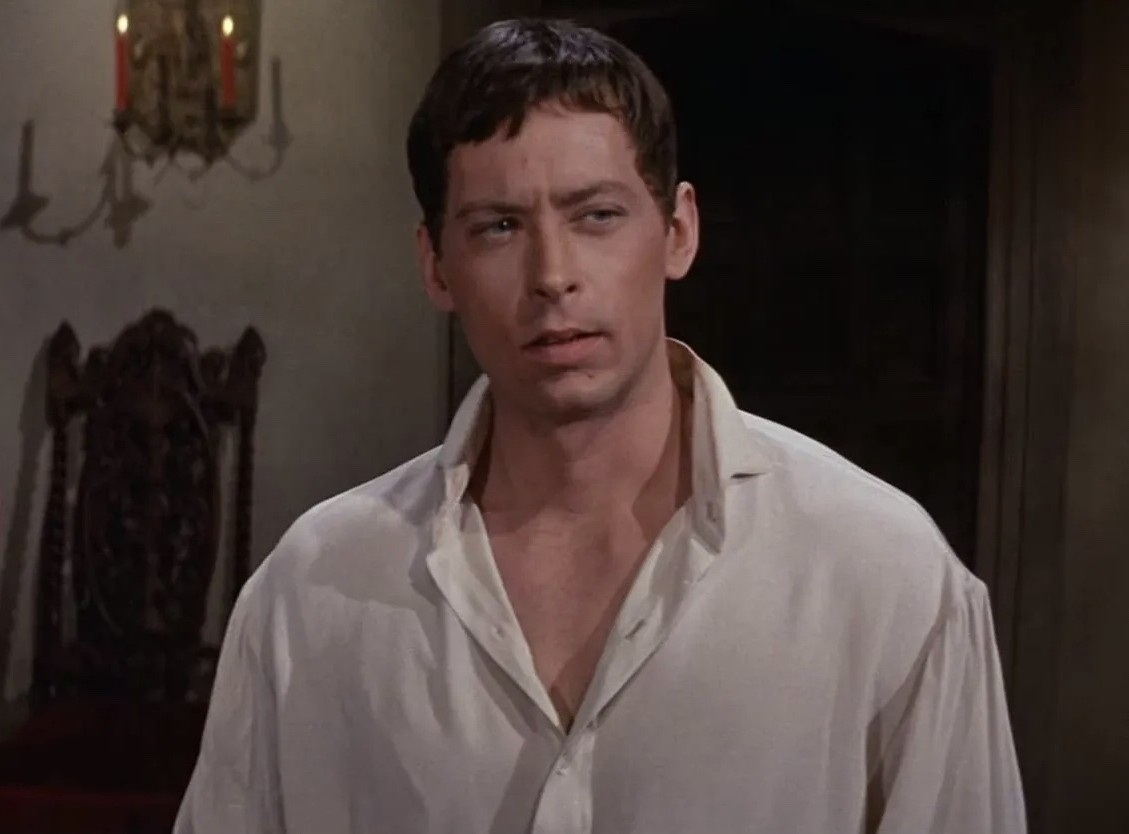
Kerr then unexpectedly wound up in a classic when cast as the romantic male lead in Roger Corman’s version of Poe’s The Pit and the Pendulum (1961) opposite Vincent Price. This was the second in AIP’s Poe cycle and is often invoked as the best (personally we prefer Masque of the Red Death and Tomb of Ligeia and love The Raven, but we wouldn’t criticise anyone who said their number one was Pendulum). Kerr’s performance is not a strength of the movie, but the weak part of AIP’s Poe cycle was typically the romantic male lead (Mark Damon, Richard Ney, David Weston, John Westbrook).
Kerr’s career drifted into television – guest roles on shows like Wagon Train and The Virginian, semi-regular appearances on Arrest and Trial and the TV version of Peyton Place, and so on. He did some directing for stage and theatre but wanted something more, so enrolled in law school. Kerr worked for thirty years as a lawyer, specialising in personal injury and medical malpractice trial work, doing the occasional acting job for a little side money. He died in 2013. His son Michael worked in the business as writer, director and producer; as of writing, he is working on a documentary and book about his father.
John Kerr was a competent actor with a sensitive young man look who had the great fortune to be cast by a legendary director in a “hot” play of the time opposite a genuine star. Hollywood’s desire for new blood, plus the Kazan stamp of approval, saw several producers and executives convince themselves that Kerr had just the material for movie stardom. Almost immediately, this was revealed to be not the case, and playing roles in Spirit of St Louis, Friendly Persuasion and Mister Roberts wouldn’t have changed it. From all accounts he was a conscientious, intelligent man. Not a movie star.
