



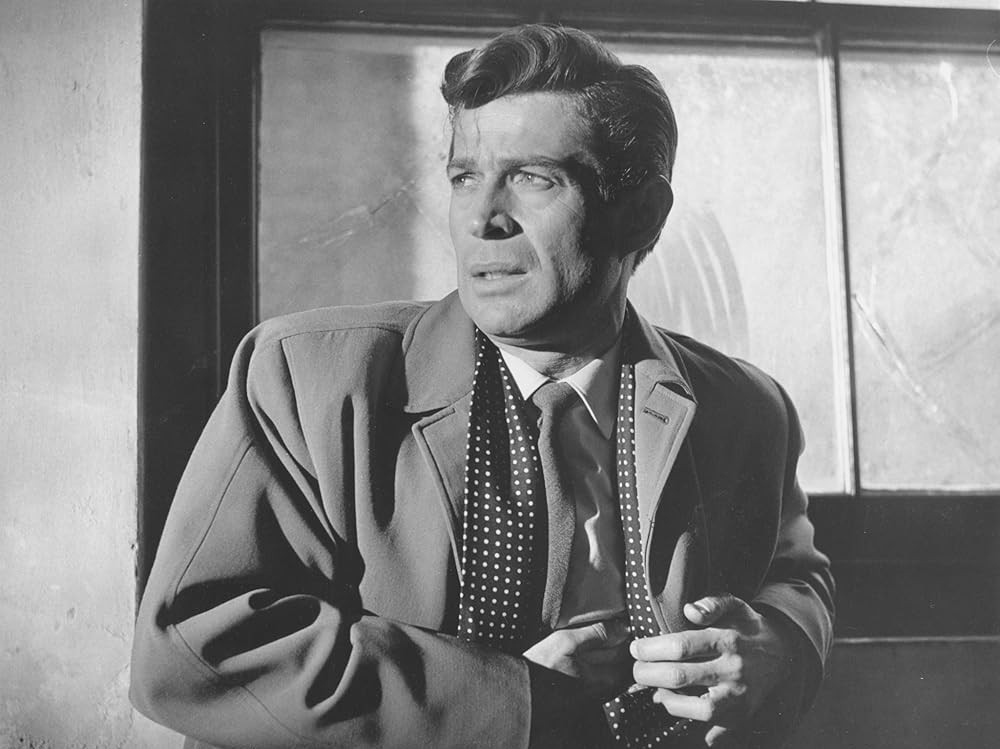
by Stephen Vagg
During the Golden Years of Hollywood, the major studios typically had a few back up stars under contract – a kind of reserve grade team comprised of potential stars that could be developed into big ones, or at the very least, keep big ones in line. During the 1950s, the major male stars at Universal were Tony Curtis, Jeff Chandler, Audie Murphy and Rock Huson. George Nader was a reserve grade player for these names – called upon whenever one of the big four turned down a role or needed a less charismatic co-star to support them.
Nader never turned into a significant star himself, but he played leading roles for twenty years, which isn’t nothing. He was also one of Hollywood’s most high profile gay leading men and is perhaps best recalled for his relationship with Rock Hudson – though not in the way you might think.
George Nader was born in Pasadena, California, in 1921. He studied theatre at college and served in the navy during World War Two, after which he tried acting. Nader was a rugged, handsome, virile type, with a strong voice and imposing head of hair. He wasn’t super expressive, but he had talent and got work quite quickly, at first in theatre (mostly at the Pasadena Playhouse) then B Westerns like Rustlers on Horseback (1950) and Overland Telegraph (1951) (with Tim Holt).
He was soon promoted to leading roles, albeit in a low budget effort called Memory of Love (1952). This was followed by the sci fi cult classic Robot Monster (1953), where he ran around shirtless and battled an alien in a gorilla suit and deep-sea diving helmet. If you haven’t seen it, we can’t recommend it highly enough.
Nader’s looks – square jaw, helmet hair, beefcake physique – was ideal for Eisenhower Era America and he began to get leads in slightly more expensive movies: Sins of Jezebel (1953), a cheap Biblical epic playing Paulette Goddard’s leading man; Miss Robin Crusoe (1953) with Amanda Blake; and Carnival Story (1954) for the King Brothers.
Then Universal studios signed Nader to a long-term contract. As mentioned, he was a backup star, to be put on the bench when one of their big names wouldn’t perform and/or wasn’t available. Rock Hudson had recently graduated from that bench to become a major star via Magnificent Obsession (1954), although Nader more closely resembled another Universal contractee – Jeff Chandler, a similar solid type. Chandler had been with Universal for several years and was getting impatient with the quality of his roles; the studio no doubt felt Nader’s presence might help keep him in line.
Nader’s first role at Universal was in a fairly typical product for the studio: a medium budget Western called Four Guns to the Border (1954), in support of Rory Calhoun. Then he was called off the bench to replace Chandler in the crime film Six Bridges to Cross (1955), starring Tony Curtis. Nader was Jeanne Crain’s leading man in The Second Greatest Sex (1955), then he replaced Jeff Chander again in Lady Godiva of Coventry (1955) with Maureen O’Hara. The latter movie is an enjoyable piece of hokum best remembered for O’Hara’s nude ride and Clint Eastwood (also under contract to Universal but way back in the pecking order) appearing as a guard; Nader is actually the lead more than O’Hara and does well, but the film was a disappointment commercially.
Nader did Congo Crossing (1955) with Virgina Mayor, then Universal put him in one of their bigger movies, albeit in support of Chandler: Away All Boats (1956). He was Esther Williams’ leading man in The Unguarded Moment (1956), a decent attempt by Wiliams to make a non-swimming movie (a stalking thriller). He also guest starred on a lot of television, notably The Loretta Young Show.
Nader was the male lead in a four girls movie, Four Girls in Town (1957), and had the lead in a noir, Man Afraid (1957). He teamed with Audie Murphy in a service comedy, Joe Butterfly (1957), playing the Mister Roberts-esque straight man to Murphy’s Ensign Pulver-esque photographer, who is always getting in trouble (with Burgess Meredith in yellow face, Fred Clark playing a Fred Clark type and Keenan Wynn as a Keenan Wynn type).
Bader replaced an ill Jeffrey Hunter (himself a backup Tyrone Power over at 20th Century Fox) playing an alcoholic journalist in Appointment with a Shadow (1957), a noir written by Australia’s own Alec Coppel; Nader rises to the occasion but the movie feels as though it lacks a twist or two.
Nader finished his Universal contract with Flood Tide (1958) co-starring Cornell Borchers, and The Female Animal (1958) with Hedy Lamarr, replacing John Gavin (another backup Rock Hudson). Then Universal let him go.
Nader had done solid work at Universal, but he never got to be a top rank movie star – he never had his Magnificent Obsession. None of his films did particularly well at the box office, except Away All Boats; they were absolutely solid, but no more than that – like Nader himself. This mattered, since television was digging into the medium budget programmer market – the popularity of Audie Murphy and Jeff Chandler went into eclipse around this time, never to return. Rock Hudson remained a huge star, but by now, Universal had John Gavin as its back up Hudson; with Chandler’s star on the decline, the studio didn’t need a backup Chandler anymore.
Nader’s post Universal career began excellently with an MGM-Ealing movie shot in England, Nowhere to Go (1958), a fascinating drama from Seth Holt. The movie was a great chance for Nader and he’s absolutely fine – not great, but not bad. This film would have sung with a really good actor in the lead, like, say Stanley Baker or Dirk Bogarde, but it was Nader’s first really good movie.
The momentum did not last. In the US, Nader starred in two television series, Ellery Queen (1958-59) (replaced by Lee Phillips at the end) and Man and the Challenge (1959-60). Then he travelled for the next decade, making films in France (The Secret Mark of D’Artagnan), The Philippines (Zigzag, The Great Space Adventure, Beyond Atlantis), West Germany (a series of movies about agent Jerry Cotton), poverty row Hollywood (The Human Duplicators), Hong Kong (The Million Eyes of Sumuru) and Spain (The House of 1,000 Dolls).
Nader move back to the US in the early 1970s and tried to reignite his acting career in Hollywood but he developed glaucoma, which made him sensitive to the bright lights of movie sets, so he decided to retire. He became a house husband – Nader had been with his partner Mark Miller since the late 1940s, and Rock Hudson hired Miller to work as his secretary. Nader didn’t exactly bludge – he turned to writing, penning a science fiction novel, Chrome (perhaps inspired by the success of another gay beefcake actor turned novelist, Tom Tryon). When Hudson died of AIDS, Nader and Miller inherited his estate – $27 million at first (reduced by $5.5 million to pay off Hudson’s lover Marc Christian). Nader died in 2002.
George Nader was a solid, reliable performer whose acting never got its due, in part because he wasn’t that great, but mostly because he appeared in so many programmers. One looks over his filmography and the most unusual credit is Robot Monster, followed by Nowhere to Go and… that’s about it. His films weren’t bad, they just weren’t that interesting – like Nader himself really. Certainly, he never had a role that showed he could do something special – like Broken Arrow did for Jeff Chandler or The Red Badge of Courage did for Murphy or Giant did for Hudson. He definitely never wound up in a classic movie the way even John Gavin did (he made Psycho, Imitation of Life and Spartacus within a year). Nader never made any of the 1950s sci fi stories at Universal which made John Agar so beloved. Maybe he would’ve done more had he stuck around in Los Angeles during the 1960s instead of going on the international circuit… but we doubt it.
It was a very solid career, full of journeymen directors, scripts and co-stars, but for all that, technically polished. George Nader’s greatest triumph may have been his private life – so many queer actors of his generation suffered greatly, with high rates of addiction, financial trouble and early deaths (Montgomery Clift, John Dall, William Eythe). Nader found his soul mate, lived with him over fifty years, had good friends, rich experiences, always seemed in great shape and had plenty of money at the end of his life. And he was in Robot Monster.
That’s pretty cool.
