



by Stephen Vagg
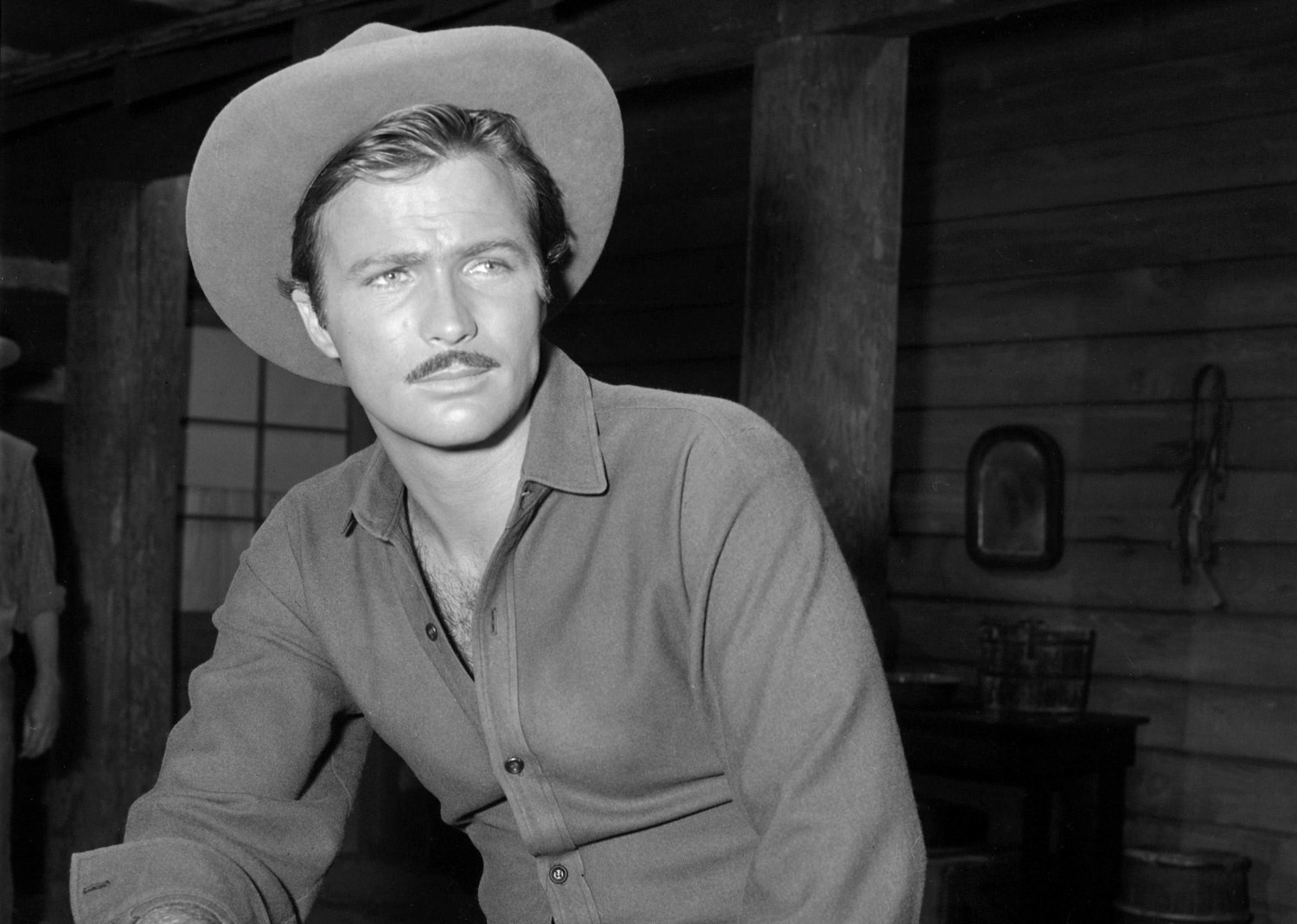
Barry Coe was a good-looking guy who 20th Century Fox thought might turn into a star. They tried to build him up the old school way – bit parts to key supports – and it never happened, but he had a decent enough run.
He was born Barry Clark Heacock in 1934. His father – a publicity man for Warner Bros – died in an automobile accident in 1941; his mother remarried and Barry took his stepfather’s surname. Coe was a college student at USC when spotted on holiday by agent Dick Clayton who told him he should be in pictures despite having only appeared in one school play. Coe did an interview with Paramount but that didn’t work out; neither did a meeting with Universal. However, he managed to secure a contract with 20th Century Fox who signed him to a long-term contract.
Fox was building its contract roster in the mid-1950s and presumably the studio saw Coe as a potential beefcake – someone who could be their Tab Hunter/Rock Hudson/Robert Wagner/John Saxon, a fixture in the fan magazines who starts off playing callow youths/romantic leads in support of a big star, and who might hopefully turn into a star on his own. Coe had small roles in expensive films like House of Bamboo (1955), How to be Very Very Popular (1955), On the Threshold of Space (1956) and D-Day the Sixth of June (1956). He popped up in the Elvis Presley Western Love Me Tender (1956) and Fox put him in TV versions of its old movies Deep Water and The Late George Apley.
Coe’s big (and, in hindsight, biggest) break was playing Rodney Harrington, the rich brat, in Peyton Place (1957) (the role Ryan O’Neal would play in the TV version), the adaptation of the racy best-seller. Coe ran around with his shirt off, kissed Diane Varsi and Terry Moore, and got a lot of fan publicity when the movie was a big hit. It’s kind of a terrible movie (problematic as the kids say) but also hugely watchable, and the adjustments made by the filmmakers to get the novel past the censor are a marvel.
Coe had a support part in a war film for Fox’s “B” unit, Thundering Jets (1958) and was in an “A” – The Bravados (1958) with Gregory Peck – although only in a small part. As the receipts for Peyton Place continued to mount, Fox co-starred him with Sal Mineo and Gary Crosby in A Private’s Affair (1959), a soldiers-on-leave musical comedy to showcase the studio’s young talent (the women were Christine Carere, Barbara Eden and Terry Moore) – it was directed by Raoul Walsh! (Fox had just made the similar Mardi Gras also with Crosby and Carere.) Coe is quite amiable in his part; the problem is there were/are a lot of handsome, amiable actors in Hollywood. Also, the film is wonky – it should be a proper musical but none of the leads are proper singers and the guts of the plot concerns a support character played by Jessie Royce Landis rather than the main characters.
Paramount borrowed Coe for But Not For Me (1959), playing Carroll Baker’s age-appropriate boyfriend; the plot has Baker hook up with Clark Gable, who was 30 years older (and two years away from dying and looked it) before winding up with Coe. Burt Reynolds and George Maharis also auditioned for Coe’s part; Reynolds claims that they lost out because Gable asked the actors if they went duck hunting – Reynolds and Maharis said no and Coe said yes. But Not For Me has an icky storyline and super-strong cast including Lili Palmer and Lee J. Cobb; Coe is the weak link, although in his defence, his character is particularly poor – an obnoxious self-righteous young actor who wants Baker to leave New York and go live in Texas. Still, you can tell that Baker and Gable have X factor that Coe lacks. It’s just one of those things. Nonetheless, Coe shared a 1960 Golden Globe for most promising male newcomer along with James Shigeta, Troy Donahue and George Hamilton.
Coe was in One Foot in Hell (1960), starring a clearly unwell Alan Ladd in a rare villainous role – Coe played a gunman. He was the romantic lead in The Wizard of Baghdad (1961) with Dick Shawn.
It is significant that even Fox, which clearly believed in Barry Coe, was reluctant to give him a leading role – the studio was aware of his limitations as an actor. He had an amiable air but struggled whenever given too much to do – his inexperience was obvious. (In hindsight, it’s a shame Coe didn’t put in a solid couple of years in summer stock and/or New York television which were both thriving in the late 1950s).
Fox did give Coe a lead in a TV series, Follow the Sun (1961). This was one of those adventure procedurals that aired on the ABC network where three handsome men solved crimes in an exotic location: 77 Sunset Strip, Surfside Six, Bourbon Street Beat, etc. – Follow the Sun was set in Hawaii, with Coe appearing alongside Brett Halsey and Gary Lockwood. It only lasted a season but ranks with Peyton Place as Coe’s best-known credit.
Coe had a support role in Fox’s Greek epic The 300 Spartans (1962) after which his Fox contract ended. He was hired to replace Pernell Roberts on the TV series Bonanza, introduced as Michael Landon’s half-brother, but apparently Landon got jealous so Coe only appeared in the one episode. He had the lead in a low-budget film called A Letter to Nancy (1965) and that seemed to be it for Coe and leading roles. He popped up in films like Fantastic Voyage (1966), The Seven Minutes (1971), MacArthur (1977) and Jaws 2 (1978) as well as doing a lot of television. He was Mister Goodwrench on television and sold nutritional supplements.
Coe was married to a former Miss Norway for 60 years and died in 2019. He wasn’t a strong actor, but he seems to have been a nice person (Reynolds called Coe “a gentleman”) and managed to turn up in some iconic movies – well, two (Peyton Place, The 300 Spartans).
