



By Colin Fraser
In chronicling the early years of Queen Victoria’s reign, writer Julian Fellowes (Gosford Park, Downton Abbey) wriggled free of the dominating impression of a fusty old woman with an enduring lack of humour. He seeks out a fairy tale romance with a pretty, young princess and a spunky young prince, and bolts them to a story of courtly intrigue: it’s more Cate Blanchett than, say, Judi Dench. Gone is the view of a purse-lipped matron in funereal black eternally mourning the loss of her husband. These are the fun years, when Victoria and Albert fell in love and proved their passion with nine children while ruling an empire.
For if Victoria was anything, she was a modern woman who quickly found a balance between romantic impulse and those conniving to wrestle her claim on the crown. Niece to Jim Broadbent’s King William IV, Victoria is obliged to fend off many who sought opportunity in establishing a regency on the King’s death; notably Victoria’s mother (played here with steely bravado by Miranda Richardson), her pugnacious consort and would-be usurper of rule (Mark Strong), and the British Prime Minister, Lord Melbourne (Paul Bettany). All this before Victoria’s eighteenth birthday…

The Young Victoria marked a considerable change in tenor for Canadian director Jean-Marc Vallee (at that stage best known for his gay, Bowie-tinged, coming-of-age tale, C.RA.Z.Y., and now most famed for his astonishing work on Dallas Buyers Club and Wild). With deft skill, however, he faithfully recreates a golden period when a teenager shouldered her birthright and fell in love with a German prince.
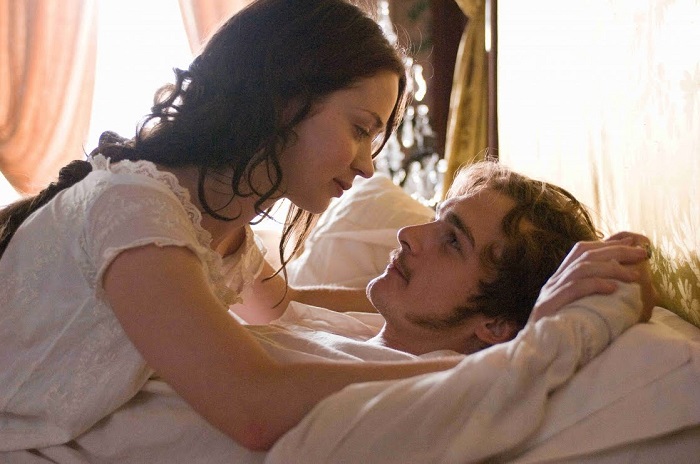
In a breakthrough performance, Emily Blunt (The Devil Wears Prada, The Girl On The Train) magically assumes the role, revealing a vulnerable, burgeoning heart, a cheerful sense of loyalty, and enough back-bone to govern her realm – all wrapped up in one eye-catching performance. She’s given surprisingly muscular support from the sinewy Rupert Friend (Cheri), who shows talent for corset romance, elegantly stepping up as Albert, a man of moral virtue on whom a young Queen could rely. His is the kind of performance that sets hearts a flutter and easily convinces that Albert was a man whose untimely death could plunge “the grandmother of Europe” into forty years of despair.
Long before those sad days, the young Victoria was obliged to negotiate external forces that all had a markedly different agenda for her rule, none of which had anything to do with her. Foremost was the devious consort to her weak-willed mother. Played with beady-eyed relish by Mark Strong, his bullying demands for a lengthy regency in her mother’s name is met with steely derision by both Victoria and her ailing, vitriolic uncle. King William made no secret of his love for his niece, and unbridled hatred of her mother. His frustration most spectacularly erupts in an outrageous spray of indignation during a banquet, giving Broadbent another show-stopping scene.
Deflecting the heat by way of fatherly guidance is Bettany’s Lord Melbourne. He relishes the role, whose agenda-driven proximity to the Queen earned her the title Mrs. Melbourne. Part insurance-broker, part used-car salesman, Bettany is every bit the smooth statesman that one would want running a country, but would not invite to dinner. That Victoria fell under his spell underlines her sense and sensibility. Richardson, Strong and Bettany are agreeable anchors who balance amorous youth with warring elders and give access to the battles raging.
But these are largely sidebars to the main event. Vallee keeps his focus squarely on the love story, playing his narrative like a period romantic thriller, as the Queen finds her feet in court, and then in bed. The Young Victoria is more than a pair of dewy eyed first cousins sharing a pensive kiss. Fellowes layers actuality to illustrate their emotional state and provide insight into lesser known events that would shape Victoria’s rule. Smaller moments – getting the keys to a sparkling new Buckingham Palace, or a minor revolt that led to an attempt on Victoria’s life – spice up the action even further.

Despite behind-the-scenes machinations that brought the pair together (theirs, it was hoped in many quarters, would become a marriage of acute European convenience), here was a coupling of the truest love. Albert soon became Victoria’s rock, a position that Friend effortlessly conveys from their first meeting long past the moment when cupid’s arrow strikes them dumb. Vallee captures it with a thrilling intensity, and if reality was only half this good, it’s small wonder that the Widow of Windsor seldom left her castle. As Albert set about fixing the Palace with German efficiency, Victoria set about fixing the country with shared views of social equity, and so a nation was transformed.
Then, unexpectedly and unequivocally, it stops. Brutally. The Young Victoria is one of those rare films that ends too soon, leaving Albert’s tragic death to footnotes and leaving us wanting more of their ill-fated romance. Despite the Queen herself being a youthful 42, Vallee saw fit to finish years earlier, and his film is poorer for this hasty conclusion. Yet it’s a minor gripe. Resplendent in vivid production and boasting a striking central performance, the heart-piercing passion of The Young Victoria ensured we were all amused.
