



By Christine Westwood
“Gentrification is when a neighbourhood changes,” explains writer and director, Ira Sachs (Love Is Strange), discussing his film, Little Men, ahead of its premiere screening at The Sundance Film Festival. “It’s partly due to a different class coming into a neighbourhood and changing the appearance and the cost. Our film is about that sort of tension; it’s about families who live next door to each other and their differences. Part of the theme is, ‘How do we live together?’ I’m interested in generations. I’m the son of parents in their 70s, and am myself the father of two four-year-olds, so I’m interested in how we impact each other as parents and as children. This film is really about that precious moment of friendship that maybe doesn’t last, but that we remember from our childhood, and also when something happens that seems minor but has really big consequences.”
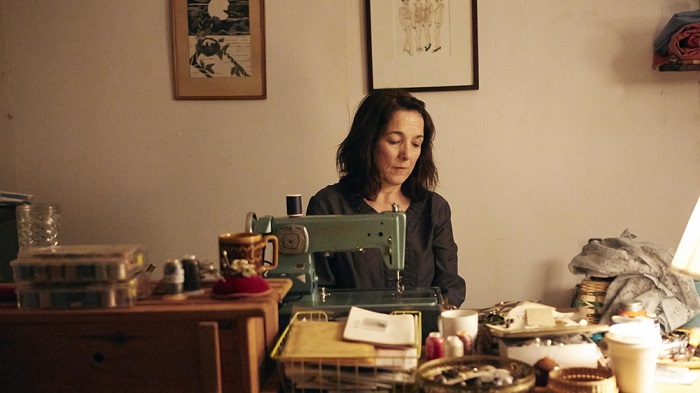
In Little Men, the New York neighbours on one side are the Italian tenants of a dress shop, especially Leonor (played by the famous Chilean actor, Paulina Garcia), who was a friendly companion to her landlord while his own family were absent. When the father dies, his son, Brian (Greg Kinnear), moves in with his own wife, Kathy (Jennifer Ehle), and son, Jake (Theo Taplitz), and soon discovers, with pressure from his sister, that he must evict the tenants in order to manage his own family’s needs. Jake, meanwhile, becomes good friends with Leonor’s similarly aged son, Tony (Michael Barbieri).

The film is sensitive, dealing with the ordinary stuff of life rather than any huge dramatic crisis, but it is quietly horrifying to watch how basically good people can badly hurt each other simply because of coming from different viewpoints, and believing that they’re right. It seems easy at first to side with the tenant, the apparent victim, but her obtuseness and sense of automatic entitlement begin to grate, and open up more sympathy for her neighbours.
Casting the innately likeable Kinnear as the “cruel” landlord subverts the cliche of the bad guy. At the same time, it’s unsettling to watch him go about the eviction, yet Sachs’s even handed empathy for all his characters lead us to grasp Brian’s viewpoint as he struggles to consolidate his resources and support his family going forward.
Sachs’ skill is in pitching the story at the level of the two sons. Their contrasting personalities – the extrovert Italian and the quiet, artistic WASP – make them far from obvious buddies, yet they click. There is a long keynote scene in the film that is haunting, comprising a tracking shot of the boys wordlessly traveling the neighbourhood streets together. It beautifully evokes the sense of those deep bonds you make in childhood that are never really replicated. The boys’ story weaves another layer in the film’s themes. Their parents’ fight and subsequent actions have a devastating ripple down effect. The boys’ attempt to defy their parents is gently comic and at the same time painful to watch, bringing the audience to face the sad fact that we can’t always make life fair.

Greg Kinnear spoke warmly of his director at the Sundance post-screening Q&A. “Ira’s a unique filmmaker with a very clear voice. His movies are all these slice of life things, yet there’s a real dynamic working in this movie that’s very powerful. You put your faith and trust into him. He’s a director and a writer that I felt confident about.”
Jennifer Ehle spoke to FilmInk about why she became involved in the film. “I really just loved this story. From the outside, what happens looks tiny and insignificant, but to these people, it’s absolutely meaningful. There are detonations that have long reaching effects. It’s rare to find a small story with so much meaning. We’re so used to big explosions, so it was nice to have this intimacy. Part of the theme is that life is unavoidably messy, and we should try to keep our communications as clear as possible. Greg and I didn’t work on a backstory. I just trusted Ira and the story. Ira sets up the tone of the room, and the way that things proceed. We were all on board and worked in tandem.”
It was Ehle’s first trip to Sundance, but she says, “I’m going to The Berlin Film Festival next with A Quiet Passion, a film about Emily Dickinson by Terence Davies, and Little Men is screening there also.”

At the screening introduction, Sundance festival director, John Cooper, reminded the audience that “since 1994, Ira Sachs has had six films at Sundance. It’s impressive. He is one of the renowned independent voices that are coming back to the festival. Every one of his films is ‘Ira’, but every one of them is different in itself.”
After the screening, Sachs himself had an opportunity to share his thoughts and feelings with the appreciative audience, including his luck in casting the two charismatic young actors who played best friends, Jake and Tony. “I was very excited about getting in to Sundance. It was my seventh film, but each time, you’re excited and nervous and you’re anxious about the story, so it’s very rewarding. You try to cast the best people that you can find and let them do what they do best. I was very fortunate. I work with an extraordinary casting director. When we saw the tape that Theo sent in, we felt like we were watching a documentary; it was so natural. We cast him very quickly as Jake. We sent an email to The Lee Strasberg School and Michael Barbieri came in to read for the part that Theo had already been cast in. So I said, ‘Switch scripts; read the other side…read Tony.’ He read the material and I was so taken with him. It really was perfect chemistry. They were the easiest actors I’d ever worked with. A lot of my job was just to make it possible for them to discover the relationship between themselves. With movies that I love about kids, like Kes or The World Of Henry Orient or Ma Petite Amoureuse, it’s always the kids that you remember. It’s not about acting; it’s about who they are. That’s why I tried to find kids who would stick in your mind and memory and who would remind you of being young. I wanted it to remind people of those friendships that were so strong in childhood but didn’t make it through. It usually had something to do with the parents, and often to do with class or racial difference.”
Taplitz and Barbieri, aged 13 and 14 respectively, had a chance to share their view of the film. “My parents are super supportive of what I do,” Barbieri explains in an engagingly expressive Italian accent. “The film’s story isn’t my personal experience, but I’ve had friends who’ve had this type of thing happen. It’s a terrible thing when parents fight. It causes problems for their kids, and no matter how much they try not to bring them into it, it’s going to happen. Ira did a great job to make it realistic.”
Before the screening, Taplitz told FilmInk, “My agents saw me in a play, A Midsummer Night’s Dream, and I auditioned for this. I recorded myself doing the part and Ira really liked it. He had me come back and read with a couple of people, and then he told me that I was going to be in it. Me and Michael didn’t know each other. Ira had us Skype and told us, ‘You won’t talk about the film or go over any lines.’ His style is very natural; he doesn’t want ‘acting.’ He wants it natural, and he wants you to just be you. He said to us, ‘Just talk about similar interests and stuff like that.’ When I first read the script, I really thought that it was taken from someone’s life. He really captured it in the script so beautifully.”

Also on the press line, Sachs explained how he developed the structure of his complex arcs of interconnecting characters. “It’s a lot to do with instinct, and growing up watching a lot of films and reading a lot of novels. The novel has had a lot of influence on me understanding how things have unity, but also, you don’t need to show everything. You have to balance what you show and still be emotionally accessible. As for aesthetics, I work in a very realistic fashion…mine is a very naturalistic approach. I thought of this film as a portrait of a neighbourhood and the people in it, so I worked a lot on medium shots and made the locations as important as the characters.”
In a last, thoughtful word to the screening audience, Sachs adds, “The movie is personal to me. It’s about memories of being young, but it also comes from the questions that I have to ask myself, particularly as a parent. I have ideals for myself, but what are the choices I make and how do I follow through in ways that I’m comfortable with? With the adult characters, they’re all struggling with the questions that many of us do, which is how to be good people and to be good parents, how to love, and how to take care of the people that we love. It was important for there to be no winner or loser, no victim or bad guy. It’s just the question of how do we live together, which is a question that many of us are thinking about. It was wonderful to examine these questions with this group of people.”
Little Men is released in cinemas on December 8.

Always a help to the reader to know who is the distributor in Aust and NZ.
With a book, it is axiomatic to include name of publisher. Why not, with film, the distributor?
It was done, admittedly with fast scrolling, in the old At The Movies show.
Hi David, it’s Rialto and is listed, as always, on our review of the film https://www.filmink.com.au/reviews/review-little-men/