


By Gill Pringle
Lena, you are primarily a writer. How difficult is it to suddenly be an actor and to say dialogue somebody else has written?
Lena Waithe: I’m usually very stressed out as a writer, and so when I’m an actor, I’m like ‘this is fun saying someone else’s lines’. I can sympathise with the writer a little bit more because I know the feeling. You know, my family was actually more surprised that I wanted to be a writer rather than an actor because I was always a ham. The big thing I did as a kid, which I think kind of spoke to the fact that I wanted to be a writer, I would mimic and perform things that were on TV. People didn’t have to watch because I would come back and just sort of act it out, like the next day because I would memorise it. I have such a profound respect for actors and I really appreciate what they do. I think a big part of it is because I can’t do what I do without them. I don’t send a script out without doing a table reading, just a little impromptu table read for myself.
By yourself?
LW: Yeah with actor friends of mine so I can hear it out loud and hear from them and hear from the characters’ perspective. Stepping into acting is really an extension of what I do as a writer in terms of trying to get into the shoes of a character and bring it to life. I think because I have that experience, I’ll do a scene and I’ll look at Steven [Spielberg] first, but I’ll also look at Zak [Penn] in a different way. That’s why I think it kind of gives me a bit of a superpower on set.
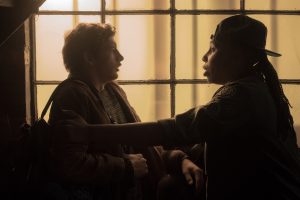 Tye, thousands of people auditioned for the role of Wade, what was the process like for you?
Tye Sheridan: When I first read the script I did not understand that this was going to be shot motion capture, that everything in the oasis was going to be motion capture so when I read it and like, there’s this crazy New York race sequence and it takes place inside of the oasis but they’ve recreated downtown New York and you’re 4th Avenue racing… it’s like ‘how are they gonna do that? Are they gonna lock up the streets in New York?’, this will be the coolest movie ever.
When I first heard about the project, I was completely obsessed with virtual reality at the time. So when this script came to me, I thought it was so cool that Steven Spielberg was making a movie about a world where most people spend time in a virtual reality and that was so cool for me and I sent in a self- tape and my agent called me and he said ‘I think they’re gonna pass and look for someone else’ and I thought ‘yeah of course, like there’s no way I could ever be in this film’. I was like ‘but you know I can’t wait to see it in a theatre, that film sounds very cool.’
And then a couple weeks later, my agent called me back and he said ‘hey, you remember that Spielberg movie?’ And I was like ‘Yeah , yeah, what’s up?’ and he said ‘I think they want you to put it on tape again and just try and you know, make it a bit more comedic and bigger and don’t be afraid to have fun with it’, and so I thought ok. So I put it on tape and then I sent the audition tape and I got a good response and I got invited to LA to read with Olivia who was cast at the time and I remember walking into the audition and, this is something I can relate to now, but I was asking Olivia, I don’t know if you remember this I was like ‘so you’re like gonna be in a Spielberg film, that’s crazy like how do you feel?’
 Olivia Cooke: What did I say?
TS: You were like ‘it’s crazy right, it hasn’t really set in yet’ and I’m like ‘what do you mean?’ And you’re like, ‘you’re here with Steven and you’re doing a Spielberg movie’.
But that experience alone, like going to that audition, I was so grateful for and I called my parents before and I said ‘I’m going to an audition , Steven Spielberg’s gonna be there, I highly doubt I’m gonna get the movie but at least I’ll get to meet him and like read with him’. So I walked in and I told him thank you for all the films he had done because he had heavily influenced my life as a storyteller and as a filmmaker and so I had to say that. Then we ended up talking for 20 minutes about VR and ET. I think we connected immediately and then a month later I found out that I got the part.
He was originally auditioning for an overweight actor. Did that make you wanna go have loads of pancakes? Or were you not aware of that?
TS: I have a very high metabolism… I’m very skinny to the point where I’m like abnormally skinny I think so maybe that substitutes for being overweight.
LW: I thought Aech was supposed to be overweight? In the end, I think there are certain things about the characters that they have insecurities about and I think originally Aech was supposed to be a bigger girl, guy whatever but no girl in real life which I think was gonna speak to the reason why her avatar looked the way it did and also like myself, obviously I’m not like a super big girl but I think it still worked because it’s just really about people being uncomfortable in their own skin, whether it’s a weight thing or not, I think either way I think it kind of works.
TS: I think those insecurities still play in the story and it’s really like an insecurity about where he comes from and how he’s never had parents in his life and his aunt doesn’t have time for him. There’s so many elements that really make him unique… so that’s why he escapes to this beautiful world.
 What did you learn from working with Spielberg?
LW: One thing I learned was this cool trick that sometimes he would do with us. If we were doing a scene, he would say ‘okay now do it again, but do it lightning fast’. It was do it uncomfortably fast and we would do that and we would kind of go ‘what’s happening?’ But the thing I learned is that he was really trying to get us out of our heads because I think sometimes when you’re doing a scene you start to like ‘okay, so I’m gonna do this and when I get to this point, I’m gonna do that’. You sit with a scene for long enough and you have all these cool ideas and I think sometimes he’ll watch and then go okay so rather than tell you ‘okay you’re doing too much’, he’ll say, just do it really fast. So you don’t have time to do all these little tricks that you wanna do, or play with the words like you wanna play with them and then you find that it’s actually more honest when you get out of your head and you don’t have time to take a breath in between every line and then of course he’ll dial it back and so now at this point you feel good, you actually feel confident about what you just did and you go ‘oh, let me throw whatever the hell I was thinking away. So that was just a little thing I learned, a little trick of the trade, to get out of your head which I think sometimes can be the best thing for actors.
TS: To break it up, to give it some new energy, to give it some new life. But also, he gave Olivia and I this film called His Girl Friday with Cary Grant, and he said ‘go watch that film because there’s an interesting thing that’s happening where they say the dialogue so fast and the dynamic between the two characters is like just almost like a…’
OC: A tennis match.
TS: The back and forth. This kind of plays on the nature of their relationship in the film and that they’re both obsessed with all this ‘80s pop culture and they’re sometimes testing each other and they’re trying to see who knows more trivia. So in scenes like that, that was the note that we kept getting, was faster and faster. But as far as like what the most important thing I think I learned from working with Steven, I think he has that quality of a great leader and he knows how to talk to people and he knows how to command. If he was speaking, everybody on set was engaged in listening. He just holds this energy about him and it’s infectious and it bleeds into the rest of the set and that’s why I think he has been so successful as a director because there’s something about him that is innate, that is not only innate to filmmaking but it’s innate to leading a group of people and he has that quality that Lena put it… He’s a giant that…
LW: That doesn’t make you feel small.
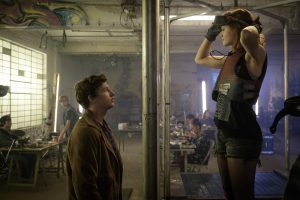 What are your personal visions of the future? Is it gloomy or is it positive?
OC: I think when we did this job, when we shot it, it was 2016 and Trump’s yet to be president and so this, this version of the future and of reality seems pretty bleak and pretty pessimistic. But now it really doesn’t feel that far left, a documentary as a guidebook to how to live.
LW: Brexit had happened…
OC: …foreshadowing for what was to come.
LW: If my fiancé was here, she’d say I’m definitely an optimist. I sort of can’t help it, I don’t know especially as like a black person in this country it’s like, it can only get better, it can only go up for us. I like to hope that we as a society are a lot more kind and generous and loving than we sometimes give ourselves credit for. I think that we as a people genuinely want the same things, we all want life, love and the pursuit of happiness so I think that eventually, the pendulum will swing back and I think we will start to look at each other as equals and start to realise that we are more alike than we are different and I think that’s also what this movie touches on is that all these characters really want the same thing, they want to be seen, they want to feel validated, they want to feel loved and appreciated and so I think that’s how the future is bright. Also, I think the next generation coming up are gonna make the world a much smoother and nicer place.
Whats your perception of ‘80s pop culture?
LW: I was born in ‘84 and so I didn’t get to really experience it there completely but look, I mean I’m a big Whitney Houston fan, The Cosby Show debuted that year. A lot of the things that I loved, really started in the ‘80s, a lot of the music that I listen to, like Janet Jackson was really doing her thing in the ‘80s as well. I think that kind of stuff continued to flourish when I got older.
TS: I was born in ’96. I think movies that are classics and are hits will stay around forever and people will keep watching them, and that’s why I think I love movies so much. They have that impact on people. But yeah I mean definitely, Back to the Future, films like that…
LW: The Breakfast Club...
OC: I was born in ‘93 so that definitely seeps over to when I was a kid and growing up with all these movies…
Which is your favourite Spielberg movie?
LW: I gotta go with The Colour Purple, I’ll watch it constantly still…
TS: ET.
OC: Hook.
Ready Player One is in cinemas from March 29. Read our review here.
