



By Travis Johnson
Aaron Moorhead and Justin Benson do almost everything on their films. For The Endless, their third feature, they not only wrote, directed, produced, shot, edited, and created the special effects for the film, they stepped in front of the camera to play two brothers who return to the backwoods UFO cult they escaped from years before. It seems like an overwhelming workload but, having dipped their collective toe into the bigger budget mainstream world, it seems they wouldn’t want it any other way.
 Let’s start at the beginning – what was the initial inspiration for The Endless?
Aaron Moorhead: The Endless is our third film. We had our first film, which is called Resolution, and our second film, which is called Spring. Especially after Spring we had a lot of opportunities that opened a lot of doors for us, to work on big budget things, and we started working on them and we still are working on those, but it took us a while to realise that those take a long time – they’re just giant, lumbering machines. We started feeling like we weren’t filmmakers anymore. We started as DIY filmmakers, that was kind of the whole idea, but we started feeling like executives or something like that. So we decided to just go and make a movie that nobody could stop us from making, and nobody was telling us to make or paying us to make – we’d just go make a movie. And so we thought, okay, so we know we’ll direct it, we know we’ll do some of the producing, we know we can edit it, we know we’ll do the cinematography – these are all out skill sets – how about we are also in it? So that was part of the choice to make it, to put ourselves in it.
Justin Benson: We were working some jobs on the side at the time, and if we were in the film ourselves we had saved up a small amount of money so we could self-finance this tiny little movie, and then some other things were kind of little puzzle pieces. Like, we realised that a lot of the projects that we had been working on recently were exploring the themes of conformity and anti-conformity. When is it noble to rebel and when is it not? So telling a story about a cult seemed like that would be a good fit. Even though we never talked about it it seemed like we had a fascination about it in many ways. So okay, how do we satisfy that craving to explore that theme further?
And another thing too was that we made this tiny movie, Resolution, back in 2012, and it’s a movie that very few people will ever see. It was a successful movie for what it was, but it’s a tiny little movie with a tiny release. But we kept thinking about those characters, and also the themes from that movie and the mythology of that movie, and inspiration can come from anywhere, and there’s absolutely no reason to make a sequel to a movie that seven people saw. So we didn’t make a sequel, but we did make a movie that takes place in the same universe as our first movie and oddly has perfect continuity. It’s fun if you see one and stumble across the other.
And at the same time too there was something fun and innovative and punk rock about trying to build a microbudget genre universe without sacrificing quality, and sort of building a universe without being concerned about the toys or the video games connected to it, because those things will never exist, right?
AM: I would so play a video game of this movie, though!
JB: So it was almost like we franchised our little movies, but we also used the material from the first movie as inspiration for us, like we could use the inspiration from that first movie to make something we’re really proud of and can stand behind.
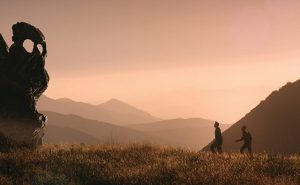 Did you do a lot of research into UFO and apocalyptic cults, or are those ideas so entrenched in our culture now that you could just wing it?
JB: You know it’s funny, we’re gonna sound like dumbasses if we tell you it’s number two, but it is. We read some Wikipedia, watched some documentaries, but it is what it is. But we’re making movie about conformity and banality, it’s not necessarily about a cult. The cult is the way in, but it kind of becomes about this much bigger thing about conformity and rebellion, and the cult is not the threat. So we have a cult that is modeled after many very famous American cults – Heaven’s Gate, Jonesetown, Waco, The Branch Davidians, all that kind of stuff. But we felt that we’d be able to use the real estate of people’s minds that is taken up by the idea of a cult in order to tell a completely different story. And so the movie doesn’t say anything really about cults, besides that they’re bad, right? And even this movie doesn’t really say that they’re bad – although, by the way, personally, I do think they’re bad – but that wasn’t what this movie was trying to say. I think if you leave the movie thinking “cults are bad” I rather hope you’re thinking broadly that blind conformity is bad, rather than that we tried to paint a negative picture of a cult.
AM: there was research for the brothers in the movie, but I didn’t know I was researching. For 20 years I researched some friends of mine who are brothers close in age and I just observed their dynamic and the way they are with each other. When they express emotion and when they don’t express emotion. How much they love each other but they very rarely say it, except in extreme circumstances. So it’s almost like there was more research into the personal relationships in the movie than there was into cults. However, we both have undergraduate educations, we both had to take sociology!
 How did you go directing yourselves and each other?
AM: I can’t tell you what the difference is between acting and directing myself, because acting is so fresh to us, so I’d be curious to see what that looks like working for another director on a long-term project, vs what I would tell myself.
But directing each other, a lot of it just comes out in rehearsal. We broke down the script into rehearsal days, and it was really easy to walk to each other’s place and run the rehearsal. I think we rehearsed four scenes a day, which breaks down to 12 or 13 rehearsal days exactly, and then we probably did five more after that, and then we did more with the actual cast spread out over a couple of months, and that’s where almost our entire process happens.
Everything on set feels like we’re just trying to recapture everything that happened in rehearsal. There’s a lot of magic, because that’s what it is, but there’s not a lot of improvisation outside of very pragmatic improvisation, as in, “well, there used to be a river here and now there’s not” but not “let’s try something else” – “let’s try something else” happened back in rehearsal. When we get on set we have a plan and we execute the plan. Unless you can tell that it’s coming off the rails – that’s something you have to know as a director.
 There are a lot of great effects gags and visual flourishes in the film that carry a lot of atmosphere but do so quite inexpensively. When you’re writing, are you conscious of the money and resources you’ll have to pull off things like that, or do you just write it out and hope you can make it work in production?
JB: That’s a very good question that no one’s ever asked as specific as that, and the 1000% true answer is that we’re conscious of it every second of the development and writing stage, and we never put anything in the script that we don’t know how to do, because this is independent film and the quickest way to end up with a movie that looks ridiculous is to put things in the script that you can’t afford to do on your budget. Aaron and I, before we met we each had about a decade of do it yourself filmmaking experience, so we each understand what we can and can’t do very well. Aaron’s a brilliant visual effects artist who specifically specialises in 2D compositing and so my script writing in independent film, I’ve become specialised in writing for a brilliant 2D compositor. It’s funny, but we’re not joking – that’s literally what our process has become. As I’m writing it I’m thinking okay, I know what Aaron can and can’t do in terms of visual effects.
AM: It’s really cool how Justin does this beyond the visual effects aspect where he writes a scene where we have a tug of war with something that seems like it’s a thousand feet high – it just goes off into the distance. That cost us nothing, and it’s such an interesting, weird visual, it’s so striking. That kind of a thing is very hard for a lot of people to think up – it’s either expensive and big, or minimalist and cheap and small. There’s nothing in between. But this movie was shot for pennies, and definitely nobody would guess what the budget is, so that’s a cool badge of honour.
The Endless is playing at Cinema Nova in Melbourne and Event George St in Sydney from March 22, and Cinema Paradiso in Perth from March 29, 2018
