


by Julian Wood
Last year at the Sydney Film Festival, a haunting little film from Hungary about two unlikely lovers scooped the top prize in competition. Ushered onto the stage on closing night was a shy small woman. Clearly somewhat daunted, she had to address the huge crowd in her second language. One got the sense that she is not one for speeches. However, the very warm reception that she and her film had received belied her modesty.
Now that the film is getting a well-deserved cinema release, we caught up with Ildiko Enyedi from her native Hungary.
We started by asking her what she recalled from that Festival triumph. Did she expect that audiences would connect with the film so strongly?
“I was very happy because people responded to the film emotionally and all the thoughts were coming later. And not the other way around. Because I wanted the film to communicate on a very basic level.”
She went on to say that, especially in the case of her film which seems so elliptical and even light in a way, that it could have ended up being of very narrow appeal. “Audiences might have ignored the film because it is not very explicit, if you like.”
On Body and Soul takes place in a slaughterhouse, which is an unusual setting for a love story. It also relates, in some indefinable way, to the deeper issues of animal and human relations. In a way, the start of the film (which contains a magical sequence of two deer in a wintry forest) photographs the animals as if they are human and the humans as if they are animals. Enyedi likes this line of thought.
“Well, yes, in my eyes. There aren’t such big differences between humans and animals. We share this same place, this planet. Looking back at my career, I realise that all my films have a lot to do with animals and they have a sort of function in the films too. They are not there just because they are beautiful creatures.”
She is able to elaborate on this theme in terms of film technique. Enyedi knows she can rely on audience visual literacy to understand the conventions of such things as the over the shoulder shot for a point of view and so on, and she makes that work for her in linking the human and animal stories.
“Actually, there’s something conscious in this film; to find camera positions, and so on, to link them via a cinematic language… so as to look at these animals as complex beings. And in this film, I try to get us to accept that these two animals [the stag and the doe] are protagonists. I wanted the relationship between the two deer to be very real. Very simple and very credible. And not just symbolic or metaphorical but really as it is happening between them. And then that simple closeness and naturalness is what is missing in everyday life between [the lovers] but it is the direction they are heading. It may not be perfect, but they are trying.”
Is it fair to say then that if we could be as ‘in the moment’, as natural, as animals we would be more human ironically? “Yes, that is it exactly.”
There are so many aspects of the film that contribute to situating the lovers in their uphill struggle to connect. The co-workers in the abattoir seem a pretty rough lot and they certainly don’t make it easy for the lovers. However, Enyedi has a different interpretation of their demeanour. It is part of the film’s ethic that it does not judge people either in terms of what they work at, or how they are with others.
“Actually, I tried at least to show that, as a mass, people can be quite mean. They don’t realise that what they are doing is hurtful and mean. When they are individuals they are not mean people. They are all actually burning in their own little private hell. And as soon as we get close to them we see them differently.”
The central role in the film is that of Maria. She is beautiful in a rather unworldly kind of way. It is almost as if she is too ‘porcelain’ for this rough world; and she is played with a film-stealing intensity and stillness by the Hungarian actress Alexandra Borbely.
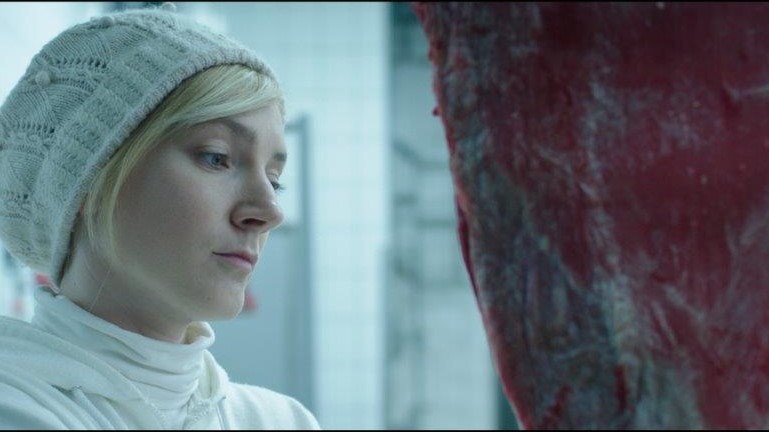
Enyedi is in awe of the risks actors take, and of the remarkable quality that Borbely brings to the screen in particular.
“With Alexandra we worked a lot. We spent time together beforehand and we researched certain movements or, for example, what sort of shoes she would wear and how she would walk etc. And then, on the set, I didn’t have to tell her anything.”
Borbely has a way of playing the vulnerable and slightly wan Maria that is not only highly watchable, but draws so much sympathy and protectiveness out of the audience. Enyedi wholeheartedly agrees, and tells us how this located directly with the whole experience of shooting the film.
“It was amazing to see. [It was] actually how you describe it. It was the same effect on the crew. It was a very tender shoot. Very open and loving. It was an environment that wrapped her in a way and I think it helped a lot. It was a very focused, very calm and very silent team. And everyone was happy to share her story in a way. On the set she transformed into Maria; she didn’t just play her. And I am thankful for that because you know how many people there are on a set – how many different energies and so on? And all these energies were able to go in one direction; in her direction. It was beautiful to see, and it was down to her intensity and truthfulness.”
On Body and Soul is in cinemas from May 10, 2018
