




by Stephen Vagg
A studio that worked out of the Rank Organisation in the 1950s, and which could serve as an inspiration for a resuscitated Australian film industry today!
We became aware of British Film-Makers when researching our earlier piece on Earl St John – in particular, the excellent book by Sue Harper and Vince Porter, British cinema of the 1950s: the decline of deference which is the source for much of the research for this piece.
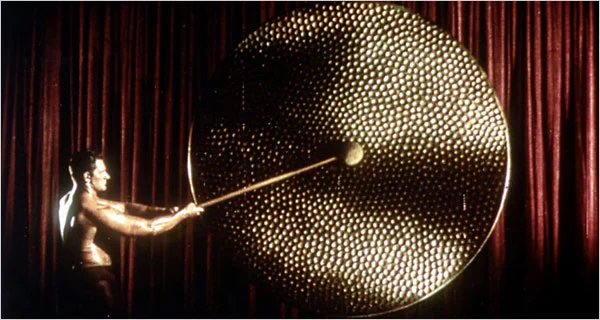 British Film-Makers (BFM) was a short lived production company, which made 14 British movies between 1951 and 1953. The pictures were financed by the well-known Rank Organisation (you’ll recognise the man with the gong) and the British government-financed National Film Finance Corporation (NFFC). When BFM films are discussed, it’s normally in context of the whole Rank Organisation, but we felt that the company itself deserved its own analysis.
First, some brief background: the British film industry had boomed during the war, over expanded in peacetime, got involved in a trade war with Hollywood and almost collapsed. A number of British film producers such as Alex Korda went bust; the Rank Organisation, which dominated production and exhibition, lost sixteen million pounds in one year. Feeling guilty for having started the aforementioned trade war in the first place, and worried that a whole industry might be wiped out, the British government stepped in to help filmmakers via such schemes as the NFFC (which would invest in movies) and the Eady Levy (a tax on film tickets that was given to producers), which in turn led to BFM.
The British Film-Makers scheme worked as follows: Rank would provide 70% of finance for a movie with the NFFC providing the balance, and the films would be released through the Rank-owned General Film Distributors. Any films made by BFM had to be approved by a board of directors, which included chairman Michael Balcon, head of Ealing Studios (also owned by Rank but its own little fiefdom); Earl St John, head of production at Rank; and James Lawrie, head of the NFFC (and thus the representative of the British government). Rank had various producer-director teams under contract; they would develop (or be given) projects, pitch them to the board, and make them through BFM.
Rank continued to finance other films during this period through its other companies, such as Ealing and Two Cities, but most of its movies were made out of BFM. The scheme lasted for two years, 1951 to 1953. Rank pulled out of the BFM scheme at the end of 1952, claiming that it wanted to be “free and independent”. This led to the formation of Group Film Productions, a company which became, for a time, Rank’s main producing arm.
Various historians of this period (Quentin Falk as well as Harper and Porter) all seem to agree that there were fourteen different movies made under the BFM umbrella and these are the ones we are focusing on today.
The films comprised of:
– two war movies (Appointment with Venus, The Malta Story),
– two comedy stage play adaptations (The Importance of Being Earnest, Meet Me Tonight),
– two comedy vehicles for big stars (The Card, Top of the Form),
– two married couple comedies based on original stories (Made in Heaven, Something Money Can’t Buy),
– a “woman’s picture” melodrama (It Started in Paradise), and
– five thrillers (Hunted, The Long Memory, The Venetian Bird, Desperate Moment, High Treason).
Now, none of the BFM films became classics or blockbusters – indeed, we are guessing that only die hard fans of 1950s British cinema would have heard of any of them (and thus, are the likely to be the only people who might have even read this article to this point – hi there!). Still, it was a varied, economically responsible slate that helped put the Rank Organisation back on a firm financial footing. Indeed, the BFM output did so well that by the end of 1952 the Rank Organisation announced it would no longer need assistance from the NFFC and from then on would finance films on its own (although, it still benefited from government assistance in the form of the Eady Levy).
Let’s go through the BFM movies:
War films were generally a solid bet for the British industry of the 1950s and BFM made sure that its two war efforts had big stars and interesting stories based on fact. Appointment with Venus, from the producing-directing team of Betty Box and Ralph Thomas, imported David Niven from Hollywood to star in this charming (true) tale of the rescue mission of a cow from the Channel Islands. The Malta Story, based on the siege of that island, had the three biggest stars in Britain at the time – Alec Guinness, Jack Hawkins and Anthony Steel. Both films performed well at the box office. In fact, it’s surprising that BFM didn’t make more than two war movies, but we suppose Rank made others during this time through different companies (The Cruel Sea, The Planter’s Wife).
Comedy was another safe genre and BFM got classy with adaptations of Oscar Wilde’s The Importance of Being Earnest and three plays from Noel Coward’s Tonight at 8.30, which became the anthology movie Meet Me Tonight. Both films had colour photography and stars – they were not cheap jobs. Earnest was a very solid effort which immortalises the genius of Margaret Rutherford and Edith Evans – although stagey, it holds up well and was a decent performer at the box office. Meet Me Tonight was a disaster, poorly directed, adapted, cast and acted – we don’t think anyone liked it, then or now, and it was a flop. One winner, one dud.
More successful were the two comedy vehicles for big stars, both based on pre-existing IP: The Card with Alec Guinness from an Arnold Bennett novel and Top of the Form with Ronald Shiner, an informal remake of a Will Hay film. How much you enjoy these movies today will depend on your taste for the stars, but in 1952, both men were coming off a string of hits and British audiences responded enthusiastically. A well-constructed star vehicle for a popular comic is as close to a surefire genre as you can get – during this time, Rank also financed (through Two Cities, not BFM) a Norman Wisdom film, Trouble in Store – directed by John Paddy Carstairs who made Top of the Form – which became a sensation. It beggars belief that Australia no longer makes star vehicles for comics.
The reason why BFM made two married couple comedies is harder to wrap one’s head around. Made in Heaven was from the producer/writer of Hotel Sahara, but lacks that film’s sense of fun and well cast stars. For instance, Petula Clark, while charming, is far too young to play a bride who needs a maid, and Sonja Ziemann is a dull import. Something Money Can’t Buy starts out interestingly, a look at the travails of a newlywed couple (Anthony Steel and Patricia Roc, who had an affair during filming which resulted in her having Steel’s love child) but spins off into weird, dull subplots about work. In fairness, the ideas behind both films aren’t bad, and Something Money Can’t Buy actually did okay at the box office according to Rank’s internal records. And during this time, Rank had a huge success with an original married couple comedy, Genevieve – that was made through Sirius Productions and not BFM, so we can’t include it on this list, but if Made in Heaven and Something Money Can’t Buy had simply been better made, we think they had a chance of really breaking through.
It Started in Paradise was the one film out of the fourteen specifically targeted at female audiences. It’s an original story, a sort of All About Eve set in the world of fashion – the kind of tale that Gainsborough Studios might have made in the 1940s under Ted Black. However, the movie is sunk by incompetence at all levels except photography and costumes; Compton Bennett, who’d leapt to fame as director of The Seventh Veil, spent the rest of his career being found out, of which It Started in Paradise is a key example. It flopped at the box office.
That left five thrillers, easily the most common genre at BFM. Indeed, it’s a little odd that there were so many thrillers, especially as that genre had not proved as successful commercially in Britain as others, notably war movies, comedies, musicals or adaptations of classic novels. However, there had been some (The Third Man, State Secret, Seven Days to Noon). What’s more, we get the sense that the British film industry was simply comfortable making thrillers in the 1950s – there was plenty of possible source material to adapt (stage plays, books, TV plays), they didn’t cost too much money (unlike say adaptations of Charles Dickens), they wouldn’t be controversial, they might sell to the US (where comedies and war films seemed to struggle).
The Venetian Bird was a not-very-good attempt by the team of Box and Thomas to use The Third Man formula – like that film, it was based on a novel by an acclaimed thriller writer (in this case, Victor Canning) about a man (Richard Todd) who travels to an exotic foreign city (Venice) and deals with a mysterious beauty (Eva Bartok) while searching for a mystery man (John Gregson). Hunted and Desperate Moment both starred Dirk Bogarde playing someone on the run (Bogarde had leapt to fame being on the run in The Blue Lamp and would also go on the run around this time in The Gentle Gunman and Blackmailed); Hunted is excellent, Desperate Moment is a little dull, despite Mai Zetterling and German location filming. High Treason was a flat unofficial sequel to Seven Days at Noon (Andre Morrell plays a cop in both), about a plot to uncover Russian sabotage, with some anti-commie propaganda. The Long Memory was about an ex-con (John Mills) unjustly convicted, who gets out of prison and goes looking for revenge; a little reminiscent of late ‘40s crime films like Brighton Rock, it’s very well directed by Robert Hamer, even if Mills seems miscast. None of BFM’s thrillers became hits, not even The Long Memory or Hunted, despite their quality; indeed, thrillers would never be that popular at the British box office, yet British studios continued to generate them in sizeable numbers.
We went into BFM in such detail because it offers a possible model on how to make a diverse, broad-appeal local film industry in a smaller country. Namely: put key producing-directing teams under contract so they can pay their living costs while they develop projects; keep budgets reasonable; finance films through a combination of money from government and industry; underpin that industry money with a specific levy on tickets; ensure cinema chains have a say in what is made so they can get behind it. This isn’t the perfect model, but it’s not a bad one – it’s certainly worth discussing.
To our knowledge, trialing this sort of model in Australia has never been discussed. We are not sure that it ever will because there never seems to be any sort of desire to put the Australian feature film industry on a sound commercial footing (with the occasional exception, eg Cosens Spencer in the 1910s, Cinesound in the 1930s, Hexagon in the 1970s). There is a gap in the market to make reasonably budgeted, commercial Australian films in genres we do well – star vehicles for genuinely popular comics, true historical stories with stars, adaptations of classics – and you could do it: re-allocate Screen Australia’s money to the cinema chains and make them invest it in features, introduce a quota for Australian films (something like 8-10% isn’t outrageous) to compel them to be exhibited. Are such things even discussed? Or is it just easier to blame everything on COVID, Netflix, fear of being cancelled, and kids being on their phones these days? Maybe that wouldn’t work, but we’d like to see it be given it a go, or at least discussed – surely, it’s better than what we have now?
There are lessons to be learned for us if we look in the past at countries other than America!
