




By Cara Nash
In killer fashion, The Dressmaker has well and truly crushed any lingering assumptions that there’s no commercial market for movies by and about women. The darkly comic drama directed by Jocelyn Moorhouse and starring Kate Winslet has cashed in over $20 million at the local box office, only the eleventh Australian film to hit that milestone, and it was remarkably still screening in fifty cinemas three months after being released. It’s a hugely gratifying result for its producer, Sue Maslin, who optioned the rights to Rosalie Ham’s bestseller back in 2009. “One part of me set out to make what I hoped would become a classic Australian film,” Maslin tells FilmInk. “On the other side of the equation, I was always clear that it had to make sense from a business perspective. I had always been ambitious to the extent that I modelled [the business plan] on a best case scenario, which saw the film making $15 million at the box office. People said that was a blue sky scenario! Most Australian films don’t perform anywhere near that, but I tried to make decisions at every stage of the journey that could deliver that result.”
The film ultimately surpassed that result, but the journey there has been an uphill battle for Maslin, who struggled to get others to see the cinematic potential in the story about a feisty dressmaker who returns home to settle old scores. “Here is a film that focuses on the story of a woman, is directed by a woman, and is based on a novel written by a woman. If you look at the figures, that’s pretty unusual,” says Maslin, who also produced Japanese Story and Road To Nhill. “Year out, less than 25% of all our films have female protagonists, so we were behind the eight-ball from the outset in convincing the marketplace that there is a market for a film like this.” Maslin found a major collaborative partner, however, in Universal Pictures, who have been key to the film’s success. “I went with Universal because they are absolutely convinced that there is a commercial market for films skewed toward women. They’ve showed it time and time again – look at Mamma Mia!, Trainwreck, and Sisters. They get it, and others don’t.”
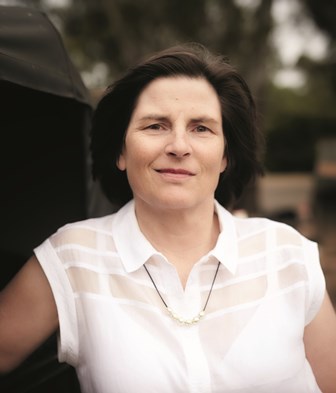
While she found a true ally in Universal, the film still proved a tough proposition internationally, even after Maslin and Moorhouse nabbed Kate Winslet and Judy Davis for the lead roles. “Here I was presenting a film with two of the world’s greatest actresses attached. Yet the feedback that the sales agents got from the world marketplace was, ‘Oh yeah, that’s fine, but who is your male lead?’ I was confounded and disappointed by that. It’s a worldwide problem – this perception that films must appeal to men or that they must have male A-list actors to be saleable. It’s a self-replicating loop, and the way that it will change is to show a demand for these films.”
The Dressmaker has well and truly demonstrated such a demand, and its success, aided by growing discussion over the industry’s deep gender imbalance, has provided further incentive for government funding bodies to implement policy changes. In December last year, Screen Australia announced the introduction of the Gender Matters Initiative, which aims to ensure that production funding is targeted to creative teams that are at least 50% female by the end of 2018. “There’s no one strategy that’s going to address the problem because it’s so ingrained, and it’s been around for so long,” Maslin says. “I love the Screen Australia strategy because it’s a catalyst. It’s saying, ‘Let’s just get more films in development and flowing into the marketplace that are predominantly by and about women.’ That kick-starts what eventually can’t be driven by quotas and can’t be driven by Screen Australia, but is just the commercial realities of the marketplace.” While there has been talk of introducing funding quotas, Maslin doesn’t believe that is an effective strategy. “Artificially skewing the marketplace by demanding quotas might work in the short term, but I don’t believe that it’s a long term solution. You can’t dictate to the marketplace what it must screen.”
Maslin is dedicated to working toward long-term solutions. When talk turns to the government’s further cuts to Screen Australia’s funding at the end of 2015, Maslin says that we need to view the problem through a new lens. “Screen Australia has done an exceptionally good job at trying to absorb those cuts without affecting programs,” the producer says. “We’re moving into a new era now where it’s going to have to affect the money that actually flows out into production, and that’s a big problem. But the bigger issue at stake here is what it would take to make this industry more viable from a business point of view, and less a cottage industry constantly relying on handouts from the agency. We’ve got to look at everything from how the producer offset rebate works to the way that money flows back from a successful film to the industry or, most likely, doesn’t flow back. It’s not just about the government handout. I’m actually committed to trying to do something about that this year, so come back to me in six months…”
The Dressmaker is available on Blu-ray, DVD and Digital now.
