



COMPUTER GENERATED ENTERTAINMENT
Computer Generated Imagery (CGI) is industry shorthand for anything that you see in a film that isn’t actually there, but was instead generated by a computer. According to American Cinematographer magazine, audiences marvelled at the first extensive use of 3D CGI in 1982’s sci-fi classic, Tron, which grossed $33 million and made cinema history in more ways than one. Further developments followed, culminating in the impressive visuals of blockbusters such as Terminator 2 and Jurassic Park. Ever since, CGI has been exponentially improving, resulting in impressive current-day scenes, from the downed Star Destroyer where Rey goes a-salvaging in Star Wars: The Force Awakens to the bear that mauls Leonardo DiCaprio in The Revenant, making for shots that could never be achieved otherwise.
But contemporary cinema is enamoured with CGI. As computer graphics have taken over the silver screen – not exclusively in action or sci-fi films either – a number of industry professionals, critics and laypeople alike have expressed their concern about the overuse and quality of CGI as it is presented to us, including debaters in The New York Times and Viggo Mortensen. While you’ll hear very few voices advocating doing away with CGI, the point is that some productions rely on CGI too much, disregarding other visually interesting powerful techniques to create intense action and give life to the supernatural and the superhuman. Let’s take a look at some very successful movies which have not depended solely on CGI to wow audiences.
CASINO ROYALE (2006)
Daniel Craig’s classy first outing as James Bond was in 2006’s Casino Royale. This film reinvigorated the franchise, moving it closer to the tone of Ian Fleming’s original thrillers.
The toe-curling parkour sequence which kicks off the action is an 8-minute lesson in what can be accomplished without digital effects. Eon productions brought in French free runner and parkour champion Sébastien Foucan to play Bond’s adversary in this extraordinary chase. Bond pursues him across the crumbling rooftops of a Madagascan skyline; they dodge traffic and hitch rides on the bumpers of passing cars, then have a toe-tingling melee on a beam crane swinging 200 feet in the air. The stunts are a credit to the physicality of both actors. Foucan’s ballistic athleticism makes for some incredible shots, and Craig’s crane-jumping antics topped a BBC Radio Times poll as the best Bond stunt thus far in the series.
The James Bond franchise, valued at a total of $7,979 million famously avoids putting all its eggs in the CGI basket. The films features another notable scene: subtle yet suspense-filled but based on performance and script instead of visuals. It’s the tense game of Texas Hold ‘Em set at the exclusive Casino Royale, where Bond must pit his poker skills against the villainous Le Chiffre.
Director Martin Campbell uses tight editing and the actors’ solid acting to showcase the dramatic tensions inherent in the game mechanics. When players start to go all in, Le Chiffre bets $12 million and expects Bond to fold. Certainly a bold move, a stereotypical example of what is called aggressive play in poker terminology. He doesn’t – he goes all in to produce an unbeatable straight flush and snatches a pot worth a cool $115 million. Poker expert Thomas Sanbrook was on-set to teach the cast to handle their cards correctly, stare one another down, and toy with their chips in a realistic manner. No special effects here, just crisp and ergonomic storytelling.
THE THING (1982)
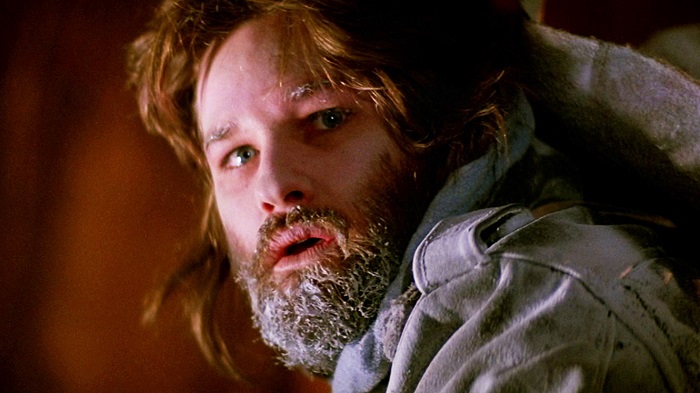
For his first major studio project, indie-horror maestro John Carpenter agreed a $15 million budget with Universal Pictures to direct The Thing, in what was to become quite possibly the quintessential creature-feature, in which a handful of scientists stationed at a remote Antarctic outpost find their camp attacked by a deadly shape-shifting extra-terrestrial.
Carpenter, for the sake of authenticity, needed the studio-built base interiors to match up with the external shoots conducted around snow-swept British Columbia. With pavement temperatures in Los Angeles topping 37ºC, this meant refrigerating the 6 studio sets all the way down to a wintry 4.4ºC to allow for shots where the panicked breath of the besieged scientists might be caught on camera.
Today, such an effects project would be a comparatively routine CGI affair: an actor’s frosted breath might be digitally painted into individual frames of the movie, as and when required – and with the added bonus of not working in a freezer for three months. Back in 1982, no such option was available. 22-year old Rob Bottin (acclaimed today for his effects-work in Robocop, Predator, A.I, etc.) was assigned to handle the enormous volume of special effects planned for the movie. That included the creature itself in all its flesh-fusing glory. He used stop-motion, live-action latex puppetry, early animatronics, and buckets of real gore to create the most grotesque and terrifyingly visceral alien monster to ever hit the cinema screen.
THE FISHER KING (1991)
Terry Gilliam shot his moving New York fairy-tale on a budget of $24,000,000. A subtle screenplay tells the tale of two very different individuals, equally damaged in their own right.
Depressed former-radio shock jock Jack Lucas (Jeff Bridges), encounters homeless, semi-lucid drifter Parry (Robin Williams), adopting him into his life and home. This act of grudging kindness leads eventually to the deeply cynical Lucas embarking upon a path of redemption.
A whole host of complex technical effects and an elaborate costume design fashioned out of latex, leather and urethane was used to clothe the Red Knight figure that pursues Parry through the film. The finished suit weighed anywhere between 125 and 150 pounds, and had to be padded for the stuntman’s safety.
At the core of The Fisher King is a surreal 2-minute sequence judged now by critics to be quintessential Terry Gilliam. A love-struck Williams follows the object of his affections through the crowds of Grand Central station. As the character slips into wistful reverie, the anonymous commuters partner up to dance an enormous waltz under a mirror ball, before everything goes back to normal abruptly.
Shooting the waltz required 12 professional choreographers and around 1000 extras – all of whom needed exhaustive orchestrating. The production team used loud-hailers to herd them around, with but a perilously slim window in which to get the sequence correctly recorded onto film. The end result is a triumph, one that would arguably not have felt so human had CGI been used to create it. For several years after the event, fans staged an annual New Year’s Eve dance at the terminal.
STAR WARS: EPISODE VII: THE FORCE AWAKENS (2015)
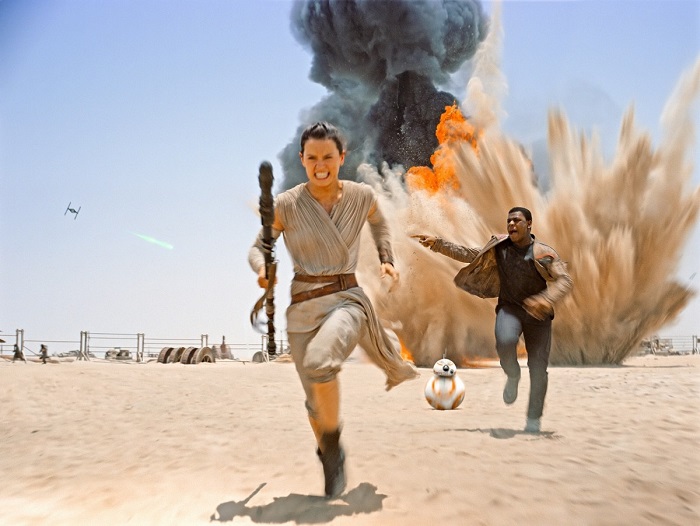
And so to the final film on this list. LucasFilm and J.J. Abrams wanted to keep CGI to a minimum for this much-awaited reboot to the Star Wars universe. Judging by the movie’s enthusiastic reception, they succeeded.
Made with a whopping $200,000,000 budget, as of 03 April 2016, the film had already taken $934,898,148 at the U.S box office. That number, of course, is still climbing. IMAX cameras were deployed in the filming, and digital backdrops transform the various location shoots into suitably alien landscapes, but the digital touch is light and the artist’s hand is steady.
CGI is most certainly still in evidence, used variously to enhance model effects in the dizzying space battles and points of detail on alien costumes, but thankfully there’s absolutely no sign of Jar Jar Binks or chorus-line attack droids.
Rob Bottin supervised the visual effects, using his skill to muster a reassuringly solid-looking roll-call of aliens, as particularly evidenced in the bustling bar scenes at Maz’s cantina, and the rundown salvage depot Rey calls home at the start of the adventure.
Puppets and costumes here have a physicality about them that was sorely lacking in the previous trilogy of films. This time around, digital effects are a garnish, rather than the main and only course, and dutifully make way for fast-paced story-telling and well-orchestrated action set pieces. Most of the stuff seen on screen is actually there, and the difference is plain to see.
THE SHAPE OF THINGS TO COME
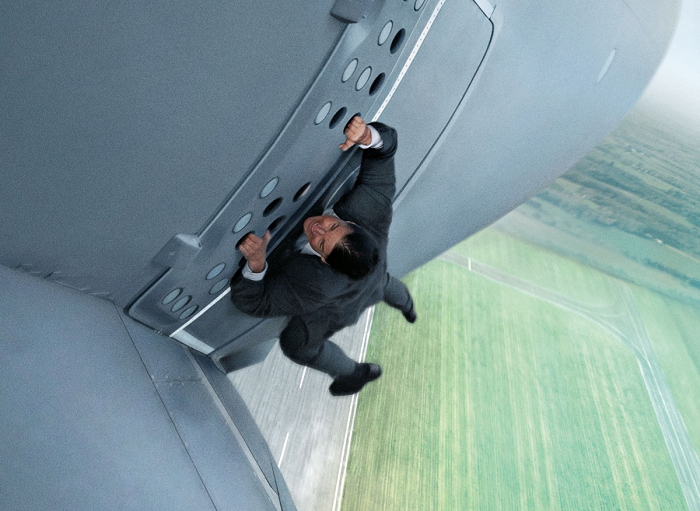
You really don’t need CGI to pull off riveting cinematography. The nodding spot lamps of Pixar were delightful, but somewhere along the line, that passion, that artistry, stands in danger of being lost. Christopher Nolan famously steers clear of CGI wherever possible in his films, although he would be the first to concede that the technology certainly has its uses, and rates it as an indispensable tool.
Often, CGI doesn’t even work out to be much cheaper than filming live action anyway – it takes so much computing time and data storage and manpower to credibly render CGI generated models that you might as well just do what Francis Ford Coppola did for Apocalypse Now and blow your entire budget on hiring a small country… CGI has a role to play, but it mustn’t be relied upon to the exclusion of all others. Films need to still elicit “oohs” from their audiences, not a disengaged “meh” – and too much of anything is a “meh.”
