


by Filmink Staff
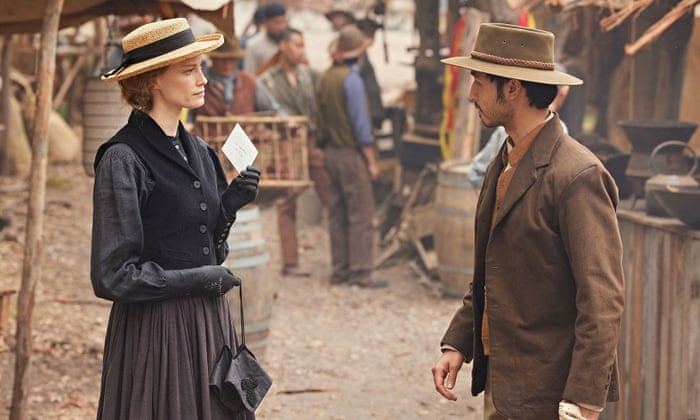
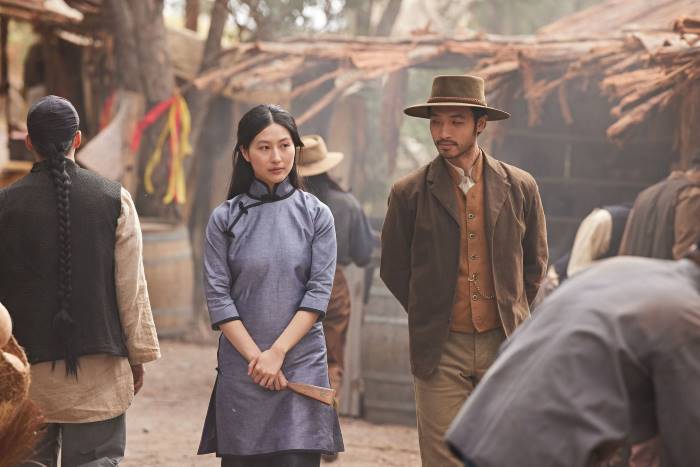
Set in the 1850s during Australia’s Gold Rush, where thousands of people converged on Ballarat, Victoria seeking their fortune, the four-part mini-series New Gold Mountain is a murder-mystery built around a clash of cultures. Europeans and Chinese prospectors move uneasily through a maze of suspicion and secrets. Headman Leung Wei Shing (Yoson An) tries to keep order.
Created by Peter Cox (This is Not My Life), directed by Corrie Chen (Wentworth) and produced by Elisa Argenzio (Fires) and Kylie du Fresne (The Invisible Man), a major highlight of the show is the spectacular and beautiful score that merges the musical traditions of East and West.
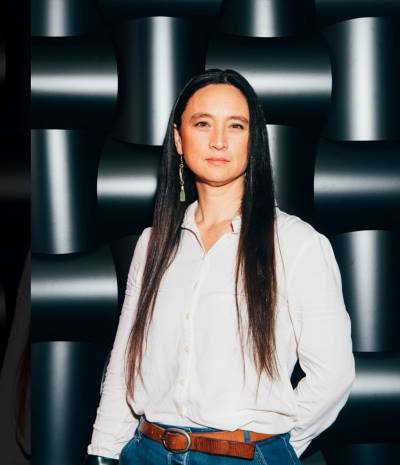
We talk to multi-award winning composer Caitlin Yeo about how she created the music.
You have said that New Gold Mountain offered the opportunity for you to explore your background. Can you tell us about that?
“My dad is from Singapore. His background is Malay Chinese. With New Gold Mountain, it was a chance to learn more about myself.
“I think the biggest thing I learnt about my culture… it’s stuff that you can’t say in words.
“That’s because a lot of the things to do with learning about culture are all those things that are not said. With culture, you can say ‘they use these instruments’ and ‘they have these traditions’ but there is a whole lot of stuff that lies between the surface – that is unspoken, behavioural attributes. That was the stuff that I saw on screen in New Gold Mountain that I deeply related to. I found myself learning that this was not just me in my home, but this was part of my Chinese heritage.”
 Tell us about your approach to the music?
“We did research the music of the time, but we had to make sure that the music had a modern approach. It would be impossible to do something that was [precisely] of the time.”
Because our ears don’t recognise the ‘meaning’ of the music of the 1850s; it would stand out because that music is, in a way, ‘dead culture’; it doesn’t resonate with emotional significance?
“Yeah. New Gold Mountain [was more like] a revisionist Western with a twist [as opposed to a documentary].”
Still, in the music, we feel the ‘past’, not only of a bygone movie era but also of a real past.
“The great thing about New Gold Mountain is that there are so many things within the show that are still happening today; in terms of the clash of cultures; the way people speak to each other. It might be housed in a different era. But I think there is still very much a connection between that time and now. We wanted to make sure we made that connection.”
What were your conversations with director Corrie Chen about the music?
“The brief was that the music had to be lush and big and suspenseful. They wanted it dramatic… but not melodramatic.
“It was a great opportunity. A lot of the music in Australian TV does not make itself known. It works as underscore and [the reasons] could be low budget or not much time but the filmmakers [here] were adamant that they wanted it epic.
“It had to feel as though there were thousands of miners there at the time and the clash of cultures was epic… but they didn’t have thousands of extras [virtual or real] so that [canvas] was filled out with the music.”
There is a tension throughout the music track; we hear a Western classical approach, and a Chinese ‘classical’ style is present… the soundtrack features Chinese instruments like the Dizi.
“I played that. That’s like a flute. It was given to me by my father.”
There’s also a Guquin, a plucked instrument; a Pipa which is described as ‘like a banjo’.
“Corrie said she wanted to make the Asian sounds and Chinese instruments for the Western characters; and she wanted the Western sounds used for the Chinese characters. That was a fantastic point of difference for the way we played the music. What it ended up doing was it gave a sense of antagonism to both cultures across the series. You felt they were both present in each other’s lives.”
It feels operatic at times with certain musical ideas directly expressing what’s going on…
“That was another idea… at the time in China there was the Peking Opera. We referenced that in a subtle way in the percussion. [Overall] there is a lot of orchestral percussion like the bass drum and there’s an Irish whistle, which sounds a bit like a Chinese whistle.”
We hear lots of percussion – a sort of metal drum sound – familiar to your work on Bomb Harvest (2007) and The Rocket (2013) both directed by Kim Mordaunt. But there are some other unusual sounds here?
“One of the big percussion sounds is the gold pan.
“After reading the script the one instrument that united all of the characters was the gold pan. Everyone in the series is searching for gold. They are all looking for this fortune to make a better life for themselves. There was a sense of frontier in them; they were out to discover a new and better world. They would do anything for it.
“I thought a gold pan would match the sound of a lot of Chinese gongs and cymbals. So, I asked [the producers] to bring me back a gold pan from the shoot because I thought it would make a great percussion instrument.
“We went into early recordings with it, with Ben Walsh, a great percussionist who is really good at playing things that are not instruments.
“It was quite extraordinary the amount of different sounds you can get out of a gold pan by putting water in it, by putting pebbles in it, by bowing it, hitting it, playing it dry, turning it upside down, close miking it.”
Was there any improvisation?
“No. Every single note was scored; even the percussion was turned into sheet music; and even the Chinese instruments we used had both English and Chinese notations.”
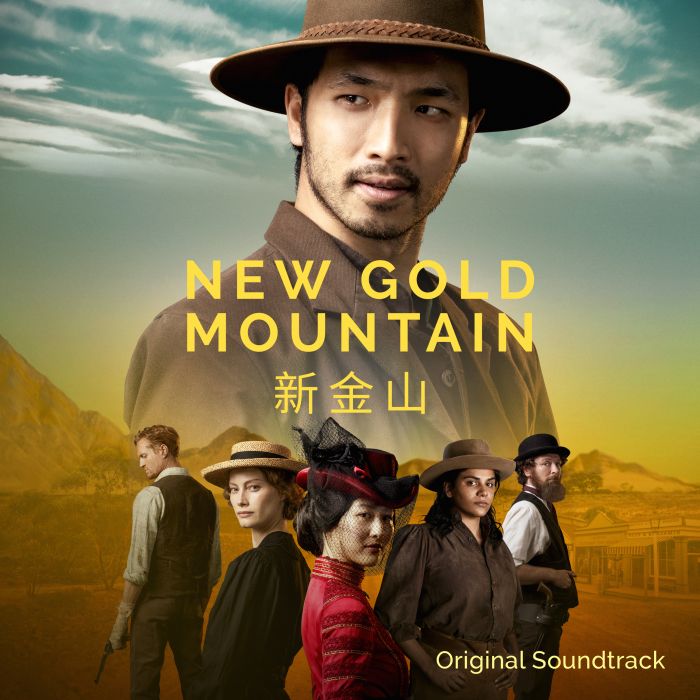
The New Gold Mountain soundtrack is out now and includes a version of Silverchair’s ‘Tomorrow’ with Cat Stratton performed in Mandarin.
Photo Credit: Caitlin Yeo photo by Belinda Dipalo

