



By Travis Johnson
Set on the eve of the D-Day invasion of 1944, Jonathan Teplitzky’s Churchill sees the great Brian Cox as Britain’s legendary wartime leader, butting heads with allied commanders Dwight D. Eisenhower (John Slattery) and Bernard Montgomery (Julian Wadham) over what he views as a suicidal strategy that will cost countless lives. It’s an intimate portrait of the human being behind the iconic figure, anchored by a powerhouse performance from Cox. We were lucky enough to steal a few minutes with the veteran actor on his recent visit to Sydney.
You would have been around 19 when Churchill died. What was it like having him around as a living figure, an actual presence in the world?
In my then-young life he’d been around quite a lot; I knew of him because of my uncles. He was the MP for our home town – Dundee in Scotland. He was the MP from 1908 to 1922, when he changed parties and they kicked him out. My uncle Geordie, he was responsible for escorting him, shall we say, out of the town after he got thrown out, and to make sure he was on the train. And he made this speech on the train in which he cursed “I will see the grass grow green over the industrial wasteland of Dundee.” He prophesised that, and it actually came true, ironically.
And when he was campaigning in the ’22 election and he was ill, they carried him around in a sedan chair, and my uncle sings out “How much do they pay ya?” They said, “They give us a quid!” “We’ll gie ye twa if ye drop’um!”
So Churchill was always a bit of a bogeyman for me, and I remember vividly as he was dying, and Lord Moran [Churchill’s personal physician] would go every day to the house and the effect on the nation was very tangible. And then you really started to think about what this man represented, and I was at an age of impression, and I realised that this was somebody who saved the UK. And he did, because of his vision. There was a very strong sense that Churchill was a man standing alone against fascism. It was pretty insidious. And democracy was gone, democracy didn’t exist in the world virtually, certainly not in Europe in the ’20s and ’30s.
And the other thing about Churchill was that he was a European. He actually had a plan to stop France from being annexed in the way it was. He wanted to make French citizens, citizens of the United Kingdom. And he also wanted to make United Kingdom citizens, citizens of France. He wanted to keep that sense of Europe, because he knew that Europe was important. That’s the big mistake of Brexit, and the Churchill I knew would never have had any truck with Brexit. He would certainly have a few choice words for that fool, Boris Johnson. He would put him in his place very fast.
Winston Churchill was ultimately a man of principle, and ultimately a visionary, and I think you can’t get around that. I mean, I’m from a Left family, and I can see that he was part of that old feudal order and I can see that aspect of Churchill and it’s slightly anathema to me, but at the same time he was formidable.
So, coming to the movie and Alex’s [screenwriter Alex von Tunzelmann] script and the boldness of Alex’s script, when I read it I just thought, this is a gift, it’s a great role, it’s a man who is conflicted, it’s a man who is troubled by and guilty of his own hubris. And he was a depressive. And he was an alcoholic. So it’s a very rich canvas.

How do you approach playing Churchill the man, and balance that with presenting Churchill the icon?
Well, it’s a gift. Churchill the icon? Icons are boring. Icons are what we visit upon them. They don’t think of themselves as iconic – we think of them as iconic. Churchill didn’t go around saying, “I’m an icon”. He was plagued with depression, so he wasn’t unconfident, he was a very confident man, but his own veracity he questioned, and particularly in the wake of Gallipoli. He just thought this [The Normandy invasion] was gonna be a whole repeat of that and he wanted to redress that, it was important to him.
And the speeches, the iconic speeches, they’re Shakespeare. He even uses “we few, we happy few, we band of brothers,” which is directly from Henry V. And he was a renaissance man. He was a painter, he was a poet, he was a journalist, a soldier, he was a strategist, and the interesting thing about him is his plan – and we only discovered this towards the end of our filming – the military adviser on our show had been to [Royal Military Academy] Sandhurst and he suddenly told us, “Oh yeah, we knew about Churchill’s plan, and we did a computer analysis of it.” So I said “What did you come up with?” “Well, interestingly, the analysis said that the war would have finished six months earlier!”
So it’s just astonishing, really, that he had this grasp of something. And it must have been doubly hard when you’re already seen as yesterday’s man, which was his biggest fear. So that is all grist to the mill to creating the man.
 This is not the first time you’ve played a historical figure, a real person. How does that colour your approach to the role?
Oh, you have to be responsible. But also, it’s a human being and we’re all subject to that.
The common idea is “What do you remember?” Now, I don’t remember my good notices, but I do remember my bad ones. But you’re kind of motivated by that – whether you like that or not, it motivates a certain part of your engine, and I think Churchill was the same, motivated by the fact of the mistakes he made, and there was an element of redress that was important to him. As an actor, that’s what attracted to me.
What kind of research do you do for a role like this?
The thing I put together was… there’s a little scene of him rehearsing his speech, and you realise that it’s a performance. The rhetorical Churchill is a construct. It’s very different from the real guy. The real guy was almost childlike. I’ve said it before and I’ll say it again: all babies look like Winston Churchill, and Winston Churchill looks like all babies. There’s a reason for that – even the cigars and the bum-sucking, it’s a sort of comforter. So there was that sort of insecurity inherent in him. It looks secure, but it’s not. Anyone who smokes in that way and drinks in that way – and he did drink; oh my god, did he drink, champagne for breakfast, brandy for lunch, and whisky in the late afternoon and early evening, not to mention the wine – so his consumption is phenomenal!
So you have to take all that on board in order to create the man. It’s the challenge but it’s also the joy of my job. I love these characters, you know.
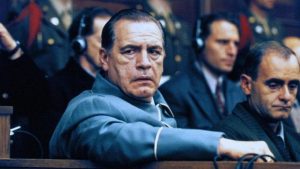
I played [Nazi Hermann] Goring in 1999. Goring was a fantastic, fascinating character. He was an anglophile, he was a genius; in the air he was, after Von Richtofen, the most decorated member of the German Luftwaffe, and when the first world war ended he flew his squadron into Switzerland, abandoned the planes, and eventually walked back into Germany and then went to Sweden because of the Treaty of Versailles. And again, we don’t realise that the Treaty of Versailles was an awful, punishing thing, and it was actually what led to the rise of Hitler.
So when you play somebody like Goring you realise that it’s a different thing because it’s not heroic in the same way, it’s a man who has a vision of his country trying to survive. Those historical figures, they are products of their time, and I think we understood that more and I think that’s what drama does, and that’s why drama is so important. In the dramatic arts we try to investigate, and when you look at it you start to really understand what the human folly is. That’s why I love my job.
Churchill is in cinemas June 8, 2017.
