


by Sam Addams
A generic talking-head clip and a testimonial that actually moves pipeline are worlds apart, and the difference is the team behind the camera. Every agency promises to “tell your story.” Far fewer have worked inside your industry, and that gap shows on screen.
The ten companies below take very different angles: some live entirely in B2B SaaS, others span dozens of verticals, pricing runs from subscriptions to per-project quotes. Each entry covers what an agency does well, where it falls short, and who it’s really for.
Top 10 best customer testimonial video production companies
| # | Agency | Core focus | Typical timeline | Key differentiator | Best for |
| 1 | Represent Studio | B2B SaaS testimonials and case study videos | 2-3 weeks | Six distinct video formats built around SaaS sales cycles with structured collaboration via Notion and Figma | B2B SaaS teams needing sales-ready testimonial assets |
| 2 | Testimonial Hero | B2B customer testimonials and written case studies | Content delivered in hours for some formats | Global videographer network with flat-rate pricing and no hidden fees | B2B revenue teams wanting turnkey testimonial production at scale |
| 3 | Demo Duck | Animated explainers, live action, mixed media | n.c. | 14 years blending animation and live action for brands like Google and GEICO | Companies needing testimonial videos alongside explainer and campaign content |
| 4 | Blue Carrot | E-learning, explainer videos (2D/3D), interactive content | n.c. | AI-augmented production pipeline covering courses up to 485 lessons in 8 languages | Organisations pairing testimonial content with large-scale training programs |
| 5 | Vidico | SaaS product videos, brand videos, case studies | n.c. | Five offices worldwide, 920+ brands served, subscription model from $5,000/month | Global SaaS and tech brands wanting ongoing video output with rollover budgets |
| 6 | Lemonlight | Full-funnel video strategy and production | Accelerated by AI-powered platform | Crews in 80+ cities with transparent pricing regardless of client size | Brands needing testimonial shoots in multiple locations without sourcing local crews |
| 7 | Thinkmojo | SaaS brand video, product launches, event content | n.c. | Creative strategy shaped by work with Salesforce, Zendesk, and Square | SaaS companies seeking high-concept brand and testimonial video |
| 8 | Superside | Design, branding, video, AI-enhanced creative | n.c. | AI-first subscription model with 800-person creative team and documented 94% ROI over three years | Enterprise teams needing testimonial video as part of a broader creative subscription |
| 9 | Anyway Studio | B2B product videos, tutorials, demos, UGC | Under 10 days for initial delivery | Seven native English-speaking actors, custom branded sets, unlimited revisions | B2B content marketing teams producing weekly video at a steady pace |
| 10 | Flowjam | Animated launch and explainer videos for SaaS | Delivery in weeks | Founder-led studio with full IP transfer, voiceover and music included, no hidden costs | Early-stage startups wanting an affordable animated testimonial or launch video |
1. Represent Studio
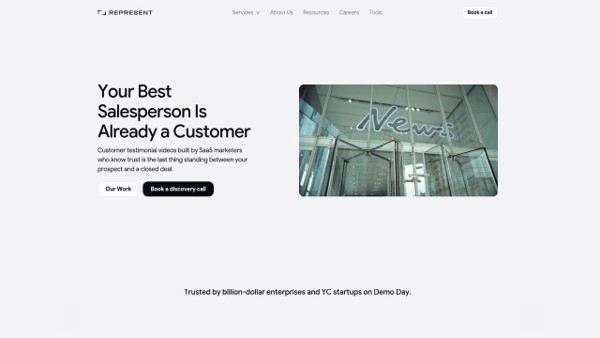
Represent Studio produces customer testimonial and case study videos built specifically for B2B SaaS companies. Founded by Renat, the studio works with billion-dollar enterprises and YC-backed startups alike. Every video is treated as a tool for the sales cycle, not a brand vanity piece.
Most agencies on this list bury testimonials inside a long service menu. Represent Studio did the opposite, building six distinct formats around how SaaS teams actually use video. Landing pages, ABM campaigns, partner announcements, and sales decks each get their own format with tailored duration. A “Story with B Roll” runs 60 to 90 seconds for quick social proof. A “Customer Stories” package delivers up to three videos of 90 to 180 seconds for deeper pipeline influence. And a “Testimonial Series” scales to twelve videos when a company needs a full library.
Production runs through Notion for scripts, Figma for wireframes, and timestamped video feedback, so teams track every iteration without chasing email threads. The studio has captured shoots across four different sets in two days, which matters when your customer’s availability window is tight. No long-term contract is required, and the model sits between hiring a freelancer (cheaper, less strategic) and retaining a large agency (more overhead, slower cycles).
Pros:
- Six video formats mapped to specific SaaS use cases (ABM, landing pages, partner announcements, sales enablement)
- SaaS marketing specialists guide scripting and positioning, not just production
- Structured collaboration tools (Notion, Figma, timestamped feedback) keep review cycles transparent
- No long-term commitment required, with flexible engagement on a per-project basis
Cons:
- Focused on B2B SaaS, so teams outside tech may not find a tailored fit
2. Testimonial Hero
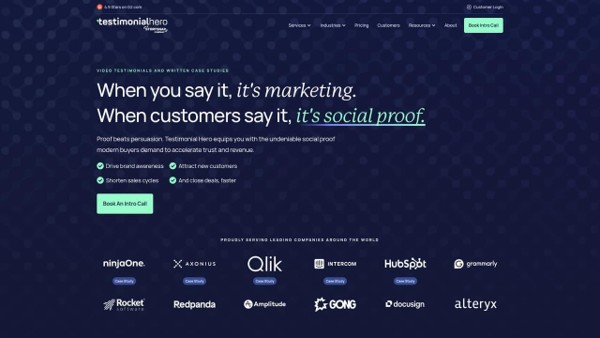
Testimonial Hero works on one thing: turning B2B customer stories into video, written case studies, one-pagers, and sales slides. Instead of keeping a single crew on payroll, the company coordinates a global videographer network and sends local professionals to the customer’s location. That wipes out the travel costs and scheduling headaches of flying a full crew across the country.
Pricing is flat-rate with no hidden fees, a detail worth noting when several competitors here either quote custom or layer in post-production charges. Testimonial Hero also shoots on high-resolution smartphones, cutting equipment overhead while keeping quality consistent. Their creative producers handle scripting, interview prep, and coaching. Some content formats ship in hours, which makes the company one of the fastest options on this list for teams staring down a tight launch window. A 4.9/5 rating on G2 (volume not specified) points to steady satisfaction among B2B revenue teams.
Pros:
- Flat-rate pricing with no post-production surcharges
- Global videographer network eliminates travel costs
- Fast turnaround: some assets delivered within hours
- Produces written case studies and sales collateral alongside video
Cons:
- Relies on smartphone capture, which may not match cinema-grade production expectations
- Less suited for companies wanting highly produced brand films with elaborate sets
3. Demo Duck
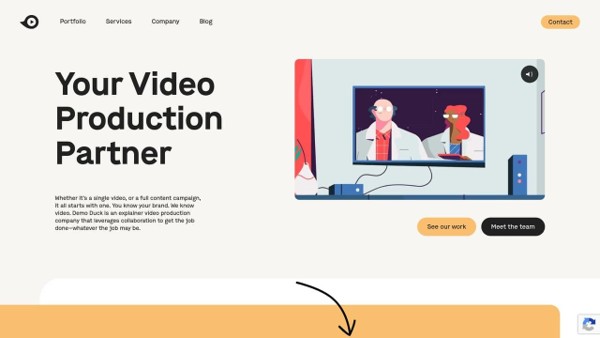
Founded in 2011, Demo Duck built its name in animated explainer videos over more than a decade, but the roster also spans live-action testimonials, docu-style productions, and mixed-media campaigns. The Chicago team keeps designers, directors, and animators under one roof, which gives it a range pure testimonial shops simply don’t have.
Their client list includes GEICO, Google, Rippling, and Northwestern Mutual. That mix of insurance, tech, and fintech shows real versatility across industries. When a testimonial calls for animated overlays, product walkthroughs woven into the interview, or kinetic text to punch up key quotes, Demo Duck does it in-house rather than subcontracting. Each project bends to your brand’s visual identity instead of running through the same template.
The animation-first DNA is what sets them apart here. Most testimonial agencies default to talking heads with B-roll. Demo Duck can blend real customer interviews with motion graphics that explain your product’s technical value, which pays off for companies with complex offerings that need more than one person speaking to camera. In practice, that means a viewer grasps both the emotion and the how-it-works in a single clip.
Pros:
- 14 years of experience across animation, live action, and mixed media
- In-house team of designers, animators, and editors keeps production unified
- Portfolio spanning SaaS, insurance, non-profits, and financial services
- Strong at weaving product demos into testimonial narratives
Cons:
- Not a testimonial-only shop, so the focus is broader than specialists like Testimonial Hero
- No published flat-rate pricing, which makes budgeting harder upfront
- Turnaround timeline is not publicly documented
4. Blue Carrot
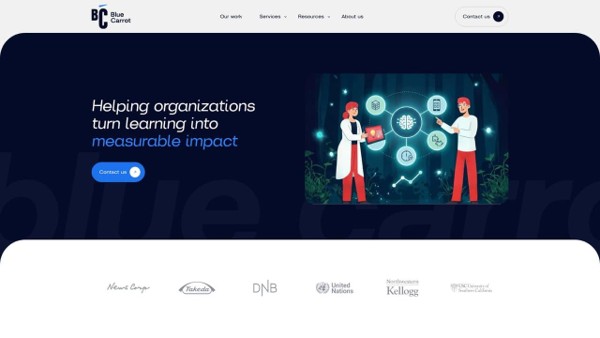
Blue Carrot comes out of the e-learning and training world, which makes it an unusual name on a testimonial video list. The company produces 2D and 3D animated explainers, interactive courses, and synthetic video content for Fortune 500 clients, universities, and organisations with 300+ employees. One of its projects ran to a 485-lesson course translated into eight languages.
Testimonial videos sit inside a broader production suite here, not front and center. Where Blue Carrot pulls ahead is its AI-augmented pipeline: large language models assist instructional design, and generative AI speeds up localisation and production. Every published client review shows a 5/5 rating, though the total review count isn’t specified.
Here’s what that changes for you. If you need customer testimonials next to onboarding videos, product training, or compliance content, one team handles the whole stack, and your visual voice stays consistent across all of it. The consultative model includes a pricing calculator and free initial consultation, which lowers the barrier for scoping large projects.
Pros:
- AI-enhanced production speeds up localisation and content creation
- End-to-end capability from scriptwriting through interactive course development
- Experience with complex, multi-language projects at enterprise scale
Cons:
- Testimonial video is a secondary service, not the core offering
- Stronger in animation and e-learning than in live-action interview formats
5. Vidico
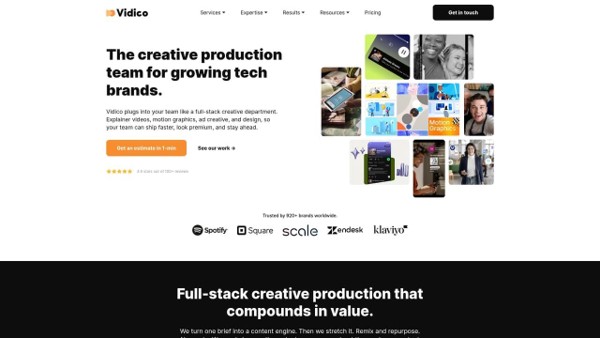
Vidico operates from Melbourne, Sydney, New York, Dubai, and Singapore, one of the widest geographic footprints on this list. Over eleven years, it has run campaigns for 920+ brands and generated over 1.5 billion views, per its own figures. The client roster includes Spotify, Square, IBM, and Airtable.
The model itself is what stands out: a monthly subscription starting at $5,000, with unused budget rolling over. That structure suits SaaS and tech companies producing video continuously rather than one-off. Vidico handles both live-action and animation in-house, and localises content for 200+ regions in 17 languages. The team positions itself as an extension of your marketing department, not an outside vendor you brief and forget.
Case study videos share the lineup with explainers, product videos, social media cuts, and ad creative. It’s a generalist model at scale, not a boutique testimonial shop. The upside: you can start with a testimonial and expand into launch videos or paid ad assets without switching partners.
Pros:
- Five global offices enable local production across multiple continents
- Subscription model from $5,000/month with rollover on unused budget
- Content localised for 200+ regions in 17 languages
- Dual live-action and animation capability under one roof
Cons:
- The $5,000/month minimum is the highest entry point in this selection
- A generalist video agency, so testimonials receive the same pipeline as product and ad content
- With 920+ brands claimed, individual attention may vary at peak capacity
6. Lemonlight
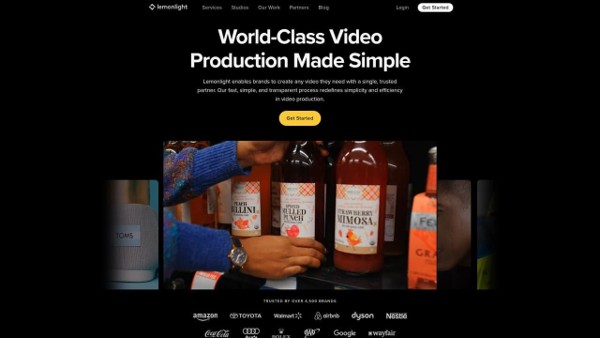
Lemonlight covers more industries than anyone else here. Retail, biotech, education, automotive, real estate, food: the agency works across thirteen named verticals and has served over 4,000 clients, including Disney, Amazon, and Google. Founded by Hope Horner in 2014, it runs an in-house studio in Inglewood, California, and coordinates crews in 80+ cities worldwide.
The production flow bundles strategy, scripting, casting, filming, and editing into a single project. An AI-integrated platform reportedly trims the production timeline by about 40%, which lands Lemonlight among the faster full-service options here. Pricing holds steady whether you’re a startup or an enterprise, a transparency stance that contrasts with agencies adjusting quotes to perceived budget.
What this changes for you: logistics stop being your problem. Book one testimonial or commission hundreds through the same system, and the crews are already in the cities you need. The tradeoff is that a scale-oriented model can feel less hands-on than a smaller, specialised studio.
Pros:
- Crews in 80+ cities solve multi-location testimonial logistics
- AI-powered platform accelerates production by a claimed 40%
- Transparent, consistent pricing regardless of company size
- Full strategy-to-edit pipeline handled internally
Cons:
- Breadth across 13 verticals means less sector-specific expertise than SaaS-focused studios
- The scale-first model may feel less personalised for boutique projects
- Based primarily in the US; international production details are less documented
7. Thinkmojo
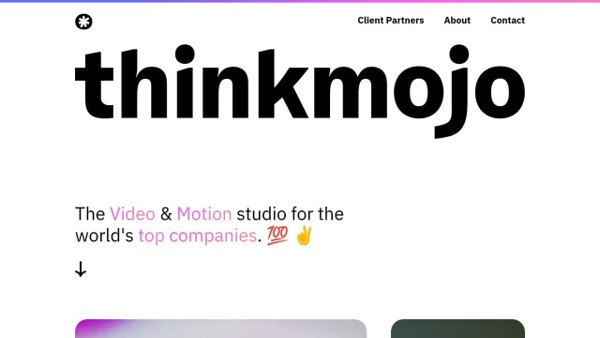
Thinkmojo built its name producing video for SaaS brands like Salesforce, Zendesk, and Square. The studio sits where creative storytelling meets commercial strategy, turning abstract product value into content people actually share. That share-ability is the real payoff, since a testimonial that circulates does more work than one that just lives on a landing page.
Compared with the production-first agencies here, Thinkmojo leans hard into creative direction. The team studies what has worked before, from past campaigns and industry benchmarks, then builds concepts around those patterns. You get polished, high-concept videos, but you also have to trust the creative process and invest in pre-production thinking upfront.
Its offerings span product explainers, launch videos, event content, and brand activation, alongside testimonial work. The portfolio skews toward visually ambitious projects. There’s less public detail on pricing, turnaround, or package structures than you’ll find with subscription-based competitors like Vidico or Superside.
Pros:
- Proven track record with major SaaS brands (Salesforce, Zendesk, Square)
- Strong creative-strategy blend that goes beyond basic production
- Experience turning complex SaaS products into shareable visual stories
Cons:
- Limited public information on pricing and timelines
- Portfolio emphasises brand and launch video more than pure customer testimonials
- Smaller operation with fewer documented details on team size and capacity
8. Superside
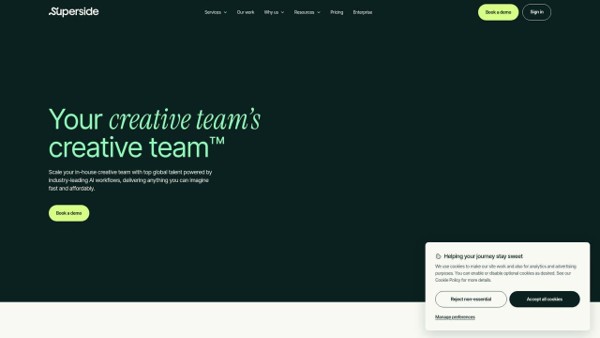
Superside is not a video production company in the traditional sense. It’s an AI-first creative platform offering design, branding, video, and marketing content through a subscription. The company employs 800 creatives recruited from top agencies and brands, and has delivered over 40,000 projects. Testimonial video is one service inside a much larger creative operation.
The subscription lets teams scale resources up or down month to month. Superside’s proprietary platform, Superspace, centralises briefs, feedback, and deliverables in one place, and plugs into Jira, Asana, Monday.com, and Slack. The company reports a 94% ROI over three years with a six-month payback period, per its own documentation.
For enterprise teams already spending on design and branding, folding testimonial video into an existing Superside subscription consolidates vendors and one invoice replaces several. The catch: you’re working with a large distributed team, not a dedicated video producer who knows your product inside out. Efficiency gains of roughly 35% are claimed from AI-enhanced workflows at every production stage.
Pros:
- 800-person creative team covers design, branding, and video in a single subscription
- Superspace platform integrates with project management tools you already use
- AI workflows at every stage claim ~35% efficiency improvement
- Flexible monthly subscription adjusts to shifting creative needs
Cons:
- Video is a subset of a broader service, not the primary focus
- Distributed team model means less continuity than a dedicated studio
- The enterprise-grade model can feel oversized for a single testimonial project
9. Anyway Studio
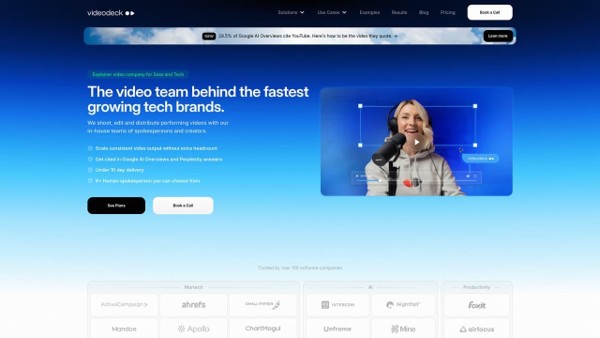
Anyway Studio (formerly Videodek) runs a model built around speed and consistency: videos delivered in under ten days, a roster of seven native English-speaking actors, and custom-branded sets with personalised props. The studio doesn’t use AI-generated presenters, a point it stresses for teams that value human authenticity on screen.
Monthly packs let unused videos roll over for up to three months, and output ramps to about one video per week after the first month, per the studio. Revision rounds run unlimited until you’re happy. Beyond core production, add-ons cover graphic design, YouTube SEO optimisation (A/B testing titles and thumbnails), and repurposing long-form content like webinars into shorter cuts.
Its model works like a content engine rather than a bespoke production house. You trade cinematic flexibility for a predictable cadence, which is exactly what B2B content marketing teams want when they publish on a weekly schedule instead of shipping one flagship piece per quarter.
Pros:
- Under 10 days for initial delivery, scaling to weekly output
- Seven native English-speaking actors with custom branded sets
- Unlimited revisions and full usage rights included
- Unused videos roll over for three months
Cons:
- Relies on a fixed actor pool, limiting on-screen variety over time
- Geared toward presenter-led B2B content, less toward customer interview-style testimonials
- YouTube optimisation and distribution add-ons carry additional costs
10. Flowjam
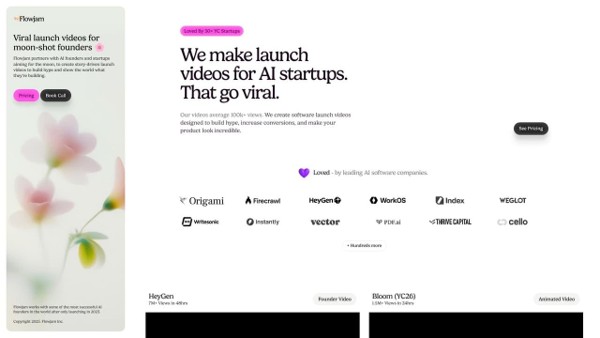
Flowjam is a founder-led studio run by Adam, who previously built and sold Zaap.ai. That startup background shapes everything: lean pricing, full IP transfer, and a process stripped of agency overhead. The studio focuses on animated videos for SaaS and AI companies, covering scriptwriting, storyboarding, animation, voiceover, and background music in one package.
Delivery lands in weeks, not months. Revisions are unlimited, and voiceover plus music come included at no surcharge, which kills the line-item surprises common with bigger agencies. Flowjam works mostly with early-stage startups, including YC-backed founders, and offers multiple script tone options so the final cut matches your brand voice.
Among this selection, Flowjam is the most affordable and focused option for animated content. It doesn’t shoot live-action footage, so real customer interviews fall outside its scope. But for a startup that needs an animated testimonial or launch video explaining how a customer uses the product, the studio delivers at a fraction of agency cost.
Pros:
- Full IP ownership transferred with no hidden licensing fees
- Voiceover, music, and scriptwriting included in every package
- Founder with direct startup experience (Zaap.ai exit)
- Unlimited revisions until the video meets your standards
Cons:
- Animation only, so live-action customer interviews are not available
- Small, founder-led team may have limited capacity during busy periods
- Less suited for enterprises needing multi-format testimonial libraries
FAQ
How much does a professional testimonial video cost?
Professional testimonial videos run from a few thousand dollars per piece to well over $15,000, depending on production complexity. Studios like Flowjam sit at the lower end for animation, while full-service agencies with multi-city crews charge more.
Subscription models (Vidico from $5,000/month, Superside) spread cost across ongoing output. Always confirm whether scripting, music, and revisions are included or billed separately.
What should you look for in a testimonial video production company?
Start with industry experience: a SaaS-focused studio reads sales cycles differently than one serving retail. Check whether the company handles scripting and strategy or just production.
Ask about revision policies, turnaround timelines, and who owns the final footage. A flat-rate model with clear deliverables beats a vague quote that grows during post-production.
How long does it take to produce a customer testimonial video?
Timelines run from days to several weeks. Anyway Studio delivers initial cuts in under ten days. Testimonial Hero ships some formats in hours. Animation-focused studios like Flowjam deliver in weeks.
Full-service agencies with strategy, scripting, and multi-location shoots typically take four to eight weeks. The biggest variable is usually your customer’s availability for the interview, not the production itself.
Is animation or live action better for testimonial videos?
Live-action interviews carry more emotional weight because viewers see a real person vouch for your product. They work best when your customer is articulate and willing to appear on camera.
Animated testimonials suit cases where the customer prefers anonymity, or when the product’s value is technical and benefits from visual explanation. Several companies here, like Demo Duck, blend both.
How many testimonial videos does a company typically need?
Most B2B teams start with two to three videos targeting their top customer segments or use cases. A single testimonial rarely covers enough ground for different buyer personas and funnel stages.
Companies with mature programs keep libraries of ten or more, refreshing them quarterly. Represent Studio’s Testimonial Series format scales up to twelve videos, and subscription-based agencies like Vidico support ongoing production.
