



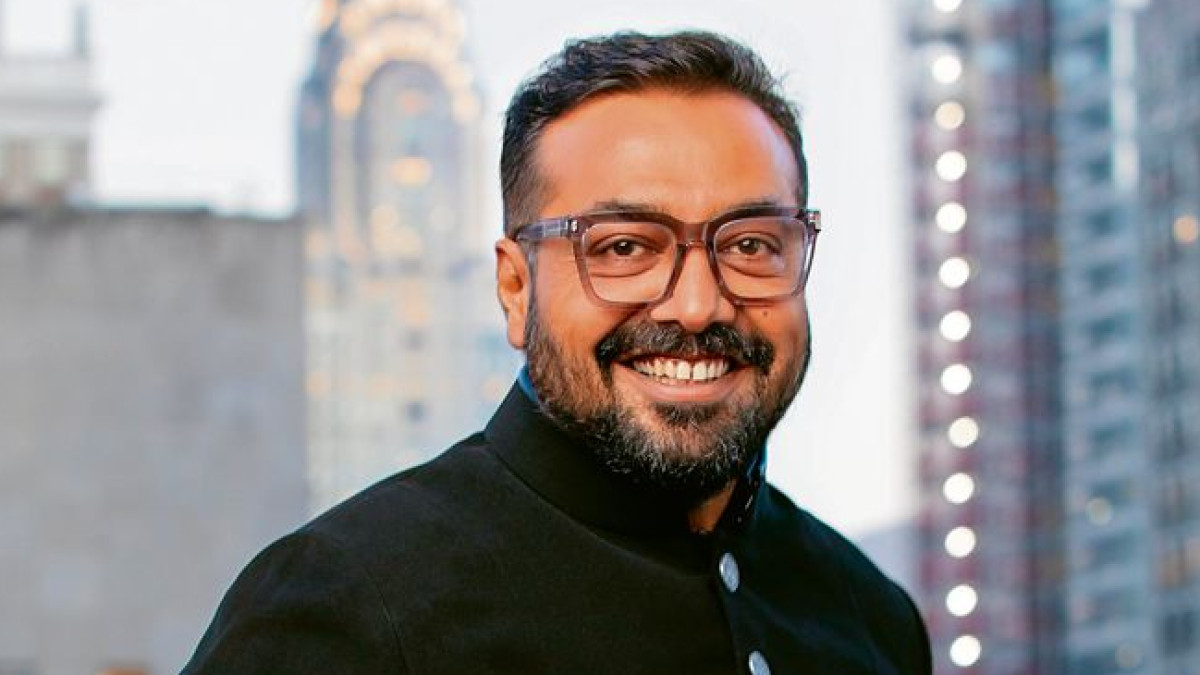
by Abhi Parasher
For non-Hindi speakers, the above piece of dialogue from the movie AK vs AK translates to ‘Sir, I only have one religion. Cinema. I will live for it and die for it’.
The mockumentary stars Bollywood superstar Anil Kapoor as one AK and Anurag Kashyap, India’s maverick filmmaker, as the other AK.
Although the film isn’t directed by Kashyap, it is one of the many films he has had a hand in writing, and one of the very few he has a significant acting role in.
In AK vs AK, Kashyap plays a heightened version of himself; a director who will stop at nothing to create a masterpiece of realist cinema. Despite playing a fictional caricature, it wouldn’t be a stretch to consider this line straight from the heart of the auteur himself.
With 27 films worth of directorial experience and a lifetime of cinema love, Kashyap has been deemed worthy to sit on many film festival juries such as Venice and Sundance. This year, he was given the esteemed honour of being Jury President at the 70th Sydney Film Festival.
A conversation with the filmmaker makes it clear that cinema is an art form that Kashyap has dedicated his life to. With a career that has traversed through many ups and downs, he finds himself with a coveted title that he may cringe at: A Master of Indian Cinema.
Anurag Kashyap was born an outsider to an industry that so often gets slack for its nepotism.
After being exposed to the works of Vittorio De Sica, he moved to Mumbai, the hub of the Indian film industry. As his savings ran out, Kashyap found himself sleeping on park benches and under water tanks, determined not to settle for anything less than his dream.
Luckily, he soon found his footing at the famed Prithvi Theatre in Mumbai and began working his way up in an industry that was a far cry from the neo-realist Italian cinema that first inspired him.
“Hindi cinema is extremely self-sufficient, in the sense that it doesn’t need endorsement or money from outside to sustain itself,” says Kashyap when we speak during his Sydney Film Festival tenure.
This is both good and bad according to the auteur. “It’s good because we can make a lot of money ourselves and therefore make a lot of films. It is bad because, with that, we don’t grow.”
Kashyap first established himself in the industry as a thought-provoking writer, getting his big break as a co-writer on Satya for director Raj Gopal Verma, a master himself.
He went on to write and direct his first feature film Paanch, which went unreleased due to the Central Board of Film Certification objecting to the film’s violence.
“I want to watch a certain type of film and I want to make a certain type of film. It becomes my responsibility to do that and find my audience,” Kashyap says. “No one owes it to me to watch my films.”
Kashyap persevered through many obstacles and setbacks as he continued to write dialogue for films such as Paisa Vasool (2004) and Main Aisa Hi Hoon (2005), before finally making his first released film, the critically acclaimed Black Friday about the 1993 Mumbai bombings.
It is an origin story that perhaps inspired another line uttered by his alter ego in AK vs AK.
“How would I have survived in this industry if I wasn’t crazy.”
Not only has Kashyap survived in a ruthless industry. He has thrived.
Roger Ebert, the famed film critic even stated that Gangs of Wasseypur, Kashyap’s masterpiece should be ‘worthy of discussion alongside Coppola’s first two Godfather films, or Leone’s Once Upon a Time in America’.
To be mentioned along with the greats listed by Ebert speaks volumes about the filmmaker. Both in the respect that he commands as a storyteller, but also, for those who aren’t privy to Kashyap’s work, it speaks to the stories he chooses to tell.
“I grew up in India and that is where my stories are from,” he explains.
With an aim to tell truthful stories, Kashyap is often torn by the depiction of violent themes in his films, which he has stated “could make me faint”.
Earlier on in his career, the filmmaker opted to keep the violence off-screen, which perhaps made the sequences that much more horrifying.
“People’s imaginations are far crueller than what you could show on screen,” he says.
However, with the aforementioned seminal Gangs of Wasseypur, Kashyap decided to depict violence in an upfront and honest manner that results in some of the most cinematic yet chilling moments in cinema history.
“Gangs of Wasseypur was different for me because I found that world farcical and funny. They were gangsters for the heck of it and I wanted to stay with that,” he says. “It is the nature of that film that decided how I shot it, otherwise I like to keep the violence off screen.”
With his new film Kennedy, which had its Australian premiere at this year’s Sydney Film Festival, it seems that the director has found a film that requires the same treatment.
Kennedy follows an insomniac ex-cop looking for redemption.
“The character is someone [Indian filmmaker] Sudhir Mishra used to talk about. He is a real man and apparently, he is still alive and living in Australia as a cattle farmer,” Kashyap laughs.
Kennedy had its world premiere at Cannes Film Festival playing at the prestigious Grand Theatre Lumiere.
“Playing at the Grand Theatre Lumiere was a big, big, big thing. I never thought I would have a film play there.”
It is a humble response from Kashyap who has had three of his previous directorial efforts compete for awards at the festival, along with a slew of films that he is attached to as a writer and/or producer.
Fortunately, it doesn’t seem like Kashyap plans on slowing down. Moreover, we may be seeing the filmmaker traverse into different languages and cultures in the near future.
“I am dabbling with wanting to make films outside, I’m just not sure what I will do,” he Kashyap. “I also have the fear of dabbling in a language I am not familiar with. I’ve seen so many great filmmakers go out and make a film in another language, and it did not turn out as well as the movies they made in their own language and their own culture.”
