



by Julian Wood
The daughter of immigrants, Allison Chhorn was born and raised in Adelaide. Chhorn (the double H is characteristic of Cambodian names) is quietly spoken and contemplative, which suits the style of her film.
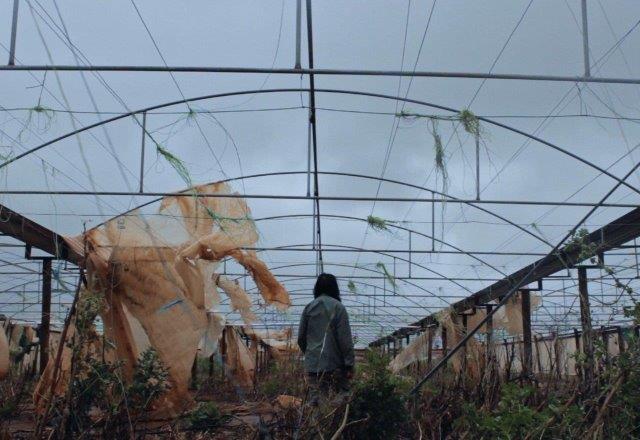
The Plastic House is a film without significant amounts of dialogue or music and it deliberately avoids editorialising the experiences it captures. The focus of the film is the titular plastic house, which is a commercial-sized green house where her recently deceased parents worked tirelessly to grow vegetables.
Chhorn recalls how she worked on the farm during her childhood. Filming the site in a single POV style makes her the centre of the narrative but also allows her to capture something of a child’s eye view. She says she liked the direct and unadorned style of shooting which could be compared in a way to the kind of minimalism that she recalled from Dogme films.
The titular greenhouse is now in a state of disrepair, but the flapping plastic roof and the large empty spaces are also redolent of what it once was and of the memories associated with its glory days.
One of the key emotional themes of the film is memory, which inevitably also contains a sense of loss. Chhorn warms to her theme at this point. She feels that memory is an important part of everyday life.
“In my film there is a sense of yearning. I am not quite sure how to talk about it in a literal sense. It’s elusive.” She tails off, as the film does, to let the silence do the rest.
We agree however, that there is another aspect and that is vital to the role that memory plays in our lives, and that is the fact that when we revisit our memories, we both embellish and consolidate them.
“Memory is a construction. I remember reading that the more you remember a memory the more you change it and then it moves away from what it was too.”
So, to remember something, or someone, is to memorialise it in our minds and in our hearts.
This is close to why the film was so necessary for her. She remembers her parents working in the greenhouse (it was them that dubbed it the plastic house), and she could conjure them when she filmed there.
As the film is so sparse in one way, and so deliberately paced, it does demand something from the viewer, but Chhorn has been heartened by the reactions she had from people after the festival circuit screenings.
“It appeals to certain viewers. People have said they are so moved by it. They bring their own experience of loss or grief to it.”
At 46 minutes the film is unusual in another way. Is it a long short or a short feature? Is that too, part of the liminal space it occupies? FilmInk wondered how the director decided upon that length. She says that it was not predetermined by anything external, but that she was always thinking of it more as a narrative or a fiction than a straight documentary.
“I did not have a lot of set ups. Making me the centre gave me the structure, and the final shape emerged in the edit. I think it is a mid-length film. If it had been longer it might have been too much. But it needed to be long enough to get the lingering atmosphere across.”
In the end she decided that the film was as long as it needed to be to tell her story, but certainly no longer.
The Plastic House is streaming at the Melbourne International Film Festival until August 23, 2020
