



by Stephen Vagg
Few flops are more notorious than 1963’s Cleopatra, the movie that supposedly destroyed its studio, 20th Century-Fox. Most buffs know the stories – Elizabeth Taylor almost dying during filming in London, the production being shut down and the sacking of director Robert Mamoulian, Joseph L. Mankiewicz hired to “save” the film and developing a drug addiction to get through it, Taylor and Richard Burton having an affair and leaving their respective spouses, Burton’s wife hooking up with Roddy McDowall’s boyfriend, Darryl F. Zanuck coming back to save the movie and studio. Most serious buffs also know that Cleopatra was a hit and didn’t in fact bankrupt the studio – Fox continued along for several more decades until gobbled up by Disney.
Still, there’s no doubt Cleopatra definitely imperilled the studio – its huge cost overruns drove Fox to the brink of bankruptcy, forcing it to sell off its studio space (which became Century City), and resulting in the resignation of studio president Spyros Skouras. But the real problem was all those flops Fox put out during Cleopatra’s production.
So, yes, Cleopatra was a mess for many reasons – it started shooting with a different script, director and star; Mankiewicz wrote “long”; producer Walter Wagner spent too much time rushing around dealing with the hotel room arrangements of the stars instead of nuts and bolts producing.
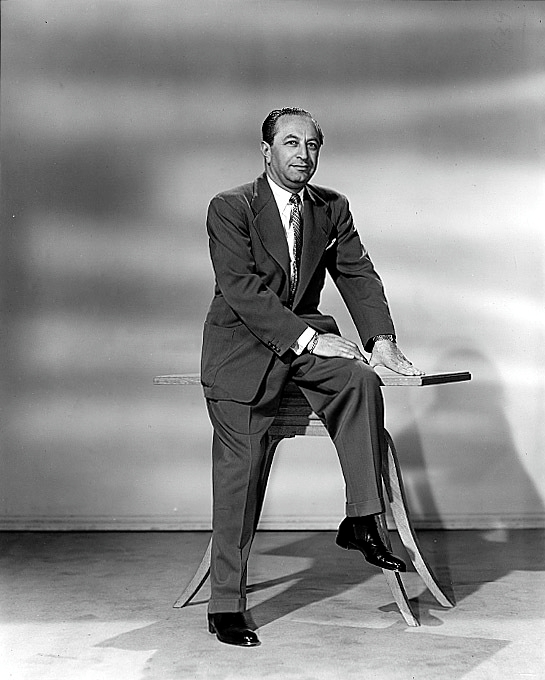 But things needn’t have reached such a critical flashpoint if Fox had put out some decent movies during the shoot. Instead, under heads of production Robert Goldstein (1960-61) [left] and Peter Levathes (1961-62) the studio unleashed flop upon flop and Cleopatra wound up actually saving Fox.
Some background… 20th Century-Fox was formed in 1935, the result of a merger between the large but tottering Fox Studio, and the new independent 20th Century headed by Darryl F. Zanuck. Zanuck was one of the great moguls, running the studio successfully for two decades, in rivalry/tandem with president Spyros Skouras. Then Zanuck had a midlife crisis, quit the job to become an independent producer and hang around Europe with a succession of mistresses (Bella Darvi, Juliette Greco, Irina Demick – you could always tell who they were because he would put them in his films). In 1956, Fox appointed a new head of production, Buddy Adler, with Skouras taking an increasing creative role in the absence of Zanuck.
Adler died of cancer in 1960 and Fox replaced him with Robert Goldstein, a former producer who had been head of Fox’s operations in London. Kind of like a footy coach who takes over mid-season when someone is sacked, Goldstein’s appointment (in July 1960) was couched as “it’s short term but if it works out then maybe it could last longer.” It didn’t work out and Goldstein was sent back to London in mid-1961, replaced by Skouras’ protege, Peter Levathes, former head of Fox’s television division. Levathes hung on for a bit until fired in 1962, when Zanuck returned to run the studio, and appointing his son Richard. (The Zanucks had some excellent years, but Darryl Zanuck would fire his son in 1970 before being fired himself in 1971. Levathes went back to advertising. Goldstein made some more movies as producer.)
Cleopatra was greenlit under Adler, started filming in London under Goldstein, was shut down when Taylor fell ill, started up later in Italy under Levathes, dragged on and was finished and released under Zanuck.
Now, what non-Cleopatra films were Fox making/releasing during that time? i.e. The Goldstein-Levathes years?
First of all, we have to acknowledge that ascertaining who exactly gave the greenlight can be tricky. Films take a long time to set up. So, when we say “Goldstein and Levathes greenlit X”, Buddy Adler and especially Skouras may have been involved. There is some guesswork. But we do know what movies the studio actually made and released in that time while it was making Cleopatra.
They fall into the following categories (many of which overlap):
a) British movies
There were financial and talent benefits to filming in London and Fox took advantage: Sons and Lovers, Oscar Wilde (the Robert Morley one not the Peter Finch one), The Millionairess, Circle of Deception, The Mark, The Queen’s Guard, The Inspector, the first version of Cleopatra.
Fox’s British record is… okay. There were some highs like Sons and Lovers and The Millionairess (both hits) but some turkeys too, notably The Queen’s Guard, one of those Michael Powell films everyone forgets (the other being Honeymoon).
b) Cheap films from Robert Lippert
Lippert had been making cheap B pictures at Fox since 1956. He was easily the studio’s most prolific filmmaker, churning out cheap pictures – Westerns, kids’ films, war movies. Little-remembered titles like Swinging Along, The Long Rope, The Secret of the Purple Reef, The Little Shepherd of Kingdom Come, Misty, Battle at Bloody Beach, Seven Women from Hell. Richard Chamberlain, Jack Nicholson and George Kennedy turn up in them, but Lippert isn’t as famous as, say, Roger Corman. He did the occasional “A” like The Big Show and The Cabinet of Dr Caligari. These films were fine. The “A”s didn’t do much – it’s interesting that Lippert could never make the leap to “A”s.
NB Sam Katzman also made some cheapies for Fox (Wizard of Baghdad, Pirates of Tortuga).
c) Epics in foreign lands
Fox loved its epics and this continued under Goldstein and Levathes. So, you had: Esther and the King (Italy), The Fiercest Heart (South Africa), Francis of Assisi (Italy), It Happened in Athens (Greece), The 300 Spartans (Greece), Cleopatra (Italy), The Lion (Kenya), Gigot (France), Hemingway’s Adventures of a Young Man (Italy), Sodom and Gomorrah (Morocco).
These films almost all flopped (except, ironically, Cleopatra). Main problem: so many of these movies were made with the studio’s contract talent who were not stars (Joan Collins, Stuart Whitman, Richard Egan).
d) Edgy, sexy dramas
Fox pushed the boundaries with some of its films: Sanctuary, The Hustler, Return to Peyton Place. Most weren’t good.
e) War movies/Westerns
Bread and butter genres. Some were big hits (The Comancheros, The Longest Day), others needless disasters (Marines, Let’s Go, Satan Never Sleeps).
f) Star vehicles for singers
Fox went all-in on these. Elvis Presley (Flaming Star, Wild in the Country), Frankie Vaughan (Let’s Make Love, The Right Approach), Pat Boone (All Hands On Deck), Yves Montand (Let’s Make Love, Sanctuary).
The Elvis movies were among the best he ever did, though not as popular as his Paramount movies. The other films did very badly.
g) Comedies
The Millionairess, Mr Topaze, Mr Hobbs Takes a Vacation, North to Alaska, The Marriage-Go-Round, Swinging Along, Snow White and the Three Stooges, High Time, Bachelor Flat, Gigot.
This was a very mixed record. With the right star, comedies were a treat (Peter Sellers, James Stewart, John Wayne). But there were some disasters – The Marriage-Go-Round, Swinging Along, Snow White and the Three Stooges, Gigot.
h) Darryl F. Zanuck productions
Fox was forced, basically, to greenlight Zanuck’s personal productions. They mostly flopped (Sanctuary, The Big Gamble, Crack in the Mirror) but The Longest Day paid for these. Fox turned down Zanuck’s The Chapman Report which was a hit for Warners.
i) Jerry Wald productions
Wald was a dynamic producer, inspiration for the lead in Budd Schulberg’s novel What Makes Sammy Run? Adler brought him to Fox in 1957, and Wald became their most reliable producer, if erratic. His record under Goldstein and Levathes is mixed: Sons and Lovers, Let’s Make Love, Return to Peyton Place, Wild in the Country, Mr Hobbs Takes a Vacation, Hemingway’s Adventures of a Young Man, The Stripper. Some of these movies are terrible, but Wald always tried for quality. He died in July 1962 only aged 50.
j) Irwin Allen fantasies
Allen was brought to the studio by Buddy Adler, but his work came out after Adler’s death: The Lost World, Voyage to the Bottom of the Sea (film and TV), Five Weeks in a Balloon. This was overall a success, due to Allen going into television. The golden rule of thumb for Allen’s career was this: if he directed, the chance of it being good dropped 50%.
k) Adaptations of novels about men having a midlife crisis
Tender is the Night, Mr Hobbs Takes a Vacation, Return to Peyton Place, Madison Avenue, High Time. The comedies did okay. The dramas did not.
l) Remakes and sequels
There were three main ones: Return to Peyton Place, State Fair, Something’s Gotta Give. Five Weeks in a Balloon was a kind of sequel to Journey to the Centre of the Earth.
The most notorious was the latter, a remake of My Favourite Wife starring Marilyn Monroe. This started filming. Levathes panicked during filming and cancelled it in June 1962. Monroe died in August. Zanuck reactivated the property as Move Over Darling with Doris Day and it was a huge hit. It was a mistake to cancel it. The film couldn’t have cost that much.
The Goldstein-Levathes years also saw the rights purchased for some big later Fox projects: Dr Doolittle, Patton and, most of all, The Sound of Music.
Whew.
So. Anyway. Most of the above movies lost money. It’s actually easier to list the hits. Voyage to the Bottom of the Sea. The Hustler. The John Wayne films. The Comancheros. North to Alaska.
Some films did okay but less than expected – the Elvis movies, Return to Peyton Place. Most of the others lost money. Snow White and the Three Stooges somehow cost $3 million.
The main issue of these Fox films – they consistently demonstrated a lack of skill in making commercial movies. How could they stuff up a remake of State Fair? A sequel to Peyton Place? A Jules Verne adaptation? Bible stories? Elvis Presley vehicles? Pat Boone vehicles?
Fox continued with Buddy Adler’s program of pushing its second-tier stars to public indifference: Richard Beymer, Stuart Whitman, Joan Collins, Bradford Dillman, Frankie Vaughan. It misused its genuine stars – for instance, Elvis Presley in serious dramas as opposed to bright musicals, wrecking the appeal of Pat Boone, a genuine box-office star, through a series of inept movies, and not giving a decent vehicle to Tuesday Weld and Lee Remick.
Fox also miscast directors. Many of them were simply too old (Henry King for Tender is the Night, Leo McCarey in Satan Never Sleeps, Raoul Walsh in Marines, Let’s Go). Or given material that they had no connection with (e.g. Jose Ferrer in State Fair and Return to Peyton Place). Or material that was too dull (e.g. Michael Powell in The Queen’s Guards).
Some good movies snuck through: Sons and Lovers, The Hustler, Flaming Star. The Innocents. The Comancheros.
But these weren’t enough to cover for the dross.
So much dross. Oscar Wilde. Circle of Deception. The Inspector. The Queen’s Guards. Esther and the King. The Fiercest Heart. Francis of Assisi. It Happened in Athens. The 300 Spartans. The Lion. Gigot. Hemingway’s Adventures of a Young Man. Sanctuary. Return to Peyton Place. Marines, Let’s Go. Satan Never Sleeps. Let’s Make Love. The Right Approach. All Hands on Deck. The Marriage-Go-Round. Swinging Along. Snow White and the Three Stooges. The Big Gamble. Crack in the Mirror. Tender is the Night. Madison Avenue.
That’s what almost killed Fox – this dross. Cleopatra (and The Longest Day) saved it.
