



by Anthony Frajman
A fan of David Attenborough since he was a child, Bescoby had read Tim Slessor‘s book, First Overland: London-Singapore by Land Rover, which chronicled a historic 19,000km road trip undertaken in 1955, from the UK to Singapore, commissioned by a young Attenborough for the BBC.
In 2005, Attenborough said in an interview for an anniversary documentary that he believed such a feat couldn’t be repeated, given how the world had changed.
Determined to prove the renowned natural historian wrong, Bescoby intended to recreate the six-month expedition, in the original 1955 Land Rover, nicknamed Oxford.
While originally wanting to do the trip with Slessor, Bescoby had to pivot when the 87-year old fell ill, as seen in the first episode. Still, committed to doing this journey, he decided to bring in Slessor ‘s grandson, to replace him.
Bescoby spoke to FilmInk ahead of the series’ third episode premiere.
The Last Overland recreates a journey that was undertaken nearly 70 years ago. What got you interested in taking this on?
“The Last Overland combined two of my great loves. One is history. That’s always been my passion. And two is a great adventure. The central premise of The Last Overland is recreating this iconic road trip from 1955. Doing that not only allows you to go on an amazing adventure across 23 countries and two continents in a really badly behaved old car, but it also allows you to compare then and now and to explore how much the world has changed in 70 years. The Last Overland allowed me to combine some kind of serious history, with a great emotional adventure, because at the heart of this story, at least at the beginning, was the idea of this great old adventurer going on his last epic journey. And that, for me, in the early stages of this project, was just irresistible.”
How different was the global climate that you travelled through, compared to when the trip was first undertaken in 1955?
“Well, that’s the big question, really. Obviously, there was something wonderful about doing it in the original car because you are as close as possible to what it would feel like to do it in the fifties. The technology is exactly the same. No power steering, no brakes, no gearbox, the whole thing is rattling and falling apart around you. You got a sense of what it felt like to do that. I’ve also written a book to go with this, where I go a lot more into the history than I’m able to in the show. But obviously, there’s the mundane changes in terms of technology, the internet, mobile phones, GPS.
“They were filming on film reel cameras, posting their film reel back from cities around the world and communicating by telegram or letter. Obviously, we were able to take advantage of all the mod cons and all the kind of luxuries.
“Geopolitically, there are three big things that you cannot avoid. One was the banishing of the British Empire. When they were driving through in 1955, the British Empire was still very much an ongoing concern. India had only just become independent. Africa was only just decolonizing. They were driving through Malaya and Singapore, which was still part of the British Empire. Fast forward 65, 70 years, it’s gone. The Soviet Empire, that was this great looming power, they couldn’t go into China and Central Asia, where we ended up going.
“We had this great sort of flip where the Middle East for them was open and accessible, and the Soviet Union was off limits and China. Whereas, fast forward 70 years later, the Middle East is a place of war and conflict, and the Soviet Union has fallen apart. And we can drive through all these kinds of independent states. Back in the fifties, they drove along the Chinese border, but they weren’t able to go in because China was just a sort of basket case with the Civil War. Mao was just getting its feet under the desk. And fast forward, 70 years, you could not ignore China from Singapore all the way through to central Europe. You could feel the presence of China in the space of one human lifetime. The world has changed dramatically.”
You were under physical threat at times during this trip. Can you tell us what that was like?
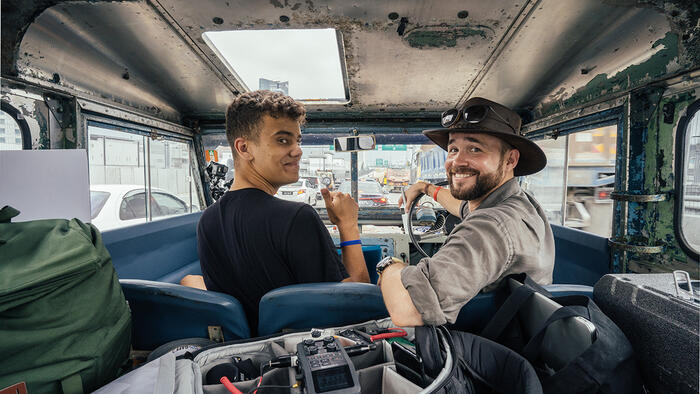
“Not only just from driving a piece of antique technology [laughs] that had a habit of falling apart when we were driving at 60 miles an hour, which it did so spectacularly… There’s certainly two moments that spring to mind, one I think viewers in Australia will already have seen. In episode two, where we ended up in the middle of Nagaland in Northeast India, which has a reputation for hostility. The Nagas had a very long tradition of headhunting, down in Northeast India. It’[s died out now, but there’s still a tense and hostile environment. We ended up right in the middle of a turf war between two neighbouring villages where they’d had a series of tit-for-tat arson attacks on each other’s houses. We ended up driving slap bang in the middle of it. More and more people, lots of them armed, started turning up at the side of the roadblock; that was pretty scary.
“And the second was driving along the Pamir Highway on the Afghan border. We briefly crossed into Afghanistan, when we were told not to. But you’re driving along North Badakhshan, which was then a Taliban stronghold before they recaptured the country. I remember our security, our guide Alex stopping us, saying, ‘just a couple of weeks earlier, some Swedish tourists had been mown down by a Talib.”
Originally, you were going to do the trip from Singapore to London with one of the original crew members, Tim Slessor – what it was it like for you with Tim having to pull out?
“The whole journey really, the whole project came about because Tim had been dying for years to recreate that journey. He was only 22 when he did it the first time. Fast forward 65, 66 years, he’s in his late eighties, he’s running outta time, but he was still willing, still physically able. When I met him, I thought, ‘this is a story that I just can’t get out of. It’s amazing, the momentum is there’. The reason it got off the ground was because Tim was this incredible character, when you see him in episode one and he does come back in episode four, so hang on in there for those who haven’t got to the end of the series yet. It was a huge blow, that on day one, he gets hospitalised. From a filmmaking perspective, we had to throw out our shooting plan out the window. But obviously as people know, there’s a twist, there’s a lovely twist, in his grandson stepping into his place, and in a way that gave the story even more depth than it had before. The grandson relives his grandfather’s amazing journey while his grandfather watches.”
Did it become a slightly different journey for you with his grandson on board?
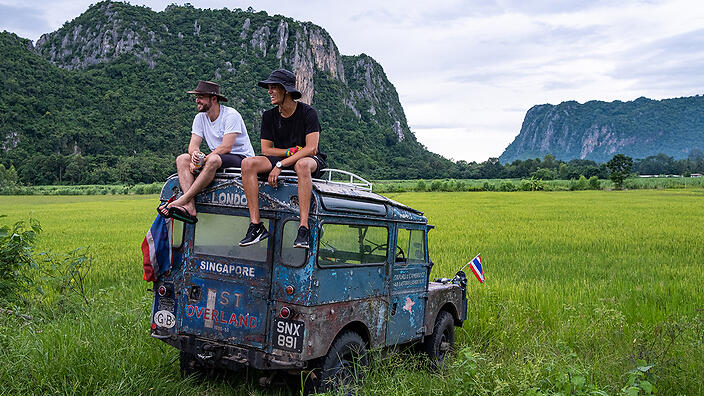
“Yeah, it did. I think because, I’d known Tim for a couple of years in the run up to us setting off, I’d gotten to know him well and obviously I’d read everything he’d written. I think I’d got inside his mind and I was really looking forward to going on this journey and reminiscing, and having that conversation with the man who’d done it before, but actually what happened was, I ended up escorting this complete greenhorn, across the world, on a journey that he never really wanted to do. He certainly didn’t wanna be in a documentary. He had no desire to be front and centre, he’d driven to Newcastle in the north of England. That’s the furthest he’d ever driven. All of a sudden, he’s on an accidental gap year of a lifetime. I think anyone who’s seen the show will realise how lucky we were as a film crew, that he’s such a gem of a character.”
You’ve been to a lot of different countries such as Myanmar. How did this this trip compare and what was your favourite country?
“I lived in Myanmar for the best part of 10 years. It was a very special moment driving back through there because I had lots of friends there and was able to show the crew my sort of my home. Obviously, it’s really bittersweet because shortly after that, they had this brutal coup, which is still tearing the country into pieces. People who are watching episode two and watching Myanmar, that’s the Myanmar that no longer exists, which is incredibly sad. That whole chapter of it was incredibly important to me.
“But the country that I was most blown away or inspired by was China. And not necessarily always in a good way, but just the sheer size of it, the scale of it. Driving on one road for two weeks through Tibet, just driving past Mount Everest, the altitude, the cold, I will never forget that place. Malaysia, the first country we crossed into, absolutely incredible the way they welcomed us, the way that they loved the story before we even got there. And places like Georgia, these little places I might never have gone. There are definitely places I’d love to go back to. I think the one that will always stick with me is probably Turkmenistan. For those who are coming up to episode three, what an absolutely bonkers place that is, and the worst place in the world to have a catastrophic breakdown.”
It took you over a year to prepare for this trip. Can you tell us a bit about what that was like?
“It was probably more like 18 months to get from inception to getting on the road. It was huge. As I said, it was one of those things where I knew it fascinated me as soon as I stepped into the story, this combination of this great old adventurer, the old car, this great journey, but that’s just step one.
“We raised the money to shoot the show, and we got back, and we were still then raising money for the post-production. We were then trying to find a home for it. And then due to Covid, everything went to sleep. So, it wasn’t another 18 months till we got back that we were able to secure the channel and the funding that we’d need to actually edit the thing. I like to say to people, there were two expeditions, there was the one that we did, and then there was a second one which started when we got back, which was how do we get this incredible footage onto TV, and thankfully, Channel Four here in the UK came in and Eone came in with the funding and the channel that we needed. And then, I’m delighted that the second place that it’s gone to is Australia, because Oxford the car is currently in Brisbane. It’s on holiday on the Gold Coast. So, any Australians can go down to Gold Coast and have a look at Oxford if they wanna see what it’s like.”
What was Tim Slessor’s reaction to the series?
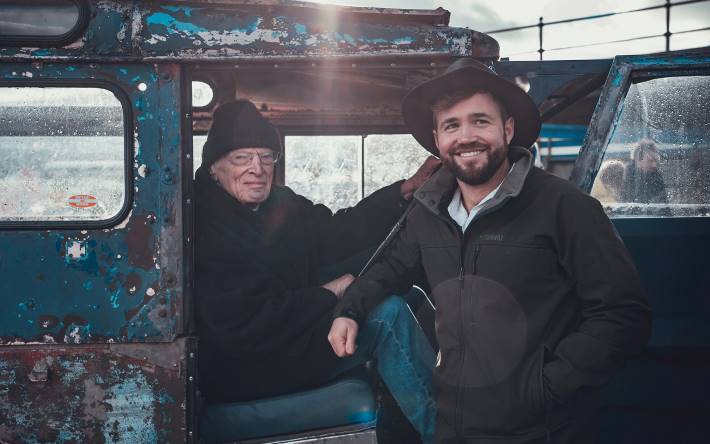
“Tim loves it. He’s a filmmaker himself, he went on have a 30-year career as a documentary maker all around the world. I was a little bit intimidated that I was recreating a project that had been first commissioned by David Attenborough. But he liked the show and I think, for him it was gutting, to fall out of this expedition because he absolutely wanted to do this. He was there. This was his great dream, but I think he began very quickly to realise what a wonderful twist it was and what other grandfather can give their grandson a gift like that?
Will you aim to take on a bigger adventure than The Last Overland for your next trip?
“It’s funny you should say that, we are actually planning something bigger for this year. I’ll leave it at that. But we’re gonna be recreating another great historical expedition over an even greater distance.”
The third episode of The Last Overland: Singapore To London screens Saturday 28 January at 8.30pm on SBS Viceland. Episodes will be available on SBS On Demand through February.
