


by Anthony Frajman
Agnieszka Holland is no stranger to tackling big subjects.
In 2019, she directed the historical thriller Mr. Jones, which followed a Welsh journalist who uncovered the truth about a 1933 man-made famine in Ukraine.
Her last film, Green Border (2023), set at the Polish-Belarusian border, examined the European refugee crisis.
Yet, her latest film, an unconventional, nonlinear study of literary giant, Franz Kafka, may be her most ambitious film yet.
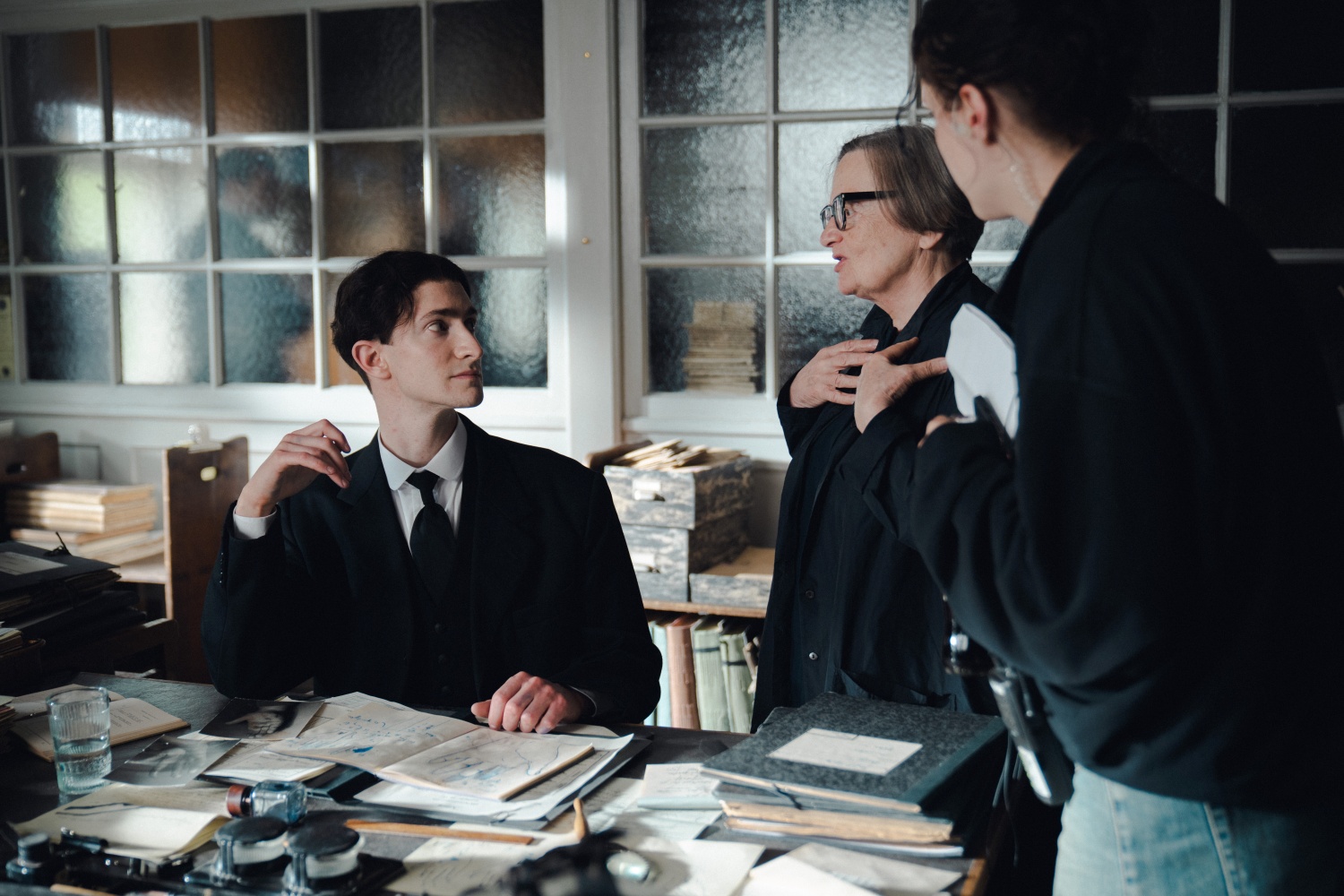
Starring German newcomer Idan Weiss, Franz: Becoming Kafka depicts the life of the author from his teenage years to his death.
For Holland, Kafka has influenced her since she was a teenager. She says she has felt a deep connection with Kafka her whole life.
“I remember quite vividly (reading Kafka as a teen), because I was a passionate reader and I read very early a lot of books, a mix of childrens books and the classical grownup literature,” Holland says.
“And then I read The Trial and it was a shock to me, because it wasn’t fantasy. It was coldly realistic, but at the same time, it showed the world in a totally different dimension, in a different way that I was used to. And it was the total opposite, it was about the human being, but in different way,” she adds.
“After I read everything (of Kafka) which was translated to Polish, I read his letters. And I felt that I know him, I understand him, that he is like someone from my family, a brother. So, it was very personal relationship then. And I decided to go to Prague to study film in Prague film school. And one of the reasons, was that that is the city of Franz Kafka. (I thought) that I could walk in his steps.”
While his name is ubiquitous today, Holland believes Kafka himself is perhaps misunderstood.
“Certainly (there’s) a lot of stereotypes. (And) cliches as well about (the) meaning of what he wrote and also about the man he was,” Holland says.
One of Holland’s major aims on Franz: Becoming Kafka, was to reexamine who Kafka was. “We wanted to look for him underneath the piles and piles of words and interpretations and images,” she says.
Though Franz: Becoming Kafka is a biographical film, Holland acknowledges that it is a subjective depiction of the author.
“It’s our projection. It’s my projection, it’s my vision in the moment when I did it. And what is so fascinating about Franz Kafka, is that (how he is viewed) changes depending on the context of the time and what’s going on in the world in that very moment.”
While many filmmakers may have gone down the standard biopic route, Holland’s film is far from conventional. Avoiding the usual choices, the action often breaks the fourth wall. “Speaking into the camera allowed us to make it in a different way,” says Holland.
The filmmaker says that making a film that didn’t follow the standard biopic rules was crucial from the beginning. “I have problems with biopics, because mostly they are arbitrary. They pretend that they know the truth about the person and their life. And I don’t think that we ever know the truth about somebody’s life. So, through that process and style (of breaking the fourth wall), we wanted to express the impossibility that nothing is exactly as you think it was.”
Holland hopes Franz: Becoming Kafka sparks curiosity in Kafka’s work for those who are unfamiliar. “I am the happiest when I see people who never read Kafka before, young people especially, connect to the film because they relate to his existential angst, and to his feeling that he wants to express something which was not expressed before,” she says.
Franz: Becoming Kafka is in cinemas 21 May 2026
