


by Seth French
The weakest poker scenes in movies are ones that feel too busy. The stare is too hard, the chip shuffle too polished, the silence too dramatic. Real table presence is smaller. It sits in the delayed reaction, the half-second of listening, the way someone waits without looking vacant.
For actors learning poker for roles, the technical rules matter less than behavioural rhythm. Screen performance is shaped by what viewers are guided to notice, and research on audiovisual interpretation shows that small cues can change how audiences read a scene, a character, and the atmosphere around them. A Frontiers in Psychology study on how soundtracks shape what we see explains to us that viewers interpret performance through layered signals, many of them subtle. We can apply that to performances focused on poker.
The Real Table Rhythm Actors Can Study
Tournament formats are useful because they teach patience without dead air. A player is not only “acting” when holding cards. They observe seat changes, pace shifts, opponent habits, chip movement, and the mood of a table after several hands. For an actor, that is a better rehearsal model than copying a famous glare.
An online poker room may offer poker freerolls, which are tournaments with zero buy-in and zero entry fee. These give performers and film fans a clear format reference for how tournament pacing can create repeated decisions, pauses, and resets. Poker freerolls can be helpful for actors who want to improve their familiarity with the game, seeking to make their performance feel more natural. Studied from a performance angle, this kind of tournament environment helps explain why believable poker acting depends on waiting, folding, watching, and returning to neutral. Those small behaviours give a scene texture. They also stop the table from feeling like a prop where everyone is merely waiting for the script’s next big reveal.
For a real-world reference, this short Xuan Liu and Ignition video works as a compact glimpse of a poker expert’s public-facing presence: travel, tournament life, advice, freerolls, and community moments. It gives actors and film fans something useful to notice beyond the hand itself. Liu appears relaxed enough to seem fluent, alert enough to suggest constant reading, and comfortable enough that anyone watching knows she has been doing this for a long time.
The Mistake Is Acting the Hand
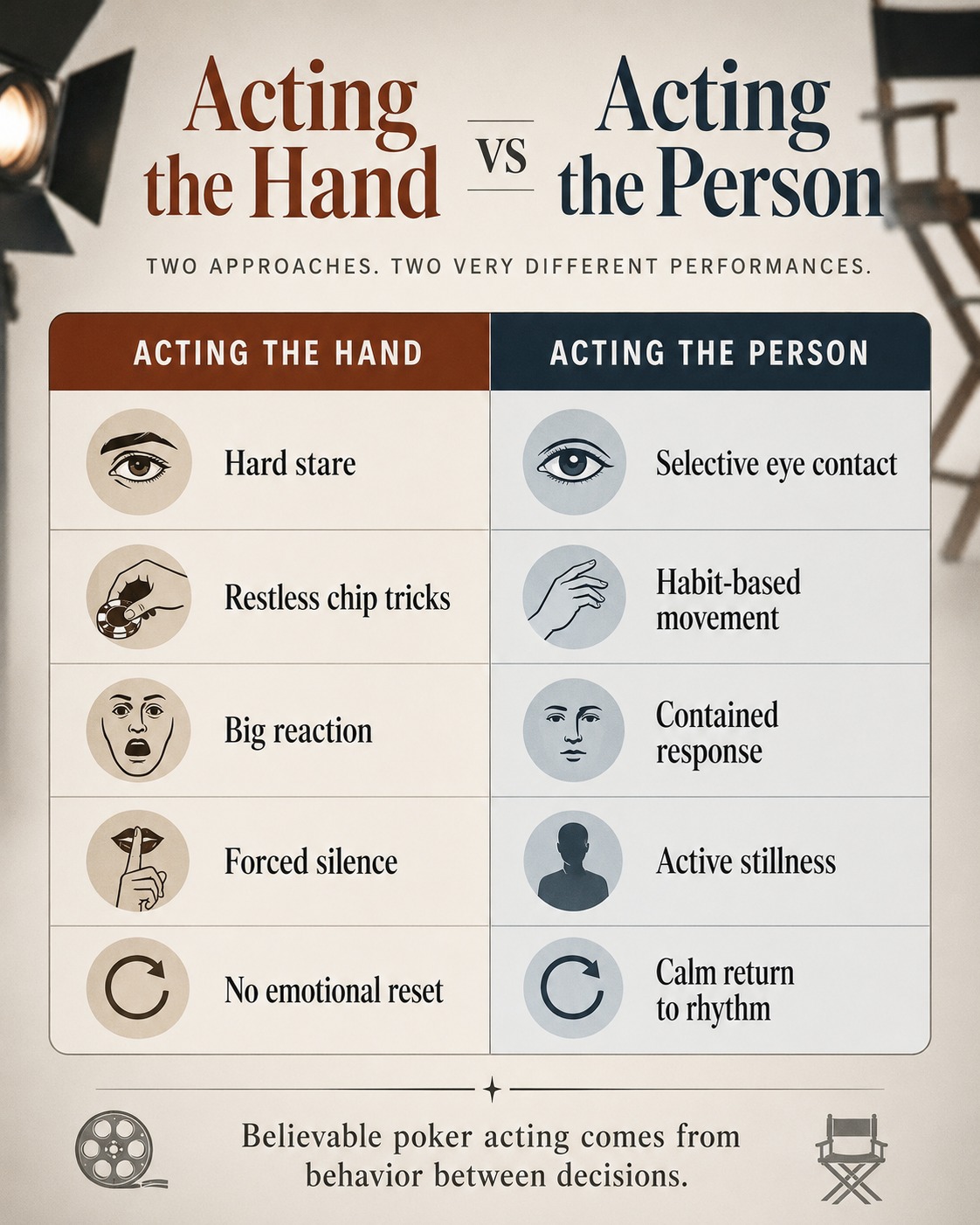
Poker acting goes wrong when the actor performs the cards instead of the character. Strong hand means strong face. Bluff means theatrical stillness. Suspicion means narrowed eyes. Those signals may help a casual viewer follow the story, but they rarely feel authentic.
A more convincing performance starts with the person: what they want, what they are hiding, what kind of pressure they enjoy, and what kind they resent. The cards provide situation. The character provides behaviour.
| Screen Detail | What Weak Acting Does | What Believable Acting Suggests |
| Eye contact | Turns every look into a challenge | Lets watching feel casual, selective, or strategic |
| Hands | Overuses chip tricks and restless movement | Shows habit, restraint, confidence, or impatience |
| Silence | Treats stillness as blankness | Makes stillness feel like active thought inside the scene |
| Reaction | Announces every emotional shift | Lets the audience catch small changes late |
| Recovery | Carries one hand into the next beat | Resets, adapts, and returns to the table rhythm |
The Face Is Only One Instrument
The phrase “poker face” has flattened how people talk about poker performance. It suggests the whole job is hiding emotion. For screen acting, the better question is not whether the character reveals nothing. It is who gets to read what.
The audience may need one signal. The opponent may receive another. The character may believe they are showing even less than they are. That 3-level design is where poker scenes become genuinely cinematic. A performer can hold a neutral face while the shoulders betray fatigue, the timing suggests hesitation, or the voice lands half a beat too quickly.
Directors can support that by resisting the urge to make every poker scene about the final card. The more interesting shot may be the pause before a player answers, the hand that stops moving, or the glance away after hearing a call. Editing matters too. Cut too quickly, and the pressure disappears. Hold too long without behaviour, and the scene turns flat.
Why Good Poker Acting Feels Quietly Physical
Poker is verbal, visual, and physical at once. It asks actors to manage stillness effectively. Sitting upright, looking away, touching chips, breathing before a line, and choosing not to respond can all carry story weight.
That is why the best poker scenes rarely depend on blank faces alone. They are built from controlled traces: a confidence that may be real, a calm that may be practiced, a smile held for one beat too long. The craft is not in pretending to be unreadable. It is in deciding what becomes readable, when, and to whom. That is why performance under pressure is never one simple thing.
Main image source: Original illustration by the author specifically for this article
