


by Dov Kornits
“We were on again, off again, should we or shouldn’t we, and I’m relieved that we’ve waited till now because I think that people are getting used to going back to the cinemas,” says producer Judi Levine about her charming romcom Falling for Figaro, an Australian/Scotland co-production starring Danielle Macdonald, Hugh Skinner and Joanna Lumley, which at one stage may have bypassed cinema release due to the uncertainty of Covid.
“I’m hoping audiences get a sense that this will be something to really enjoy and have a fun night out and go home and maybe they’ll listen to opera for a change.
“If you don’t have Top Gun, Marvel or Lightyear in your title, almost nobody’s going to see these films and yet we need laughter and enjoyment more than ever. Comedies especially, you really do want people to see it with an audience if they can, and if they feel comfortable doing that.”
Can you talk about the genesis of Falling for Figaro? Are you and [co-writer/director] Ben [Lewin] opera buffs?
“Look, not opera buffs. Ben, definitely not an opera buff… I grew up going to the opera, so I was more familiar with it than he was. The project came to us. Phil Wade, who’s the lead producer sent it to me, and I really liked it. It needed some work, but I still felt like here was a story that had a bit of a trifecta about it: it was a romance and then it also had a competition… everyone’s so interested in Australia’s Got Talent, America’s Got Talent. England’s Got… Everybody’s got talent now, apparently. The Voice, and all those sort of singing competition shows are so successful.
“I thought, ‘well, there’s something that rocks people’s boats from an audience point of view’. And then I thought, ‘you’ve got this wonderful dynamic between the three people. You’ve got comedy and romance and competition and all of the things that I thought would make just a lovely entertaining film. I said to Ben, ‘we should do this movie’. At the time, he had his head in some other projects and we had other things going on. I think we were in the middle of doing The Catcher was a Spy. When we finished that film, Ben was like, ‘well, what are we going to do next?’ And I said, ‘let’s do Falling for Figaro. We get to have five months in Scotland and six months in Australia and it’s a wonderful casting opportunity. All you have to do is sit down and fix the script’.
“I managed to seduce him into working on it and once that happened, we went into casting. Phil brought it to us also with most of the finance in place, which was an absolute godsend. It’s not often that you get a project that is already well on its way in that respect. The only piece missing was to have a partnership with somebody in the UK, which was always the intention [the script was originally all set in Australia]. In the end, Phil had gone over to Scotland and then Ben and I went, and we sort of overlapped as he was leaving; we arrived to persuade Creative Scotland to come in with the last piece of the financial pie.

“And we actually went on a bit of a whim, on a wing and a prayer. We met up with Phil in London and he said to me, ‘so when are you and Ben going back to LA?’ [where Levine and Lewin are mostly based] And I said, ‘Phil, we bought one way tickets’. He nearly fell off his chair, but we didn’t have anything else immediately in the pipeline. And I just thought, ‘I’m going to go to Scotland and persuade them, we have to make this movie, we’re ready to do it’.
“I think at that point we may have already had Joanna Lumley on board because we had a connection to her through a close friend of ours who was an opera director. And Joanna’s husband [Stephen Barlow] is an opera conductor and they had worked together. He was able to talk to them as well and say, ‘these people who are making this movie have done it before, they’re experienced, you’ll have fun’.

“It all came together and suddenly there we were in pre-production in Scotland, making a movie. It was a lot of fun, a great experience. Cold, wet, not fabulous from that point of view. Ben slipped and fractured his shoulder, so he directed the last 10 days from the car, which was an interesting way to do it. I think he feels that he might like to direct the next movie from bed. He’d sit in the passenger seat, his script supervisor was sitting behind him, they had a little monitor set up next to the car. I was behind the steering wheel so I could drive him from exterior location to exterior location.
“He could still get around, but it was a little challenging because he’s on crutches [Lewin suffered from Polio at a young age]. So, not having the use of putting pressure on his shoulder was tricky, but the cast would walk up to him if he needed to talk to them instead of him walking to them, that’s all. And you wouldn’t know if I wasn’t babbling on about the fact that he’d broken his shoulder there, you can’t tell that it’s been directed any differently from the rest of the film.”

What was involved in ‘fixing the script’?
“The original script by Allen Palmer was much more of an ensemble about the community in this little village. The opera element of it was a little bit more of a side story. It was the thing that kind of held it together, but it was just more about these characters in this village and some things that were going on in the dynamic amongst them and less also of a romance. We felt that those were two things that actually were the pull of the story, that gave it a little bit of an essence to hook onto.
“And also in the end, so much of financing a film and getting a film made these days is about what it’s always been about, characters. But if you have characters that really attract cast, where they feel that they can sink their teeth into it and do something a bit challenging, that is a big help. It made sense to have those three strong characters driving the plot. So that’s what Ben went in and did. Allen’s original concept of having this young woman who leaves the big city to go to a small town and participate in an opera competition, that basic essence was still there, but that’s how we massaged it in a slightly different direction.”

Can you talk about Danielle Macdonald and the casting? She’s not an archetypal screen heroine. Was that encouraged or was that something you had to fight for?
“I do think that originally the characters were imagined as more of your conventional Anne Hathaway, Ryan Reynolds, perfect Hollywood looking people. I knew Danny’s work from her previous films, Dumplin’ and Patti Cake$. I’d said to Ben, ‘you should look at Danielle Macdonald, she’s terrific’. I showed him those two films and he was immediately won over by her performances as well because she’s so fabulously talented and we’ve always enjoyed casting against type.
“I don’t actually feel like she’s against type. I mean, these days opera singers really do vary. They used to be always perceived as being bigger women, often very tall. You imagined that that’s what contributed to their lung capacity or something…
“But now, there are opera singers who range in all sorts of different sizes, but it was never an issue for me and Ben and our casting director… A lot of people said that Danny would be fantastic for it. We didn’t have to fight for her really, but I know that is still an issue in movie making and I mean there are women in particular, and guys breaking that taboo. It seems to be less of an issue for guys, although a lot of the guys who have been seen to be bigger in their build have worked hard to become smaller in their build. So, everybody has those hangups, especially when you’re on camera. But Danny is incredibly talented.
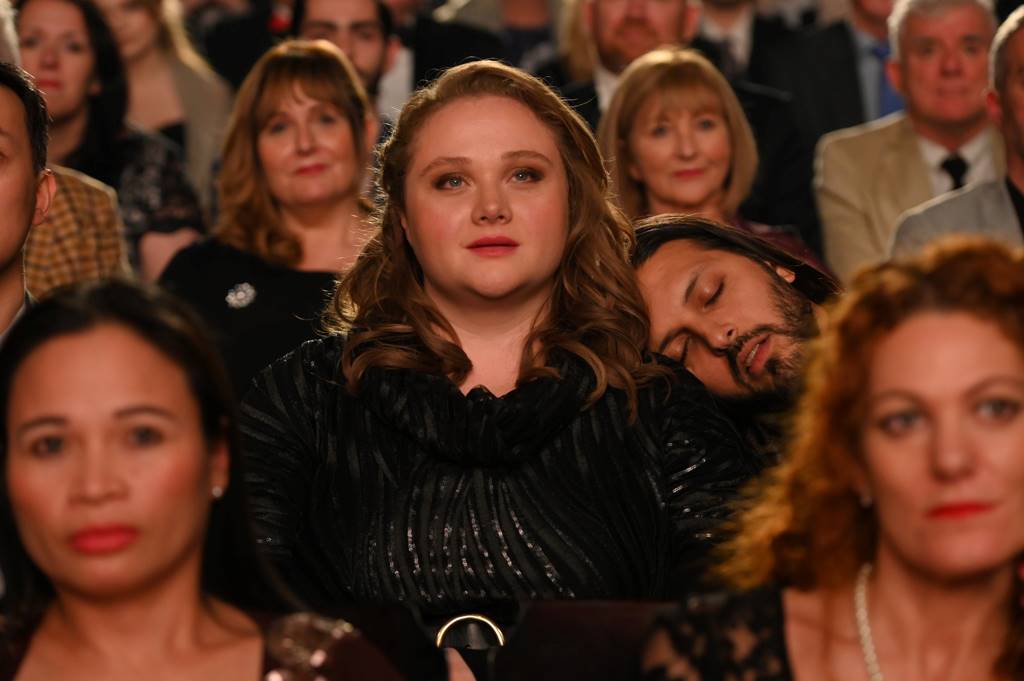
“I really hope that this gives her the opportunity to do more leading roles. This was her first role where she carried the film. I thought when she does those scenes where she’s falling in love with him and he’s falling in love with her, her expressions are just so subtle and yet you can see it, you can see it in her face that it’s all coming. It’s just beautiful.”

Tell us about opera authenticity in the film?
“Originally, there was a conversation that is not untypical when you’ve got a film with music: are you going for an opera singer who can act or an actor who can sing? Or which one is going to be the most important? And for us, I think we felt that having the acting experience and the acting chops was critical and that most likely we would have to massage the singing, which is what we’ve ended up doing.
“While we don’t like to shatter the illusions, the truth is that they’re not their own voices. Hugh [Skinner] was actually a trained singer and an opera singer, he’d wanted to be an opera singer, he sang in opera choruses. But he hadn’t done any opera singing for a long time. So, he wasn’t trained well enough to carry the film. But our singer, Nathan Lay, who is his voice, they have almost identical voices.
“Danny also… it’s strange because she keeps getting all these music films, she played a rapper, she’s played somebody who sings country, now she’s done opera, but she actually can’t sing. Don’t tell anybody! But she knows and admits it. She’s very funny about it because she’s been told by the best of them, by Dolly Parton, not to give up the day job.

“But she is such a disciplined actor and so disciplined in her practice that… she spent two weeks inside a cupboard learning how to do rap [for Patti Cake$]. For Figaro, we had répétiteur, which was a new word in my lexicon…They’re basically people who teach opera singers about some of the specifics, not necessarily the voice so much as the body language and the breathing. They will have a singing teacher [like Lumley’s character in the film] and a répétiteur who will rehearse with them and give them everything else. We had those people set up for her everywhere she was prior to us filming. In Canada when she was doing a film there, with Michelle Pfeiffer [French Exit] and in London before… And in Scotland. And she’d met somebody in LA as well.
“So, she got a lot of support to practice how to convince us that she was really singing, and it is very convincing. We’ve had a number of people in the opera world say it looks completely convincing.”
Falling for Figaro is in cinemas July 14, 2022
