


by FilmInk Staff
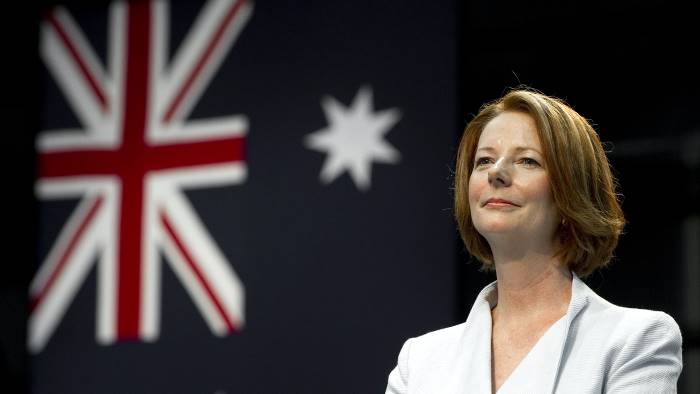
Julia Gillard became Australia’s first female Prime Minister in 2010. Two years later, in October 2012 she delivered an address in Parliament that went around the world. The Misogyny Speech was Prime Minister Gillard’s response to a sustained torrent of abuse and harassment. It’s widely accepted that Gillard’s words that day – angry, eloquent, cutting – have inspired a new generation, now just coming of age.
Strong Female Lead is a feature documentary that, in a way, recovers the story behind the circumstances that fed that speech, a toxic culture not restricted at all to the corridors of power. It’s a riveting film, told using only archival footage and restricting itself exclusively to Gillard’s three years in power. It makes a persuasive case, politics aside, that Gillard was persecuted on the basis of her gender. Surprisingly touching, brilliantly paced and even humorous, it’s a cringe inducing time-travel back to a black period in Australian life when a Prime Minister’s choice of wardrobe was given equal weight to policy. It raises the crucial question – how much has changed?
Produced by Karina Holden (Outback), Strong Female Lead is a finalist in the Documentary Australia Foundation Award for Australian Documentary presented as part of 2021’s Sydney Film Festival.
FilmInk spoke to director Tosca Looby (Magical World of Oz, See What you Made Me Do) and editor Rachel Grierson Johns (See What…Murder in the Outback) about the challenges of making the film.
How did the project start?
TOSCA LOOBY “We were both working at Northern Pictures on different projects. We would get to talking. We were both thinking about a similar [compilation] film. Then when the Final Quarter (Ian Darling, 2019) came out, that really solidified it. That was three years in the career of Adam Goodes and Gillard had three years. We felt that there was enough archive to sell the idea to a network. People still questioned the idea… but the real challenge was giving the narrative an arc.”
What was it about for you both?
RACHEL GRIERSON JOHNS “Well, it’s obviously about sexism and it’s about how sexism is really insidious. There are patterns there that we don’t even recognise. Hopefully, it shows the nature of sexism. How it operates.”
TL “We have only had one female leader as PM. She happened to be a Labor leader. We never meant to do a biopic of Gillard. Our point was, ‘if that’s how the Prime Minister can be treated, then what about the woman in the street?’”
Reviewing the footage must have been harrowing; there’s a shock jock berating her for being a few minutes late for a radio appearance; there’s the whole episode about porno cartoons circulating, privately, via email, around Parliament House; there’s rumours about Gillard’s partner’s sexuality, and the notorious ‘ Ditch the Witch’…just terrible stuff.
TL “It was really distressing. I spent a lot of time being angry and so did Rachel. We would be zooming – we did a lot of work remotely – and she would be f-ing and blindin’ [laughs] and we were in this echo chamber of f-ing and blindin’ and horror…”
RGJ “[I was in] complete rage.”
Was there a particular moment you found especially incendiary?
RGJ “A lot of it was around Gillard’s relationship with her partner, Tim. That interview when they were sitting there, and the reporter asked whether they love each other. It’s so insulting. You can’t imagine a journalist asking Tony Abbott or Scott Morrison that!”
TL “There was a question [in development] about including too much nasty stuff. The feeling was, ‘it might be repetitive. Will we be able to build story beats into it?’”
Researching the source material itself must have been a challenge?
RGJ “There was over three hundred hours of archival. That’s news, parliamentary archive and radio interviews. I think one thing that surprised us in compressing all that archive footage was that you could see certain patterns of behaviour come to the fore.”
That emerges very powerfully. There is a thread about women being shouted down, talked over by men, across different contexts; another was about what Gillard happen to be wearing…
RGJ “I think [those themes] emerged organically…”
TL “Words like ‘shame’ were picked up [in the media] and weaponised [against Gillard].”
When you see it all mashed up together, all this footage around the same themes but drawn from a long timeline, you realise as a viewer how limited, how narrow, how shallow the media focus was in the Gillard years…
TL “I think in the film when you see Gillard take those questions from [shock jocks] so politely… There’s no way today she would take it. She just wouldn’t stand for it.”
Was there a script?
RGJ “It was a case of discovery. We really didn’t have a script. We had a timeline of events. There were thirty-seven versions of the cut.”
TL “I had a lot of conversations with people who were there [in politics/media] at the time and the moments they remembered. All off the record. They were horrified by [what they experienced.] That was instructive. What I learnt was that there are a lot of people in Parliament with a poor track record with women and the culture is even worse than it appears, and it was not just Gillard. There were stories of gobsmacking disrespect.”
The film is very compelling. It’s a gripping record of a landmark moment in Australian history. Yet, politics is a turn-off for many. How did you deal with that?
TL “We were trying to pitch to people who had no political understanding. Say seventeen-year-olds who were babies at the time…through to political aficionados.”
RGJ “You don’t have to care about politics to get it. We didn’t want much politics in it.”
Julia Gillard delivered the Misogyny Speech almost a decade ago. It made a huge impact. Has much has changed?
TL “Statistically, more women have entered politics globally. But Australia is lagging. We used to rank high in terms of women reps. We have dropped to 50th in terms of women’s participation.”
How do you explain that?
TL “The culture of our parliament is really rotten.”
RGJ “We were cutting it when the Four Corners show on the [culture of sexism in the political bubble in Canberra] aired.”
The original music by Robert Davidson and performed by The Australian Voices and additional music composition by Bronwyn Calcutt, Amara Primero and The DA’s Office…the way that it is used, is really inspired. The choral music where we hear certain naughty words sung in a ‘high-brow’ style is very effective…and funny!
RGJ “[My inspiration] was that I saw this great play in London called Jerry Springer the Opera. I thought it was so hilarious with people singing ‘motherfucking cocksucker’ [Laughs]. I thought ‘maybe we wanted to use a choir to sing the absurdities’ that were used [that we know from the time.]”
Has Julia Gillard seen it?
TL “She put out a public statement where she said, ‘I haven’t seen it and I don’t need to see it because I was there.’ All along she was very cooperative; she is also quite uncomfortable with it. For starters, she ain’t no victim. Having said that, she totally acknowledges [the film] is a very important tool.”
Have the critics – the shock jocks, the columnists and even certain politicians – who were so outspoken about Gillard – seen and or commented on the film?
TL “There haven’t made a peep. On the other hand, a lot of Liberal women have gone on the record to say how we need to tell this piece of history.”
The film ends on a touching note. A woman out front of Parliament holding a sign that says: ‘Thanks Julia’.
RGJ “We showed the earlier cuts to people and that scene wasn’t there…they just wanted to vomit!”
TL “That was a way of saying ‘this is not about discouraging anyone from going into politics’.”
RGJ “We wanted young women to see this and say ‘you know what? I can do this’.”
TL “There are women everywhere who want to support women and support men who want to support women going into parliament. There is a groundswell around the world of women going into politics. We need to have their backs because we can’t let this happen again.”
RGJ “Making it, we were very conscious of the fact that people were going to have very strong opinions about this, so we used stuff from all networks… You know, I watched that speech live… this is definitely about gender.”
Strong Female Lead is screening at the 2021 Sydney Film Festival
