


by Gill Pringle
The success of unique horror movie, Don’t Breathe, propelled co-writer and director Fede Alvarez into the big leagues, handed the purse-strings to direct The Girl in the Spider’s Web as a follow up.
Today, Alvarez returns to the scene of the crime, co-writing and producing Don’t Breathe 2, handing off directing duties to co-writer Rodo Sayagues.
While many horror lovers could easily envision where Don’t Breathe 2 might pick up, then Alvarez and Sayagues choose to keep their audiences guessing, taking an unexpected twist in the continuing saga of Norman Nordstrom, aka “The Blind Man”.
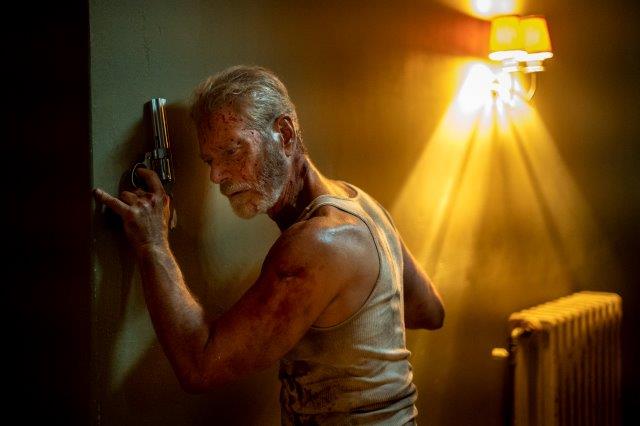
Played once more by Stephen Lang, Norman remains both unlikely hero and villain, a complex character who we don’t quite know whether to root for or revile.
In this sequel, Norman is up to his old tricks again, having kidnapped a young girl, Phoenix – portrayed by Grey’s Anatomy’s Madelyn Grace – who he is now raising as his own daughter.
We spoke with Fede Alvarez and Rodo Sayagues.
[IF YOU HAVE NOT SEEN DON’T BREATHE, SPOILERS AHEAD]
At the end of the first one, there’s a cliffhanger and a hint that The Blind Man might go for the last survivor who has stolen all his money?
FEDE: We’ve been lucky enough that the couple of horror movies that we made, they did well enough, and people liked them enough to grant a sequel. A lot of times sequels aren’t very good – so we were really trying to put us in a place where not only could it be faithful to the spirit of the first one, so that people feel like it’s from the same universe, but it could also be a stand-alone story that starts from scratch. We felt that was more exciting for us as filmmakers, to go through a bigger challenge of creating a full story. When you do something like this, you want to do something that really requires all your abilities – this is the best we can do when it comes to storytelling. Of course, some people would like us to go on with the obvious story, but we really try hard to not take the easy way.
So, you deliberately avoided the obvious sequel of Norman going after “Rocky” to get his money back?
RODO: Yes, and in the first movie, they kind of make a deal. The Blind Man says, ‘take the money and, in taking the money, you’re not going to say anything about what I’ve done, so you get away with it and I get away with it as well’. It’s kind of like a shared secret. ‘It’s better for both of us to never speak about this – we’ve both got a lot to lose’. That’s kinda the deal, so it would be weird for this guy to, right away, go ‘You know what? I’m gonna find the girl’. It would be risky for him as well.
FEDE: He’s done a lot of horrible things, but it seems like he would have a code so he would honour the deal he made with her. So, the ominous feel of that last shot was, for us, ‘There goes her soul because now she’s taken the money…’ It’s not a happy ending because she didn’t take the honourable route.
In what way are these films allegories for the state of the US and perhaps the state of the world?
FEDE: Yes, that’s why we chose Detroit in a way, because there’s certain parts of Detroit that really represent that decay, and in a way, you could even say that it might represent the future of many other areas just because the car industry at that point fed all that town and the rest of America, so there’s definitely some of that vision. We always knew that the second one was going to be deeper into the woods because he moves – and it’s all based on reality. What you saw in the first movie, we didn’t change any of the landscape; that’s exactly how that street looks like – the house where the story happens is exactly that way. We didn’t manipulate it – so, as far as allegory goes, it was pretty realistic! It’s the way it looks, we didn’t exaggerate it.
And it’s the same with this one. Those areas are being taken back by nature – in a way, the character of Norman is even more isolated from society, so he’s even more pushing away from the urban area, more in the outer rims of Detroit. It’s not that we’re pessimistic, I think we’re just trying to show a face of the country that is not shown in movies a lot.
RODO: For all of the characters in both movies, they are in a way, some kind of outcasts to whom the system has failed them. They’re living outside the system, and they have to come up with their own rules and laws and their own ways to be able to survive in this environment. And we think that represents a dimension of reality for a lot of people, not only in the US but in the whole world; they feel marginalised from a certain system, so it’s just putting the lens on a certain reality – it’s our point of view but also a certain reality, so it does work as an allegory in that regard.
Both the original and the sequel rely heavily on sound effects with very little dialogue. How did you come up with that idea?
RODO: It is definitely unique to these movies, how much the sound is prevalent and the importance it has.
FEDE: It is part of the franchise in a way, because there’s so little dialogue. But, truthfully, as Spanish-speaking people on the first movie, we thought, ‘How can we get away with writing a movie when we barely speak the language?!’ So, we figured out a way where we’d have hardly any dialogue – like five lines in the first movie. We’ve got about ten in this one! The less dialogue, the more silence there is, and silence is a part of this story and the more chance you have to become really attuned with silence, it becomes a sensory experience.
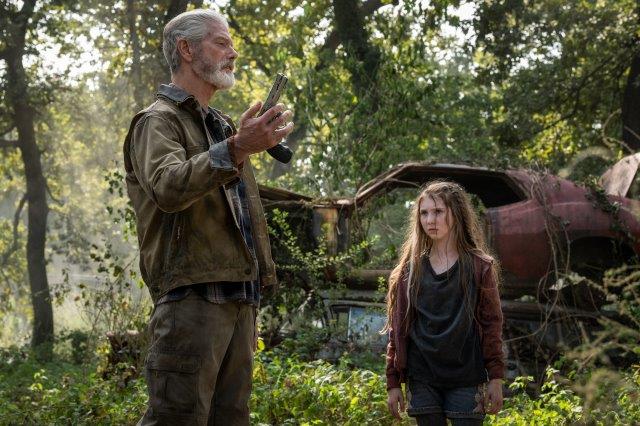
How was it directing 12-year-old Madelyn Grace, who appears throughout most of this horror thriller?
RODO: She’s been acting since she was five, so she’s very much attuned with the process. It really amazed me how professional she is and of course she’s there with her mother and tutor and everybody’s helping, and we make the best possible environment for her to do this. Our job is to make it feel like a game for her – even though the final product in this film looks intense and violent, when you’re shooting, it’s not like that at all and we make it like a game. There are scenes where she’s performing underwater, which I thought were going to be one of the more challenging and she was loving it. She didn’t want to get done with that scene, she kept wanting to keep going and do it again. The key is to make it feel like a game.
FEDE: When kids are involved in these kinds of movies, they’re not witnessing what the audience is when it comes to horror and gore.
RODO: In terms of the dramatic performance, she just killed it every day. She’s just a kid and having fun and talking to everyone on set and then when it comes to work and we call action, she transforms in a split second, and she just does everything that needs to be done in such a talented and deep and connected way. We were very pleased with her talent and performance, and she has an amazing future in this industry.
Was it tough to pass the director baton to Rodo? Like letting go of your baby?
FEDE: I think it was easy because he did a great job. When I decided that I wasn’t going to direct it, we didn’t want to bring any director from the outside who didn’t know the character, and I think the transition from writers into directors is usually a smooth one, better than from other areas sometimes, because a good director has to be a storyteller above all things I think. People sometimes think too much about the technical aspect but you have a great DP on set and a great team of head of departments who will help you with technical but the hardest part is to keep your finger on the pulse of the story as you’re shooting every scene and you’re shooting out of order and you know what story you’re building and that’s why you have to be a great storyteller and this guy here is one of the best storytellers I know. That’s why I trusted him with the movie, and I couldn’t be more proud.
Don’t Breathe 2 is in cinemas from August 26, 2021
