



by Gill Pringle at (virtual) Toronto International Film Festival
“In my defense, I’m allergic to horses. I couldn’t see what I was doing. I was taking Benadryl all the time,” laughs the actor who was so moved by director Ricky Staub’s adaptation of Greg Neri’s novel, he swiftly overcame his equine aversion.
“It goes beyond learning how to ride a horse, because very quickly you have to learn how to have a relationship with the horse. You get assigned a horse and you train and, very quickly, my horse and I had to learn each other’s rhythms and he had to understand my voice,” Elba says when we speak at the Toronto International Film Festival after the film’s premiere.
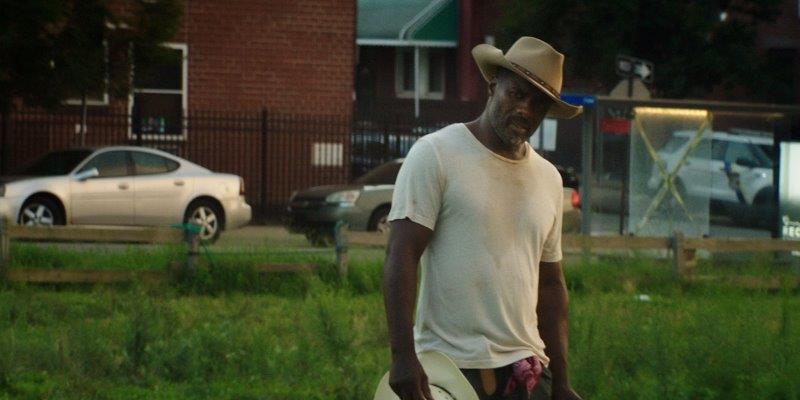
Serving double duties as a co-producer, Concrete Cowboy stars Elba as Harp, a rough-hewn Philadelphia cowboy, opposite Stranger Things’ Caleb McLaughlin in the role of his estranged son, Cole.
A story of family reconciliation, the film also offers a rare glimpse into one of America’s most unique subcultures, the generations-old world of Black horse trainers on the streets of North Philadelphia.
“There’s always a few components in telling a good story – you want to take people into the story and you want to immerse them in the story, but when it comes to family dynamics, each one of us has a very different perspective on the same dynamic. We all have fathers, we all have mothers, but we all have different perspectives on how that story plays out,” says Elba.
“For me, the story between Harp and his boy is unique in filmmaking history, because we see the struggle of a father and son from a very different perspective; we see them come together when they have no choice, and then we see the son become a man and the dad become a father.”
Drawing on experiences with his own late father, he says, “My dad was always in my life and we had a great relationship, except we didn’t talk as much as I would have loved us to.”
Staub’s script would move him to tears. “When I was reading the script, I was in tears because there were moments when I wished I had had those very special delicate moments with my dad. That really is the glue of this film.”
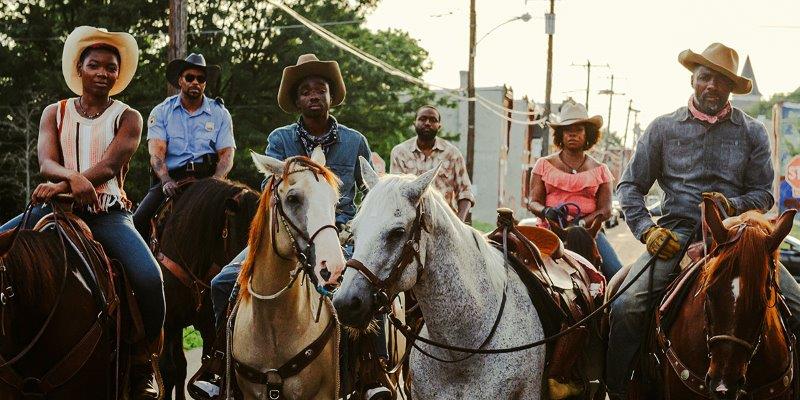
Featuring an all-Black cast, co-producer Lee Daniels [Precious, The Butler] hesitated about signing on when he discovered Staub was white. “Ultimately all my movies are about family and I was blown away by this father and son love story. I had my own issues with my father and it just touched a place in me where I wished that my father and I could have reconciled in the way that these characters do in this film.
“I was also moved by these black cowboys of Philadelphia. What is that about?! But then I was shocked. I’d seen Ricky’s short film [The Cage] but I did not know he was white and I was like, ‘This cat knows how to move a camera, this cat knows how to evoke feeling; he’s a director’. So, I pondered and prayed, and then I was in.”
Based in North Philadelphia, Staub first became aware of the Black cowboy culture back in 2012. “It’s a very striking image to be in the middle of this neighbourhood and see a guy with a horse, a black cowboy, trot down the street,” he recalls.
Lorraine Toussaint relished her role as a horse trainer. “These Black horsewomen are much more glamorous than when you think of prairie women and cow girls. They are gorgeous, they’ve got nails and a lot of bling. There’s a whole subculture of women riders that I learned about and we had several on set, and my character is actually a very real character in the community.
“Like most black women, they carry a lot of the load and they don’t necessarily get the credit, so I love that Ricky wrote these women in a very real and profound way,” she says.
Caleb McLaughlin was in awe of Elba playing his dad. “He’s more than a mentor – he’s like a second dad. Uncle Idris!” he says.
“For me it was almost like my senior year at high school because I was home-schooled most of my life, so being on this set was definitely something where I learned a lot and I’ve grown a lot. I’ve grown into the young man that I am today,” adds McLaughlin.
Even though Concrete Cowboy was made last year, before the pinnacle of awareness surrounding the BLM movement, Elba believes the film is very timely.
“It was incredibly important to us as filmmakers that we tell this story of the fork in the road that you can take as a young man in the US, and what happens on one end of the fork and what happens on the other end.
“As a group, we’ve been talking collectively about how poignant this film is – and particularly that central story line – to this moment right now. I’m hoping as a result, that people will look back at their communities and respect the role that communities play on young men’s lives because oftentimes it takes a village and sometimes, we might stray outside our village.
“It’s interesting right now, because we could not have predicted this. Ricky has been working on this film for four years and America didn’t change overnight, these issues have been going on for a long time.
“Even where I’m from in England, there’s a huge knife crime problem, but we can watch a movie like this and remind ourselves that there are very important lessons to be learned from telling stories like this.
“It really resonated for me. I’m a father of two boys and definitely, I can’t wait for my youngest to see this film,” he says.

” Elba says when we speak at the Toronto International Film Festival after the film’s premiere.”
Calling yourself a writer?
What happened to ” Elba said ” or ” when we spoke ”
And that’s in the beginning I haven’t finished reading the article.
Glad you enjoyed it John