



By Danny Peary
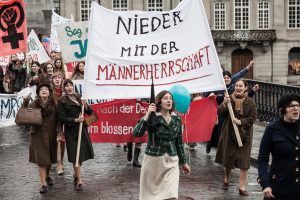
Swiss writer-director Petra Volpe’s The Divine Order, about an oppressed housewife who becomes a suffragette in 1971 Switzerland, won the Audience Award for Best Narrative Feature and its star, Marie Leunberger, was selected Best Actress at the 2017 Tribeca Film Festival.
I don’t think I was fully aware back in 1971 that women in Switzerland were finally given the vote that year. Do young people in your country learn in school that this happened so recently or is it still not considered an important event?
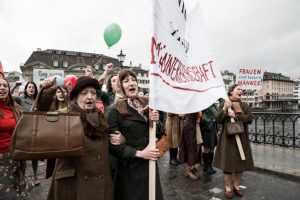
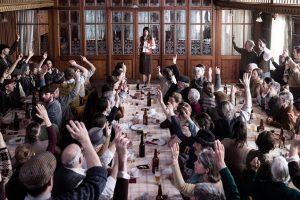
It’s still not important. In the younger generation, some know about women getting the right to vote so late, but they don’t really think about it. It’s general knowledge but there’s a difference between knowing about it and feeling something about it. This movie brings the importance of what happened out there. I didn’t learn anything about this very long struggle by women to gain the right to vote in Switzerland when I was in school. We learned about all the battles the Swiss army fought, on this mountain and that mountain, against the Germans, and so on, but we didn’t learn about women fighting for the right to vote for over a hundred years. It wasn’t that women just sat back and waited until it was given to them, they were really fighting. There was a vivid and very active women’s movement in Switzerland and it was internationally connected, doing a lot of important social and political work. We had a parallel society with the men having all the political and legal rights and the women being ignored.
 Did you have well-known heroes in the suffragette movement?
I did. When I began working on this movie, the first thing I did a lot of research. I read about the American suffragette movement and the women’s movement in America in the seventies. I read Gloria Steinem and Marilyn French. And of course Betty Friedan. She was such a great lady that I had to put her in the movie. And I read about the movement in Switzerland. I interviewed a lot of the women who were fighters and rebels in the movement. For instance, I met Marthe Gosteli who was a major fighter for equal rights and in the eighties began to collect women’s history. She was the first to do it. I found a lot of material in the archives at her foundation. She died recently at age of 100. When I spoke to her she was still so fiery.
You have some archive footage in your movie. Was it emotional seeing it for the first time?
Yes, for me it was so emotional. It was so clear what was going on in America at that time, with the civil rights movement, the anti-war movement, and the women’s liberation movement. These were such big movements. And the entire world was really changing. But Switzerland was in a vacuum and there was such a culture of change-adversity. I really wanted to start with that contrast.
Your film is the first about this subject. Why?
It’s because it’s women’s history. It’s so typical that women’s history and women’s stories are not told. That’s the problem and that’s why we felt there was a necessity to bring this story to the big screen and to the public. It’s not enough that these stories are included in history lessons – and in truth, they usually aren’t there either.
 Why did you decide to make your lead character just an average woman instead of one of your heroes?
It was really important for me to tell the story from the perspective of a woman who goes on a journey and learns something. A woman who is already a women’s liberation rebel doesn’t have a journey anymore. It was also important for me to tell the story from the perspective of somebody who could be anybody. Nora becomes a heroine because she has a very important realisation that the personal is political. I thought that’s something we can relate to – it’s true to her in the past and it can be true to someone today. It was important that this was the story of someone like my mother. Nora’s a normal person from within society who goes on this journey and takes us with her, and through her we are inspired to have civil courage and to fight for justice, equality, and all things we believe in.
At the beginning of the movie, Nora, played so well by Marie Leuenberger, sends her husband Hans [Max Simonischek] to work and their two young boys to school and then does hours of housework, as she does every day. Is she already thinking that she must change her life?
No. I don’t think she is consciously unhappy. I think that’s something a lot of people can relate to. She’s a woman of her time. Maybe subconsciously she wants something more in life.
I think we sense that when she takes “liberating” bike rides in the countryside.
Yes. But, again, it is on a very subconscious level. That’s why when a suffragette approaches her and says the right-to-vote movement is fighting for the liberation of women, Nora says, ‘I don’t feel unfree.’ Of course, her intuition is something else – and she has deeper needs.
 Did Marie Leuenberger know the story portrayed in your film?
She knew about as little as I did. Marie knew that Swiss women got the vote so late but not the story. So I sent her a ton of my research material. My actors and my whole team had to catch up on that history. We started to feel something about it. We started to see the dimension of it, what it meant that women weren’t allowed to vote and that the country’s marital laws were completely against women getting jobs or owning property. A woman couldn’t work without the permission of her husband, she couldn’t open a bank account. Those marital laws began to change only after women got the right to vote and voted for new laws. It took many more years, until 1988. Women were treated like children, like second-class citizens. Switzerland has always boasted that it is the oldest democracy, but it wasn’t a true democracy until 1971.
Did Marie audition, competing with others for the part?
I actually cast another actress. But she got pregnant shortly before we started shooting. I was devastated. Then I did a recast and Marie came in and I knew I was getting a present from the universe. There is an image of directors shooting everything as planned, but moviemaking is a lot of things going wrong and having to react when it does. That’s also the beauty of our job. Because sometimes we are just lucky, as with Marie. Something unexpected happened and I am happy and grateful.
The title of your movie seems to apply more to the casting of your movie, where things went out of and back into balance, than the actual content of your movie. How do you think your title applies to the film itself?
The title is inspired by a quote that’s in the movie. The film’s antagonist is a middle-aged married woman, Dr. Catherine Wipf [Therese Affolter], Hans’s boss, and everything she says about why women shouldn’t vote was taken from anti-suffrage propaganda of 1971. One thing that was said is: ‘Women in politics is against the divine order.’ That was a very powerful argument because it implied, ‘You’re not going against only men but also against the Divine. God has an order for this world in which women are for the family and dirty politics is only for men. If you disrupt that order, you are disrupting society.’ I’m not exaggerating – in 1971, that was one of the arguments. My title is ironic. It’s actually about women going against the divine order.
I think the theme of your movie is that if women grow, then men grow, too. Everyone benefits.
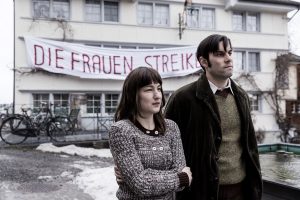
That’s very much the theme of my movie. Equality is good for both sexes. We don’t have to be strictly emotional about this anymore. All data tells us this. The more equal the society, the better for everybody. It’s a very clear statement in the movie that men are also crushed by the ideas of patriarchy and what they have to be as men. It makes them much smaller as individuals. They can’t grow and that makes everyone small. Patriarchy is a prison for men and women. Women’s liberation is everybody’s liberation.
And Nora’s name came from Nora in A Doll’s House?
Definitely. And the sex strike the women go on is a reference to Lysistrata. I borrowed playfully from that because it really fits into this one modern story that shows a whole tapestry of women’s stories – women rising up, women becoming rebels, women breaking out of an oppressive system. So I infused my story with that. The strike was also inspired by something that happened in Switzerland in 1959, when women were denied the right to vote the first time men voted on whether to give it to them or not. Fifty women teachers in Basel girls’ high school in Geneva went on strike. It was a big story and even made the New York Times. When I was doing research, I found all these things and packed them into a story that takes place in three weeks in a metaphorical little village that stands for all Switzerland. I tried to infuse this simple story of a simple housewife becoming a political organiser with all these things I found in the research.
Films have borrowed the sex strike idea from the Greek comedy Lysistrata dating back to at least the 1931 MGM film Politics. In that, Marie Dressler runs for mayor against a corrupt system and all the women who support her stop doing housework and having sex with the men who won’t let them engage in politics.
That’s cool. Unfortunately this story isn’t outdated. We didn’t know how timely this film about women fighting for equality would be when we started working on it five years ago. But there has been the election of Trump and the movements toward the right in Europe – and the Harvey Weinstein scandal. It has become so evident that we haven’t reached gender equality. Our society is sexist and there is gender bias. All of that is boiling up right now, and as I said this film is eerily timely.
Women in your film take ownership of their bodies and even weaponise them. How did the suffragette movement in Switzerland tie into the Sexual Revolution?
Women’s liberation always was also about sexual liberation. They went hand in hand. Because the oppression of women is very much about men controlling our bodies and sexuality. It always has been that women experience the oppression through their bodies. So if you want to make a movie or tell the story of a woman liberating herself and becoming a rebel, you also have to tell the story of how she connects to her body. Because it was a very strong aspect of the women’s liberation movement in America in the seventies, it was for me very important to have it in my story for my Swiss women. It actually did happen. When I did research I had a historic consultant and she said that the younger generation went out on the streets to demonstrate and also went to workshops where they learned to discover their bodies.
People who have protested know about the exciting adrenaline rush they experience the first time especially, and in your film Theresa, is the one who most comes to understand that protesting can feel good.
Absolutely. I think all the women do. I honestly believe that the movement and rebellion has to be physical. There was so much power in the Women’s March in Washington. People too often click “Like” on Facebook when what they really need to do is take to the streets again.
The Divine Order is in cinemas from March 22, 2018
Read our review here.
