


by Stephen Vagg
The new Netflix mini-series version of East of Eden prompted us to wonder about other James Dean-related IP. Will we soon be given a reboot of Rebel Without a Cause from the POV of Natalie Wood’s character? Or Giant from the POV of Mercedes McCambridge? Is it time for a big-screen version of The Immoralist? And, most of all, what the hell happened to Richard Davalos?
Remember him? Probably not.
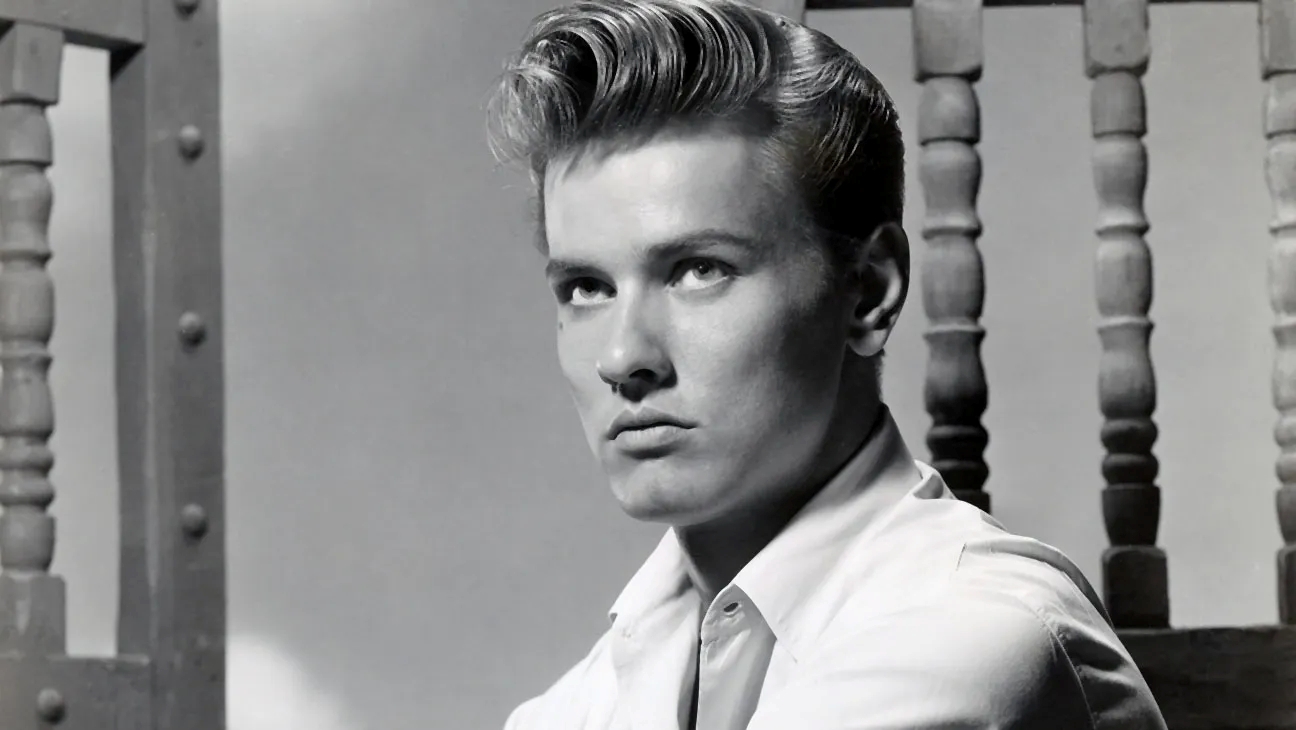
He’s better known as the other young guy who made his feature film debut in the 1955 film of East of Eden – the one who played James Dean’s cuckolded brother. Davalos was cast by director Elia Kazan, a person with an incredible track record of unearthing (or reviving) talent: Marlon Brando, Dean, Warren Beatty, Jack Palance, Eva Marie Saint, Karl Malden, Rod Steiger, Kim Hunter, Carroll Baker, Eli Wallach, Andy Griffith, Lee Remick, Stathis Giallelis. Well maybe not Stathis Giallelis. And not Richard Davalos either. Who was this non-star?
He was born in New York in 1930. After high school, Davalos served in the navy during which time he decided to become an actor. On discharge, he started studying drama at the Herbert Bergamot School where his teachers included the actor Jo Van Fleet. He also studied dancing with Martha Graham, paying the bills via a variety of jobs including as a theatre usher.
In the early 1950s, Davalos began to get roles on TV plays such as Ernie Barger is 50, directed by Delbert Mann, and The Cornered Man with Buster Crabbe. He was still working as an usher when he auditioned for the role of the good brother Aaron in Elia Kazan’s version of East of Eden. Kazan was flying high at the time due to On the Waterfront (1954) and later wrote in his memoirs that getting the green light for Eden was extremely simple – he pitched the idea and budget to Jack Warner, who immediately okayed it, even with Kazan’s desire to cast unknowns in the leads. Davalos and James Dean played the brothers, while other key roles were taken by actors who were slightly well known but in no way film stars: Julie Harris, Raymond Massey, and Jo Van Fleet.
We’re not sure how Davalos came to be cast – presumably every handsome young male at the time auditioned. We’re guessing Jo Van Fleet (who played the boys’ mother) would have had something to do with it. Incidentally, Paul Newman auditioned for the parts of both brothers but didn’t get either. Tab Hunter wrote in his memoirs that Davalos had been the front runner for the role taken by Hunter in Battle Cry (1955), but it is unclear if that happened before or after Davalos’ casting in Eden. Kazan’s memoirs have a long section on casting James Dean but do not mention Davalos at all.
During the shoot, Kazan arranged for Davalos and Dean to room together to improve their performances. It didn’t last, mostly because Dean liked to party whereas Davalos didn’t, and Dean was possibly sexually attracted to Davalos. East of Eden wound up being completely stolen by Dean, who admittedly had the much better part – it is interesting to imagine how Paul Newman would have done in Davalos’ role. Still, Davalos was effective, he and Dean had incredible chemistry, and the movie was a monster hit.
Warner Bros had signed both Dean and Davalos to a long-term contract. Dean went into other lead roles – Rebel without a Cause and Giant. Warners put Davalos to work in some other pictures, although they weren’t great parts, well down the cast list: as a German sailor in John-Wayne-as-a-Good-German thriller The Sea Chase (1955) (Tab Hunter was in this as well) and in the Jack Palance vehicle I Died a Thousand Times (1955).
Davalos went back to New York and appeared on Broadway in a double bill of Arthur Miller’s View from the Bridge and A Memory of Two Mondays, starring Van Heflin, directed by Martin Ritt. View cast him as another brother – this time, he got the girl but he was again outshone by the actor playing his sibling (Jack Warden). During the play’s run, Davalos was having dinner with Dean’s co-stars from Rebel without a Cause, Natalie Wood, Sal Mineo and Nick Adams, when they heard Dean died in a car accident.
Following this, Davalos did a lot of anthology television and… more television… And the momentum of his film career faded. It was odd. He was a good-looking guy who was in a hit film, had a contract with a studio, and wasn’t a bad actor. Even after researching this piece, we’re not sure what happened. Maybe Davalos was reluctant to leave New York. Maybe he turned down offers because he had a bit of post-East of Eden attitude and didn’t consider those offers good enough. Maybe he was blackballed by Warner Bros. Maybe he simply lacked the fire in the belly.
There must have been some movie offers. There were always parts going for handsome young men at the time – Westerns, war movies, sci fi, etc. Warners never seemed to struggle to find roles for its other pretty boy faces under contract during the 1950s – James Garner, Clint Walker, Troy Donahue, Ty Hardin, etc. To be fair, they mostly toiled in television shows, and maybe Davalos had a few years where he was reluctant to do anything outside New York, which annoyed them. We haven’t been able to find out.
Any prejudice Davalos had towards Hollywood and regular TV series faded after a few years. He returned to features in All the Young Men (1961) with Alan Ladd and James Darren. He had the starring role in a TV series The Americans (1961), about brothers on opposite sides during the Civil War, but it only lasted a season. He had a key part in the forgotten sound remake of The Cabinet of Caligari (1962).
The rest of Davalos’ acting career mostly consisted of guest shots on episodic television and theatre appearances, although he turned up in the odd feature: Cool Hand Luke (1967), starring Paul Newman; Jack Hill’s racing car drama Pit Stop (1969), with a young Ellen Burstyn; Kelly’s Heroes (1970); and Something Wicked This Way Comes (1983). His image was used on the cover of an album by The Smiths. Davalos died in 2016. His daughter and granddaughter also became actors.
Richard Davalos had an entirely decent career. It’s just not the career you would expect from a star of one of the most iconic movies of the 1950s. And honestly, we’re damned if we could tell you why.
