




by Buddy Forbes
James Bond’s straight flush in Casino Royale (2006) is a valid poker hand. Killa’s five of a kind in John Wick: Chapter 4 (2023) needs a different explanation. Both scenes arrange their cards for a dramatic reveal, but they ask us to accept different things. Bond benefits from an extraordinary deal. Killa exposes a game that was rigged.
Bond eventually wins the tournament after an earlier defeat and a return backed by Felix Leiter. The last showdown supplies the triumphant reversal: a succession of formidable hands is beaten by the one Bond has kept concealed. The result is easy to follow as drama. The cards provide a firmer answer than the players’ expressions.
The cards before the close-ups
Start with the game being played. In Texas hold’em, each player receives two private cards, while five shared cards appear face up in the middle. Those shared cards are often called the board. A player makes the best five-card hand available from their own cards and the board, rather than treating all seven as one oversized hand.
A flush means five cards of the same suit. A full house combines three cards of one rank with two of another and outranks a flush. Four of a kind beats a full house. A straight flush, five consecutive cards sharing a suit, beats both.
In standard Texas hold’em, whether it’s played around an Australian kitchen table or online at Ignition Poker, the comparison is between complete five-card hands. At the showdown, when remaining players reveal their cards, the strongest combination wins. A hand that looks imposing on its own can still be beaten, as each of Bond’s opponents discovers. The same board helps them build very different hands.
Bond’s hand holds up
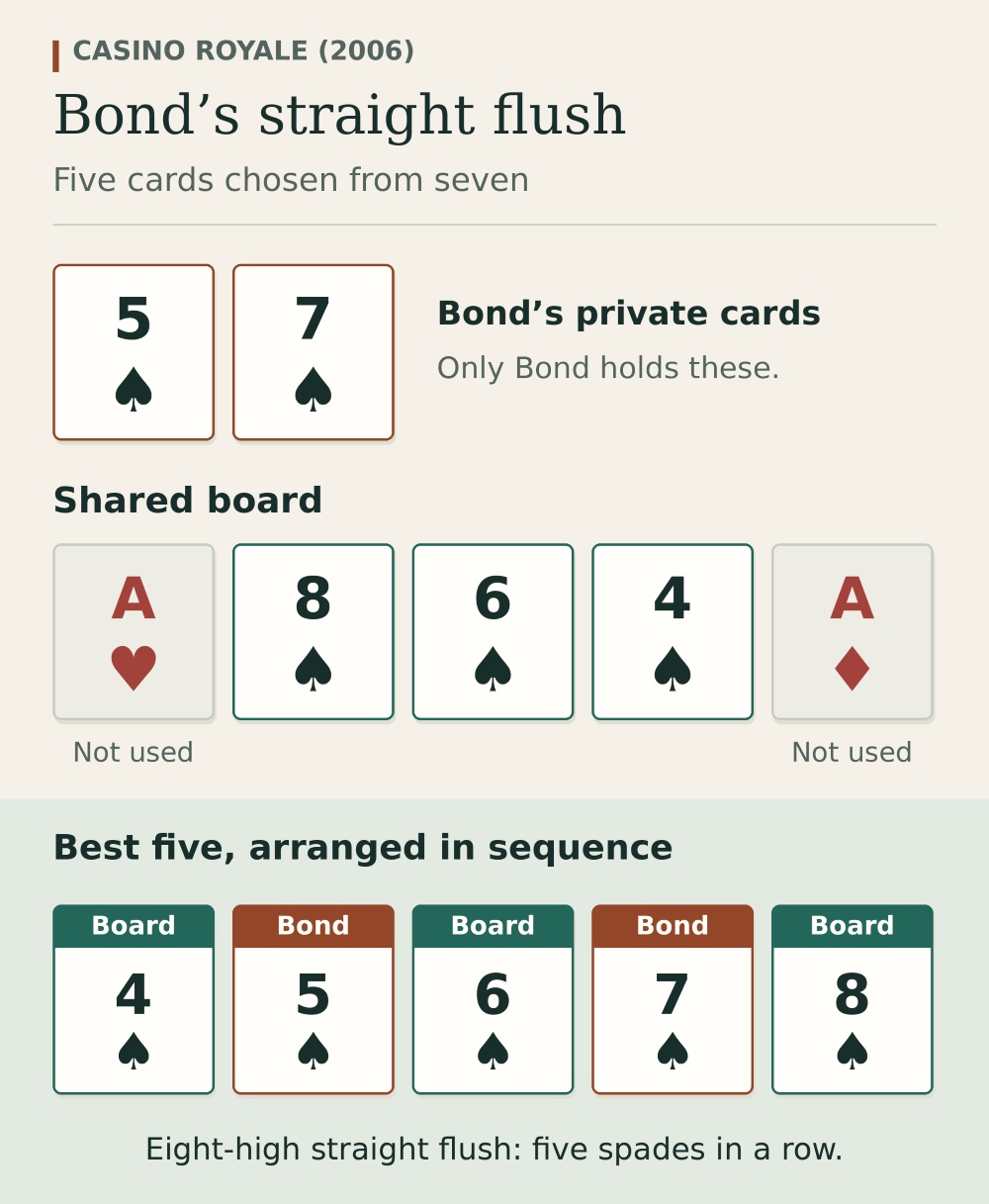
At the tournament’s final reveal, one opponent has a flush, another has a full house, and Le Chiffre has a stronger full house. Then Bond turns over the five and seven of spades.
The board’s four, six, and eight of spades complete his sequence: four, five, six, seven, eight, all in one suit. That is a straight flush. It outranks all three opponents’ hands.
One opponent’s king and queen of spades combine with the board’s three spades to make a flush. Those two picture cards look stronger than Bond’s five and seven in isolation. Once the shared cards are included, however, Bond has a sequence in the same suit. The hand category takes priority over the highest individual card.
Bond’s hand is not a royal flush, which runs from ten through ace, all in the same suit. He doesn’t need one: his eight-high straight flush already outranks the other hands.
Two aces also sit on the board. They do not enter Bond’s best five, but they help form both full houses. Every player can use the shared cards, so the opponents’ hands can contain the same aces without duplicate cards being dealt.
The two full houses also have a clear order. The player holding two eights makes three eights with two aces. Le Chiffre’s ace and six produce three aces with two sixes. When full houses meet, compare their groups of three first. Le Chiffre’s aces outrank the other player’s eights, even though the other hand contains a pair of aces too. Counting every ace without distinguishing its role would give the wrong answer.
Killa’s fifth card changes the answer
John Wick: Chapter 4 presents a five-card deal, with each player holding their own complete hand. There is no shared board to combine with two private cards, so borrowing Bond’s method would misread the scene immediately.
John’s aces and eights give him two pairs. Caine’s four of a kind outranks that, and Mr Nobody’s royal flush beats both. Each is a recognised hand category in standard poker. Their different strengths explain who would win at a showdown between those three players, without making the weaker hands any less valid. Killa, who deals the cards himself, then produces five of a kind.
A standard deck contains only four cards of each rank, one per suit. Without a wild card, a fifth card of that rank cannot appear in an ordinary deal. Killa’s reveal therefore raises a question about the deck and deal, rather than the likelihood of a remarkable hand.
Five of a kind can exist in poker variants with wild cards, where a designated card can stand for another rank. That exception does not automatically rescue Killa’s hand. The scene presents his reveal as evidence of manipulation, not an explanation of agreed wild-card rules.
Calling this a filmmaking mistake would miss the joke. With a royal flush already revealed, Killa’s extra matching card turns the showdown into a taunt. He has dealt himself something beyond the usual deck. The scene’s humour depends on that obvious excess.
Possible is different from believable
Poker professional Darren Elias questions the concentration of extraordinary hands in Bond’s finale. His objection is to several players holding such powerful combinations simultaneously. One remarkable hand is easier to accept than a whole table arranged around successive revelations.
On a rewatch, the decisive question is whether the surprise comes from cards that could have been dealt under the game’s rules, or from someone breaking those rules. Bond’s straight flush survives that check. Killa’s fifth matching card is the evidence against him.
