



by FilmInk Staff
Blackmagic Design today announced DaVinci Resolve 21.1, a major new update that introduces AI assistant integration allowing customers to efficiently manage tasks such as organising media or batch rendering, as well as expanded support for camera formats on the photo page. The Fusion 3D and shape tool kit is further expanded the with over 25 new Krokodove tools, plus there are over 100 new tools and controls for faster editing and color grading workflows. DaVinci Resolve 21.1 is available now for download free of charge from the Blackmagic Design web site.
DaVinci Resolve 21.1 will be demonstrated on the Blackmagic Design IBC 2026 Stand 7.C49.
DaVinci Resolve 21.1 now supports integration with AI assistants such as Claude, Claude Code and ChatGPT Codex, allowing customers to analyse projects, organise media, adjust settings and batch render using everyday conversational language. Customers can ask their AI assistant to create highlight edits from long form video, remove unwanted clips and render deliverables, so they can spend more time being creative rather than getting bogged down in repetitive tasks.
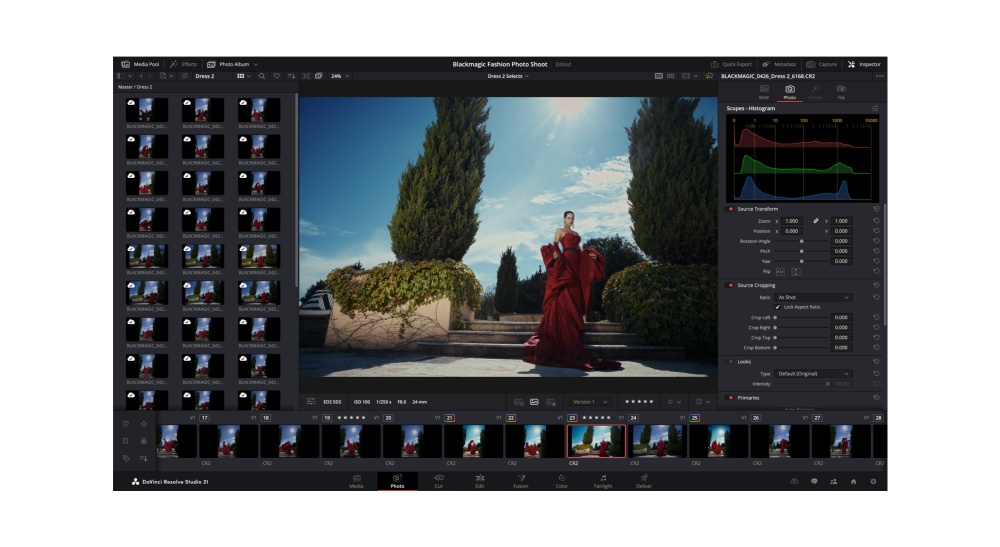
The photo page now supports a wider range of camera formats including Fujifilm’s GFX and X series, Leica SL, and Sony A7R V1, so photographers working with these cameras can import their files natively without needing to convert files. Image settings on the photo page can now be adjusted in the inspector using DaVinci Resolve color panels, including the DaVinci Resolve Micro Color Panel, giving customers hands-on control for faster, more precise adjustments. ResolveFX support has been expanded with enhanced sky replacement capabilities for still images on the Color page.
Many improvements have also been made to the media page allowing for easier media review and management. The source viewer now preserves the source media’s original aspect ratio independent of the timeline being vertical or horizontal. This means that customers working with both formats see their media correctly without manual adjustment.
In the media pool, all editable fields can now be modified directly in the list view, and customers can use tab and enter keys to navigate between rows and columns for faster metadata entry. A new decode option in preferences lets customers specify if only full resolution media should be used with AI tools, with fallback to any available media if the preferred media is offline.
When exporting a project archive, customers now have options to include only used media, choose between originals and proxies, and to include render cache, LUTs and gallery stills. When consolidating projects, a .drp file is now included with rendered project media.
Edit page multi-cam workflows are also enhanced with a new timeline viewer multi-cam mode button which displays the current clip in the source viewer for seamless angle switching. This means customers no longer lose their place when previewing media pool clips, as the source viewer automatically returns to multi-cam mode when switching back to the timeline. When creating multi-cam clips, customers can now split at timecode gaps, making it faster to sync footage from multi-camera shoots.
New keyboard shortcuts support control of up to 25 multi-cam angles, so customers working on large concert, sports or event productions can switch between cameras faster. Track selection shortcuts now support up to 32 tracks, and audio waveforms can be automatically scaled to fill available track height, so customers can clearly see audio levels across clips with different volumes without manual adjustment.
The updated trim editor on the edit page allows direct dragging in the viewer for precise frame-level adjustments, and customers can now display clip durations alongside their names in the timeline, making it easier to identify clips at a glance. The inspector panel now supports presets, so customers can save and recall favorite parameter configurations for video, audio, transitions and transforms, eliminating repetitive manual setup across projects.
In the index panel, customers can now export their list of markers as a polished .pdf report, making it simple to share notes with clients or collaborators outside of DaVinci Resolve. ‘Compare with current timeline’ features a redesigned interface for easier navigation and review of specific parts of the edit.
The cut page now features two new source timecode timer options when in source tape and multi source viewer mode. This gives customers precise offset and duration reference points during editing. New editing preferences including stop playback on scrub, always play audio when changing frames, and blade selects clip after playhead give customers more control over how DaVinci Resolve responds to their editing style.
On the color page the multimaster trim feature now supports individual trim passes for Dolby Vision, HDR10+, and HDR Vivid workflows, enabling customers to grade each HDR format independently rather than sharing a common trim. This means colorists working on multiple deliverables can fine tune each version without compromising the others. Output sizing can now be overridden for each trim, allowing independent framing for different aspect ratios, and individual timeline caching per trim prevents time consuming re-caching when switching between deliverables. When navigating between stacked clips on the color page, the playhead position is now retained, so customers can quickly switch between layers without losing their place.
DaVinci Resolve 21.1 also now supports a greater range of colour spaces and colour management solutions including GoPro Log, Leica L-Log, DJI’s D-Gamut2 and D-Log2, and Vivo’s Wide Gamut and Log, so customers shooting with these cameras can work natively without manual conversions. Additional camera transform LUTs and ACES Transform colour space choices have also been added.
There are over 25 new Krokodove tools that dramatically expand the 3D and shape toolkit. The Connect 3D tool creates vertex connections, Heightfield Create 3D allows depth based plane distortion using image maps, Tube Create 3D creates path following pipe shapes, and the new 3D Region toolset isolates effects to defined areas in the 3D environment. The sPrimitive Create node lets customers quickly generate basic shapes including cross, polygon, rectangle and star, while new advanced edge manipulation tools support more sophisticated graphic design workflows.
The macro editor in Fusion now supports loading macros directly from DRFX template bundles with automatic detection, so customers can quickly access and reuse their saved templates. Macros can be saved to specific template categories, making them available on the cut or edit pages where customers need them. The editor now includes thumbnail management and an update from selected tools feature that lets customers modify tools on the flow and seamlessly update the corresponding macro while preserving control selections and layout customisations.
A new line based calibration type in the lens distortion tool gives customers an alternative method for correcting lens distortion. The Fairlight animator modifier now includes high pass and low pass filtering controls, enabling customers to target specific frequency ranges from their source audio to drive animation parameters with precision. MultiText now supports aligning layers relative to one another, ensuring pixel perfect placement when working with multiple text elements.
Blackmagic Cloud Presentations has also been updated with subtitle support, annotation sharing and comment replies, making it easier for customers to collaborate with clients on review and approval.
Format and codec support has been expanded with GPU-accelerated HTJ2K decoding using Kakadu and hardware-accelerated HEIC decoding on Apple Silicon, giving customers faster playback and rendering with these formats. DaVinci Resolve 21.1 also supports NVIDIA RTX Spark systems on Windows. There are also 20 new scripting APIs with built-in console support, giving more control over automating workflows.
“With AI assistant support, our customers can now ask Claude or ChatGPT to handle repetitive tasks such as create highlight edits, organising media or batch rendering, which frees them up to focus on creative decisions,” said Grant Petty, Blackmagic Design CEO. “We’ve also expanded camera support on the Photo page, added new multi-cam workflows and over 25 new Krokodove tools in Fusion and improved the performance of over 100 features. It’s a huge update and we can’t wait to see what our customers create with these new tools.”
AVAILABILITY AND PRICE
DaVinci Resolve 21.1 is available now for download free of charge from the Blackmagic Design website.
ABOUT BLACKMAGIC DESIGN
Blackmagic Design creates the world’s highest quality video editing products, digital film cameras, color correctors, video converters, video monitoring, routers, live production switchers, disk recorders, waveform monitors and real time film scanners for the feature film, post production and television broadcast industries. Blackmagic Design’s DeckLink capture cards launched a revolution in quality and affordability in post production, while the company’s Emmy™ award winning DaVinci color correction products have dominated the television and film industry since 1984.
Blackmagic Design continues ground breaking innovations including 6G-SDI and 12G-SDI products and stereoscopic 3D and Ultra HD workflows. Founded by world leading post production editors and engineers, Blackmagic Design has offices in the USA, UK, Japan, Singapore and Australia. For more information, please go to www.blackmagicdesign.com.
