


by Cain Noble-Davies
Worth: $16.00
FilmInk rates movies out of $20 — the score indicates the amount we believe a ticket to the movie to be worth
Cast:
Fish Liew, Alice Lau, Carlos Chan, Kate Yeung
Intro:
... as much bitterness as there is sweetness.
Disability and sex. For some sectors of the populace, these might as well be oil and water: Not simply that the two shouldn’t be mixed together, but that they can’t. Such stances tend to be ingrained in the idea that disability makes an individual utterly incapable of making decisions for themselves. No nuance, no case-by-case; consent is just beyond their means. At best, this mindset merely infantilises, treating grown adults as no more than children to be coddled and helicoptered. At worst, it erases personhood and individuality entirely.
The sophomore feature for Hong Kong-based writer/director Tam Wai-Ching (In Your Dreams), Someone Like Me shares a similar sensibility regarding the intersection of disability support and sex work as Hikari’s 37 Seconds. Like 37 Seconds, this film also centres on an artist with cerebral palsy (Fish Liew as Ah Mui) as she discovers her sexuality and tries to live her own life and fulfil her own desires while dealing with condescending attitudes from the society around her and, more pointedly, her own mother (Alice Lau).
Someone Like Me immediately loses points as Ah Mui is portrayed by an able-bodied actor. But with that said, it should be noted that it is possible for an actor to overcome their own passing to deliver a genuine, empathetic performance that itself feels like an act of empathy towards those unlike themselves. Philip Seymour Hoffman (as far as we know) wasn’t autistic, but his performance in Mary & Max was a major factor in it being, to this day, one of the greatest examples of disability-on-film ever made.
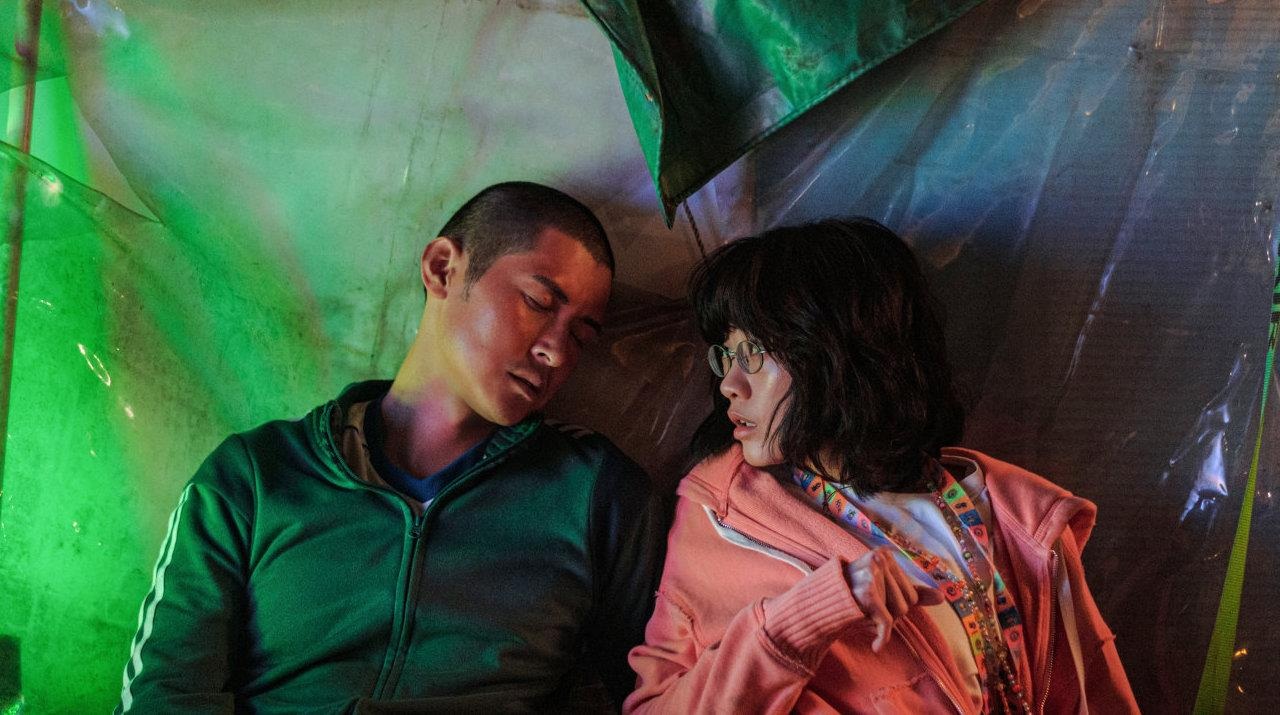
Along those lines, Liew is incredible in the central role. She wholly embodies the script’s emphasis on her own personhood, not defined solely by connection or reliance on others, and whenever she’s opposite Carlos Chan as volunteer and paramour Ken, the frame shimmers with an almost-blinding resolve that love can indeed win out against all odds. Their sexual explorations are emotionally intense, but also breezy in a way that invites a certain recognition that maturity when discussing and becoming involved in such things is needed, but not to the point where it becomes cold and purely transactional.
But what makes those moments work, despite how rom-com the interactions can be (right down to contrived ‘hey, we just happen to be at the same place’ encounters), there’s just as much bitterness as there is sweetness. Set against Ah Mui’s professional and social successes, and Ken’s ragged adamance to scrape together a living, their respective familial bonds venture very close to the line between realist bleakness and sensationalised misery fuel.
Learning more about Mrs. Mui might cause a few teeth to shatter from all the sympathetic clenching of jaws, like her initial reaction to Ah Mui’s birth, and Ken’s sister (Kate Yeung) not only dives right into the darkest mentalities that can arise from such a condition (her own disability caused by a car accident), but also Ken’s own subconscious guilt and resentment as her carer; it is thoroughly heartbreaking and hard-to-watch, but with just enough grounding to affirm all this as terrible, but a recognisably real kind of terrible. The kind you can all-too-easily picture yourself being in.
Someone Like Me also has a clarity to its overall understanding of disability within Hong Kong specifically that brings it all home, giving a palpable yet earned tragedy to the larger picture. From the smaller details, like Ah Mui not even being her actual name, just what everyone calls her (‘Ah Mui’ is Cantonese for little sister), to the societal ramifications behind the extremely confronting and gut-wrenching conclusion, it presents the idea of happiness while disabled as an active fight against established systems designed to deprioritise that very happiness. And yet, one that can be fought, even overcome, albeit in smaller ways. The organisation that initially connected Ah Mui with Ken is referenced in-film as being inspired by the real-world Taiwanese NGO ‘Hand-Angel’, which initially began as a support network for disabled Queer citizens, but has since become all-sexuality inclusive and putting boots on the ground for disabled rights in Taiwan. Happiness can be achieved… but there’s unfortunately a lot of work yet to be done before true freedom can be declared, a sentiment reflected in the film’s haunting final shot.
Someone Like Me has some sticking points concerning disabled representation, but its grounded yet hopeful perspective on living as a disabled person (not just surviving or overcoming hardships, but living) both smooths over a lot of the potential niggles, and grants its forthright declarations and observations eye-wateringly resonant power. As graphic as it gets in depicting horrific worst-case-scenarios, its ultimate message and tone highlights the injustice of it all… as a barrier to push through, rather than a pit with no escape. The sweet moments are delightful to witness, but it’s the harsher realities that will sit with you long after the credits roll.
