



by Nataliia Serebriakova
Worth: $16.40
FilmInk rates movies out of $20 — the score indicates the amount we believe a ticket to the movie to be worth
Karlovy Vary International Film Festival
Intro:
… demanding in its form and heavy in its subject, but its ambition and sincerity make it a significant contribution to contemporary documentary cinema.
Yuliia Hontaruk’s documentary To Die to Live is a work of rare endurance and emotional depth, shaped over more than a decade of close observation and personal immersion.
The Ukrainian film transcends the boundaries of a conventional war chronicle, evolving into a profound meditation on trauma, memory, and the fragile reconstruction of identity after extreme experience.
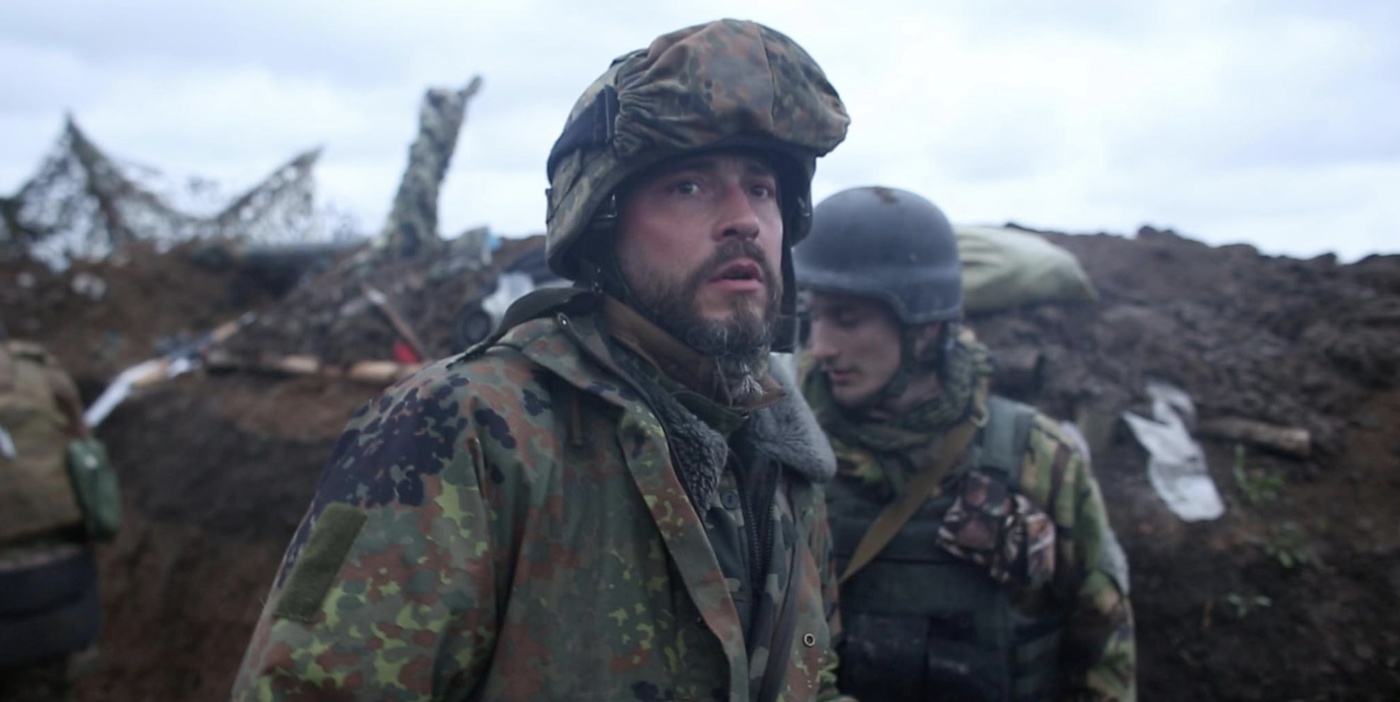
What begins as an attempt to document a volunteer unit of the Azov regiment gradually transforms into something far more intimate and philosophically complex.
Hontaruk follows several fighters from the early battles near Shyrokyne through their return to civilian life and, eventually, their re-engagement in the full-scale war of 2022. This longitudinal perspective allows the film to capture not only the immediacy of combat but also the slow, often invisible processes of psychological change that follow it.
One of the film’s defining strengths lies in its proximity to its subjects. Hontaruk does not observe from a distance; she shares the physical and emotional space of her protagonists. This closeness results in a level of trust that reveals deeply personal reflections, particularly regarding the moment when soldiers confront and accept the possibility of their own death. The film suggests that this acceptance marks a turning point — an internal rupture after which previous personality no longer exists, and a new self must be constructed from the remnants.
Formally, the documentary mirrors this fragmentation. Its editing resists linear clarity, embracing abrupt transitions, temporal dislocations, and pauses that evoke the instability of memory under post-traumatic stress. The structure may initially seem disorienting, but it ultimately becomes the film’s most honest language, reflecting the way traumatic experience disrupts narrative coherence. The result is less a chronological account than a psychological landscape.
Particularly striking is the portrayal of the character known as “Shakhta”, whose arc embodies the moral and emotional contradictions of command. His story, marked by loss and difficult decisions, unfolds gradually, resisting easy interpretation. Hontaruk’s persistence in capturing his complexity over years pays off in a portrait that feels both unresolved and deeply human.
The film’s final act, returning to the outbreak of full-scale war, avoids any simplistic notion of cyclical violence or emotional numbness. Instead, it presents individuals who have already undergone profound internal change and now face war again with a different, more controlled relationship to fear and pain. This shift is subtle but crucial: the film does not romanticise resilience, but it acknowledges a hard-earned transformation.
To Die to Live stands as both a personal and collective document. It reflects not only the journeys of its protagonists but also a broader national experience of adapting to prolonged conflict while retaining a sense of life’s value. Hontaruk’s film is demanding in its form and heavy in its subject, but its ambition and sincerity make it a significant contribution to contemporary documentary cinema.
