



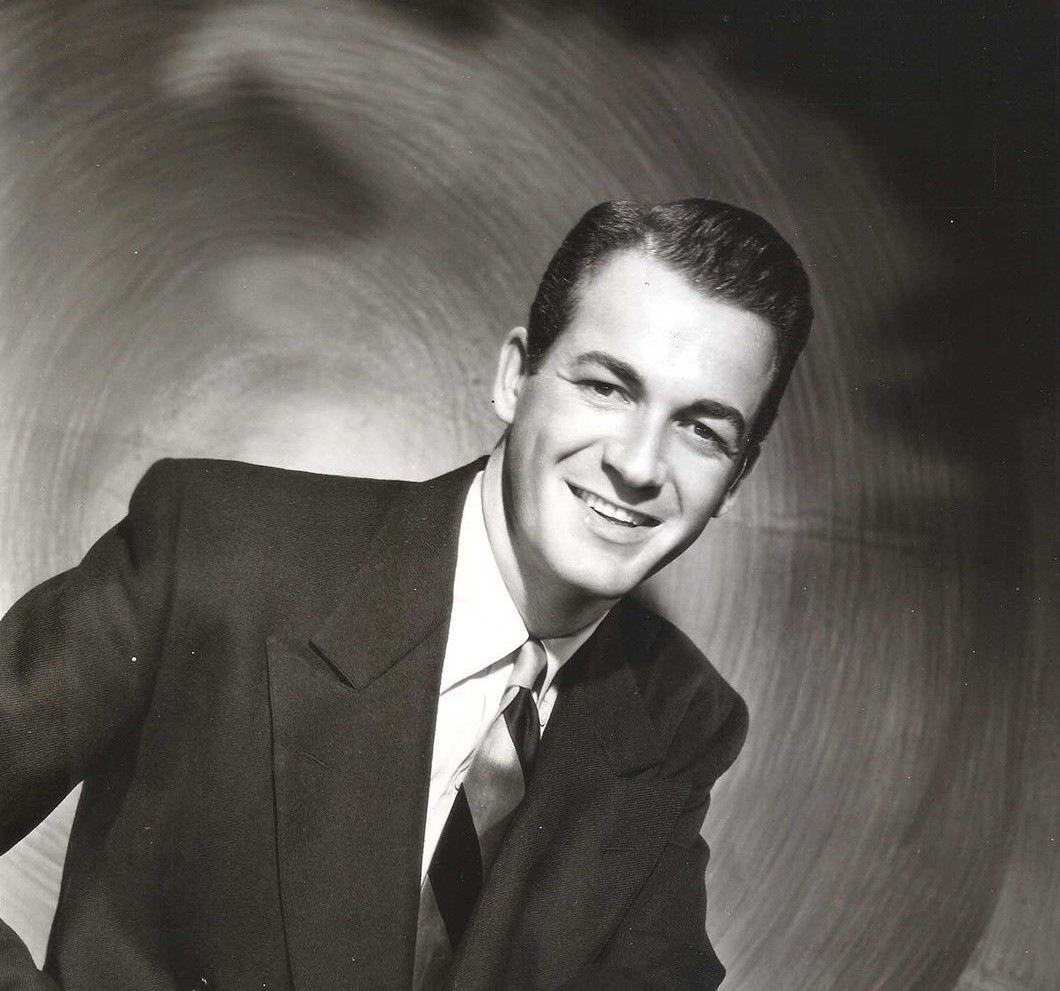
by Stephen Vagg
Sometimes an actor comes along who has all the tools, it would seem, to become a movie star: looks, talent, professionalism, the backing of a studio. Only it doesn’t happen. But they carve out their own path and accomplish more than you might think.
Such was the case of Mark Stevens.
Not the most memorable movie star name is it? Up there with “Craig Stevens”, “Chris Evans” or “Paul Walker”. Now, before any Paul Walker fans get upset, we’re not talking about their abilities or charisma or anything like that, we’re talking about the genericness of their names.
Thing is, “Mark Stevens” wasn’t his real name, or even his first stage name. He was born Richard Stevens in 1916, in Cleveland, Ohio. Stevens grew up in England and Canada, left school early, then spent over a decade working in tent shows, vaudeville, theatre, night clubs (as a song and dance man) and radio. He moved to Hollywood in the early 1940s, benefiting from the absence of leading men during World War II (a back injury kept Stevens out of the services). Warner Bros. signed him to a long-term contract and gave him the name “Stephen Richards”. Stevens/Richards mostly played soldiers in films like Destination Tokyo (1943), Passage to Marseilles (1944), Objective Burma (1945), Pride of the Marines (1945), and God Is My Co-Pilot (1945). WB didn’t get that excited by the young actor and dropped him.
So… game over? Only not – because Darryl F Zanuck at 20th Century Fox was a fan, and he signed Richards/Stevens, turned him into “Mark Stevens” and set about building him into a star.
What did Zanuck see in him? The “Mark” apparently came from the name of the detective in Fox’s Laura (1944) played by Dana Andrews, and the mogul might’ve wanted Stevens as a back-up Andrews type – someone who could play tough, and sensitive, and thus appear in noirs and musicals. Other Fox leading men around this time would do that, such as John Payne, Cornel Wilde, Victor Mature, Lon McCallister and William Eythe (incidentally, McCallister and Eythe, in a Heated Rivalry style twist, started shagging each other – where’s that biopic, Ryan Murphy?).
Stevens was cast in a series of romantic male leads: Within These Walls (1945), a prison melodrama; From This Day Forward (1946) (at RKO), a melodrama with Joan Fontaine from a bunch of filmmakers who’d soon be blacklisted; and The Dark Corner (1946), a half-successful attempt to repeat the success of Laura, as a private eye accused of murder. In Dark Corner he was billed fourth but had the biggest role; the film was directed by Henry Hathaway who later said “Mark Stevens never quite cut it. Too arrogant, cocksure.”
Like Mature and Payne, Fox assigned Stevens to leading man duties in a musical: I Wonder Who’s Kissing Her Now (1947) playing songwriter Joseph Howard opposite June Haver. Also like Mature, Wilde, Payne, etc, Stevens then flipped over to noir, as an undercover agent in The Street with No Name (1948) up against nasty Richard Widmark. After this, he was Olivia de Havilland’s husband in The Snake Pit (1948). These films were all hits, although Stevens was very much dominated by his co-stars. Incidentally, Zanuck’s enthusiasm for Stevens had a limit – the mogul didn’t want the actor cast as the romantic male lead in Miracle on 34th Street, feeling that he “does not fit the part at all” and instead gave it to John Payne.
Fox did put Stevens in the lead of a horse movie, Sand (1949), then reunited him with Haver in another biopic musical, Oh You Beautiful Doll (1949). He supported William Powers in Dancing in the Dark (1949) and was loaned to MGM for Please Believe Me (1950), replacing Van Johnson at the last minute, and went to Columbia for a noir with Edmond O’Brien, Between Midnight and Dawn (1950).
None of these films did that well and Stevens never broke through as a major star. He was always fine – handsome, competent, all that – but he lacked individuality. He never caught fire as a screen persona.
Stevens left Fox and went to Universal for whom he made a series of programmers: Target Unknown (1951), Katie Did It (1951), Little Egypt (1951) and Reunion in Reno (1951). The budgets got smaller and the studios less prestigious: Mutiny (1952), a famous low point in the career of Angela Lansbury, for the King Brothers; The Lost Hours (1952), shot in England; Torpedo Alley (1952), for Allied Artists, with Dorothy Malone; Jack Slade (1953), a popular Western for Allied. Stevens regularly appeared on TV, starring in Martin Kane, Private Eye among others. He kept in leading man roles rather than character parts, saying around this time “When they sign me, they get Mark Stevens — nobody else. I’m the leading-man type. I play myself. I’m an actor. It’s my profession. I deliver the best that’s in me, and that’s that.” The thing is, Mark Stevens playing Mark Stevens wasn’t that interesting.
However, there was far more to Stevens than his film credits suggest. The 1950s was a time for diversification – his contemporaries such as Burt Lancaster, John Payne, George Montgomery and Cornel Wilde were branching into producing, directing, and writing. And no one diversified more than Mark Stevens. He did a nightclub act, singing and telling jokes in places such as Las Vegas, Reno and Miami. He appeared on Broadway in a play, Mid-Summer (which launched Geraldine Page to stage stardom). He wrote stories and formed his own production company, Mark Stevens Productions, which made low budget films, commercials and TV series, such as Big Town, starring himself. He started directing, on television and low budget features; the latter usually starred himself: Cry Vengeance (1954), Time Table (1956), Gun Fever (1958), Man on a Raft (1958), The Man in the Water (1963) and Sunscorched (1965). The only one that seems to have any sort of reputation today is Time Table.
In 1954, Stevens said “I have to work. It’s almost a compulsion with me. The money isn’t so important as the fact that I have to be doing something.” Two years later, he admitted “I don’t like to act, I’m not a very good actor and I’m not kidding myself about it.” However, he continued to work on films and TV solely as actor in productions like September Storm (1960) and The Frozen Dead (1965).
Stevens eventually moved to Spain and retired from show business, owning a restaurant. He later returned to Hollywood and acting, popping up on shows like Murder She Wrote. He died of cancer in 1994.
We have to admit that when we started researching this article, we were going to make fun of Mark Stevens, but wound up being knocked out by what a varied and interesting career he had. Indeed, considering all the films he appeared in and directed and TV shows that he made, it’s kind of surprising that he’s so little known.
He probably lacked a truly iconic credit and/or performance. None of the films or TV shows he produced/directed really stick out – he never enjoyed, say, what Cornel Wilde had with The Naked Prey. Even when he starred in a classy movie, he was usually overshadowed by others: The Dark Corner (Clifton Webb and Lucille Ball), The Snake Pit (Olivia de Havilland) and The Street with No Name (Richard Widmark). Still, it was a rich career and there was far more to Mark Stevens than his un-exciting stage name.
A Mark Stevens film top ten: (1) From This Day Forward, (2) The Dark Corner (3) I Wonder Who’s Kissing Her Now, (4) The Snake Pit, (5) The Street with No Name, (6) Between Midnight and Dawn, (7) Little Egypt, (8) Jack Slade, (9) Time Table, (10) The Frozen Dead.
