


by FIlmInk Staff
When you work long enough in this industry, you get used to things being temporary — jobs, sets, even entire productions. What you don’t expect is for a creative home to disappear. That’s what the closure of Matchbox Pictures feels like to me.
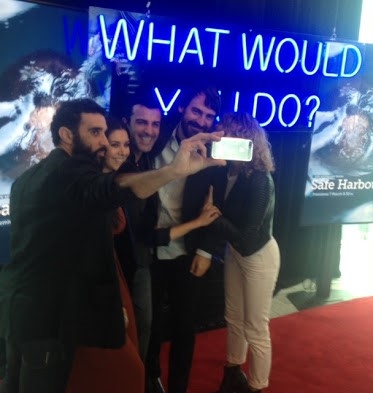
I was fortunate to work with Matchbox across several projects over the years, including the International Emmy Award-Winning series Safe Harbour, the smash-hit film Ali’s Wedding (Australia’s first Muslim rom-com), the sensational Netflix series Irreverent, political thriller Secret City (Foxtel, then launched worldwide on Netflix), and the Sam Worthington led mini-series Deadline Gallipoli. They weren’t just jobs, they were experiences that demanded something deeper — emotionally, politically, personally. Matchbox had a way of backing stories that asked difficult questions, especially about identity, displacement and moral responsibility. As an actor, that mattered to me.
A Different Kind of Set
From the first day I stepped onto a Matchbox set, I sensed a difference. There was rigour — scripts were interrogated, rehearsals were purposeful — but there was also trust. Actors were invited into the process. Conversations weren’t shut down because they were inconvenient.
On Safe Harbour, we were dealing with themes of asylum, survival and the moral compromises people make under pressure. It would have been easy to sensationalise that material. Instead, the creative team insisted on nuance. They wanted the audience to sit in discomfort. That’s rare.
We knew the subject matter was close to lived experience for some Australians. The production treated that responsibility with gravity. Consultants were present. Community voices were heard. That tone comes from the top — from a company culture that values authenticity over expedience.
What Matchbox Represented
Matchbox wasn’t just producing content; it was shaping the tone of contemporary Australian drama.
Films like Ali’s Wedding showed that we could tell uncomfortable domestic stories without diluting them for international markets, and in a humorous way. Safe Harbour proved a thriller could also be a moral inquiry that could also reach an international audience, and in a dramatic way. Either way, storytelling could still be quintessentially Australian, deeply human, and reach a global market. What a gift.
When a company like that closes — particularly under the umbrella of a global player like Universal International Studios— it sends a message about where the industry is heading. Fewer permanent local structures. More project-by-project calculations. Less long-term development.
From an actor’s perspective, that shift is worrying.
The Development Gap
Actors rely on strong development cultures. When scripts are properly nurtured, performances have somewhere to land. Matchbox invested in writers. They invested in time. That meant when we arrived on set, the foundation was solid.
Without companies like Matchbox maintaining slates of projects, the pipeline narrows. Emerging actors lose training grounds. Mid-career performers lose complex roles that reflect the diversity of Australian society.
There’s also the question of representation. Matchbox consistently opened doors for actors from culturally diverse backgrounds, not as token additions but as central figures in the narrative. That commitment wasn’t accidental — it was embedded in the company’s creative ethos.
The Human Cost
Closures are often framed in strategic language — “realignment,” “evaluation,” “market conditions.” But behind those terms are crews, writers, assistants, producers — people who built careers there.
On set, you build relationships that stretch across years. You recognise the same camera operators, the same ADs, the same costume designers. There’s a continuity that creates trust. When a production house shuts down, that ecosystem fractures.
For freelancers, continuity is everything.
Is This the End — or a Turning Point?
The Australian industry is resilient. It always has been. I don’t believe the appetite for intelligent, character-driven storytelling has disappeared. But sustaining it requires infrastructure — companies willing to take creative risks before international buyers come knocking.
Matchbox was one of those companies.
Personally, I’m grateful for the work we did together. Those projects challenged me as an actor and as an individual. They reminded me why I chose this profession in the first place: to inhabit complex human stories that reflect the world we’re living in.
The closure of Matchbox Pictures feels like the end of an era. But I hope it also sparks a renewed conversation about how we protect bold Australian storytelling — and the people who bring it to life.
Because stories like the ones Matchbox championed don’t just entertain. They matter.
- Robert Rabiah is an award-winning Australian actor.
