



by Stephen Vagg
The previous piece in this series explored how the Rank Organisation pulled right back (though not completely) on investing in films during 1968-77. This was a huge blow to the British film industry, as Rank still dominated distribution and exhibition in the country, leading to a near monopoly by EMI Films (discussed here). However, Rank changed its policy in the mid-1970s and decided to have one last attempt at investing in big movies.
The main reason was the success of EMI Films. Under the canny stewardship of Nat Cohen, EMI had produced a steady stream of hits, mostly low budget efforts such as Percy and Steptoe and Son but also the occasional international blockbuster like Murder on the Orient Express. The latter film in particular stoked the fires of envy within Rank as it was precisely the sort of film that Rank has longed to make for years – classy, star-studded, British, based on IP, family friendly, Oscar winning, a huge hit – but never been able to (though it came close once or twice eg A Night to Remember).
Orient Express – entirely financed by EMI – offered a pathway to a more lucrative form of filmmaking than the dribs and drabs that Rank had been investing in. It was also more risky, since the amounts of money were so much higher.
Tony Williams, a key executive at Rank, later recalled the situation in the mid 1970s (republished from the excellent interview by Andrew Spicer here): “The cost of production was going up, the income from the UK, which was its core business, was dropping because of the way cinemas were closing and cinema income was dropping. And whereas the very low budget films that Rank was making in the early seventies, or even mid-seventies, were at one time able to cover their production costs in the UK or with a touch of Commonwealth income, by that time they weren’t. And Rank was faced with a choice of either get out of film production completely, shut the whole thing down or become more serious about it again.”
Rank decided on the second course of action. “We felt that if EMI could do it, so could we,” admitted Ed Chilton, chairman of Rank Leisure Services.
In October 1976, Chilton announced that Rank would make four films over two years to be produced by Michael (Get Carter) Klinger: Eagle in the Sky (from a Wilbur Smith novel), Green Beach (a war story on the memoirs of a Jewish war hero, Jack Nissenthal), The Chilean Club (a black comedy from a novel by George Shipway about four army officers trying to prevent a left-wing takeover), and The Limey (a buddy comedy at one stage set for Michael Caine and Bill Cosby). “We have confidence that there is an enormous world market for international films of this stature,” gushed Chilton.
None of these films were made for a variety of reasons (none of them sound that good, to be fair). Rank did not give up, however, and instead appointed Tony Williams as head of Rank Film Productions, a newly formed subdivision devoted to filmmaking. Williams had joined Rank as a graduate trainee in the 1960s and worked in theatre management and exhibition-distribution. He later told Andrew Spicer, “I worked totally through independent producers. I was not making films directly. The role I had was effectively as Executive Producer… The policy we had was 50% investment, that was our broad policy, which was how to make the money go round. It also, if there was a co-investor, gave a degree of reassurance. So, I could – I would only work through a producer who brought me a project.”
Williams says prior to his arrival, Ed Chilton had indicated his enthusiasm for Rank’s increased production by investing in three movies: Tarka the Otter, Wombling Free and The Shout.
Tarka was an adaptation of a beloved children’s book, which was very much “old school” Rank (we’re not saying that as a criticism). Wombling Free was from the children’s TV show, although those episodes ran for five minutes, so it was a real leap to go to feature length. Despite being directed by Lionel Jeffries (The Railway Children) with songs added, the movie was not a success and truth be told, it’s not very good – it’s hard to tell the Wombles apart, there’s not much of a story, the main girl is annoying. We probably would have loved it if we’d seen it when we were five though, and it was fun to see David Tomlinson.
The Shout was a totally left field investment, directed by Jerzy Skolimowski and produced by Jeremy Thomas (son of Ralph, the director), who admitted that he made the film to achieve “A-grade festival exposure” rather than commercial success. There was something endearing about the way Rank would continue to express conservatism and safety-first filmmaking principles, then throw caution into the wind by sinking funds into some out-there project. They probably agreed to The Shout because it was an elevated horror movie, but it is one of Rank’s more notable films from the ‘70s.
Rank continued to invest in utterly unremarkable Canadian movies with old stars (Tomorrow Never Comes, Power Play), plus two Evan Lloyd productions with old stars (The Wild Geese and The Sea Wolves) and the Paul Verhoeven Dutch movie Soldier of Orange. The Canadian moves kind of disappeared but the Euan Lloyd pictures did very well, especially The Wild Geese, which is terrific. So too was Soldier of Orange. Rank occasionally accidentally invested in good movies and it traditionally had done well with war pictures.
Rank had financed Carry On movies since the mid-1960s, but as discussed in the previous piece in this series, it stopped doing that after the failure of That’s Carry On; Carry On Emmanuelle, the last one in the series (well, until Carry On Columbus in 1992) was financed by Hemdale. In the late ‘70s, and early ‘80s, Carry On’s regular producer, Peter Rogers, pitched Carry On Again Nurse and Carry On Dallas to Rank, but was rejected. It’s hard to be too sad about that.
Regardless of the aforementioned films, Rank’s main focus during the period of this piece was the Tony Williams slate. As far as we’ve been able to ascertain, this consisted of six main films.
1) The Thirty Nine Steps (1978)
2) The Lady Vanishes (1979)
3) The Riddle of the Sands (1979)
4) Eagle’s Wing (1979)
5) Bad Timing (1980)
6) Silver Dream Racer (1980)
The three big movies were adventure stories set in the past and based on novels at least forty-year-old: The 39 Steps, The Lady Vanishes, and The Riddle of the Sands. The first two were remakes of Hitchcock films from the 1930s.
“You have to go back in time to tell a story that doesn’t have to face seventies problems,” said Williams in December 1978. “What people are nostalgic for isn’t necessarily any particular period but the happier values that are missing today. The old films suffer technically against today’s. The pace of modern films is much faster. The style of acting is different. Those old actors are marvellous but if you consult the man in the street he’s more interested in seeing a current artist than someone who’s been dead for years.”
Williams did admit “It’s not really healthy for the industry to put out too many remakes” but argued that by remaking Thirty Nine Steps and Lady Vanishes “it kept Rank’s copyright in the Hitchcock pictures going. The rationale for The 39 Steps was that it is a thunderingly good story. And it was the first one that had actually gone back to the [1915 John] Buchan book. The Lady Vanishes was, again, a good story, the Hitchcock film was a good story, and the package was good.”
Rank’s version of The 39 Steps was entertaining, with some excellent moments and solid handling from director Don Sharp. It was hampered by too many scenes draining excitement from the story and avoiding conflict – this was a recurring feature of Rank movies. But it was fun and did fairly well at the British box office. [Spoilers: it would be the only one of the Tony Williams slate to do so.]
The Riddle of the Sands was based on Erskine Childers’ famous 1903 novel about two yachtsmen who discover a plot to invade England. To be honest, this film should have been made years ago – preferably in the ‘30s or ‘50s – but Childers’ family wouldn’t allow it (the author didn’t have much say in the matter, having been executed by the Irish Free State during the Irish Civil War), so the filmmakers had to wait until the novel was in the public domain. On the upside, this meant that the movie could be shot in gorgeous Panavision, in colour, and heavily on location – Riddle of the Sands looks terrific, with its windswept North Sea locations, small coastal towns and sand bars. The film’s main problem is that it doesn’t differentiate enough between the lead characters and is perhaps too restful. But it was made with a lot of love and was a tribute to Rank. It’s a shame that it didn’t do well at the box office but it’s had a long life.
The Lady Vanishes, a co-production with Hammer Films, received horrendous reviews but actually isn’t that bad – quite stylish and fun. It probably needed a better reason to exist, like updating it to the present day (the story would have worked in Eastern Europe). The changes from the original story were mostly pointless (the original’s script is one of the most perfect of all time) and director Anthony Page, needless to say, is no Hitchcock. And that matters, because Hitchcock brings so much – the atmosphere, feeling, tension, romance, all that.
It’s understandable why Rank made the aforementioned three movies. We cannot fathom why they invested two million quid in Eagle’s Wing, an arty Western shot in Mexico with a bunch of respected, non box office names (Martin Sheen, Sam Waterston in brownface as an Indian, Harvey Keitel, Stephanie Audran) and non famous director (Anthony Harvey) and odd story (everyone chasing after things). Interesting music, beautifully shot, certainly thought provoking. Just… why? Harvey complained that the film never got a proper cinema release in Rank cinemas, and that would have hurt, but we are sympathetic to the cinema owners on this one.
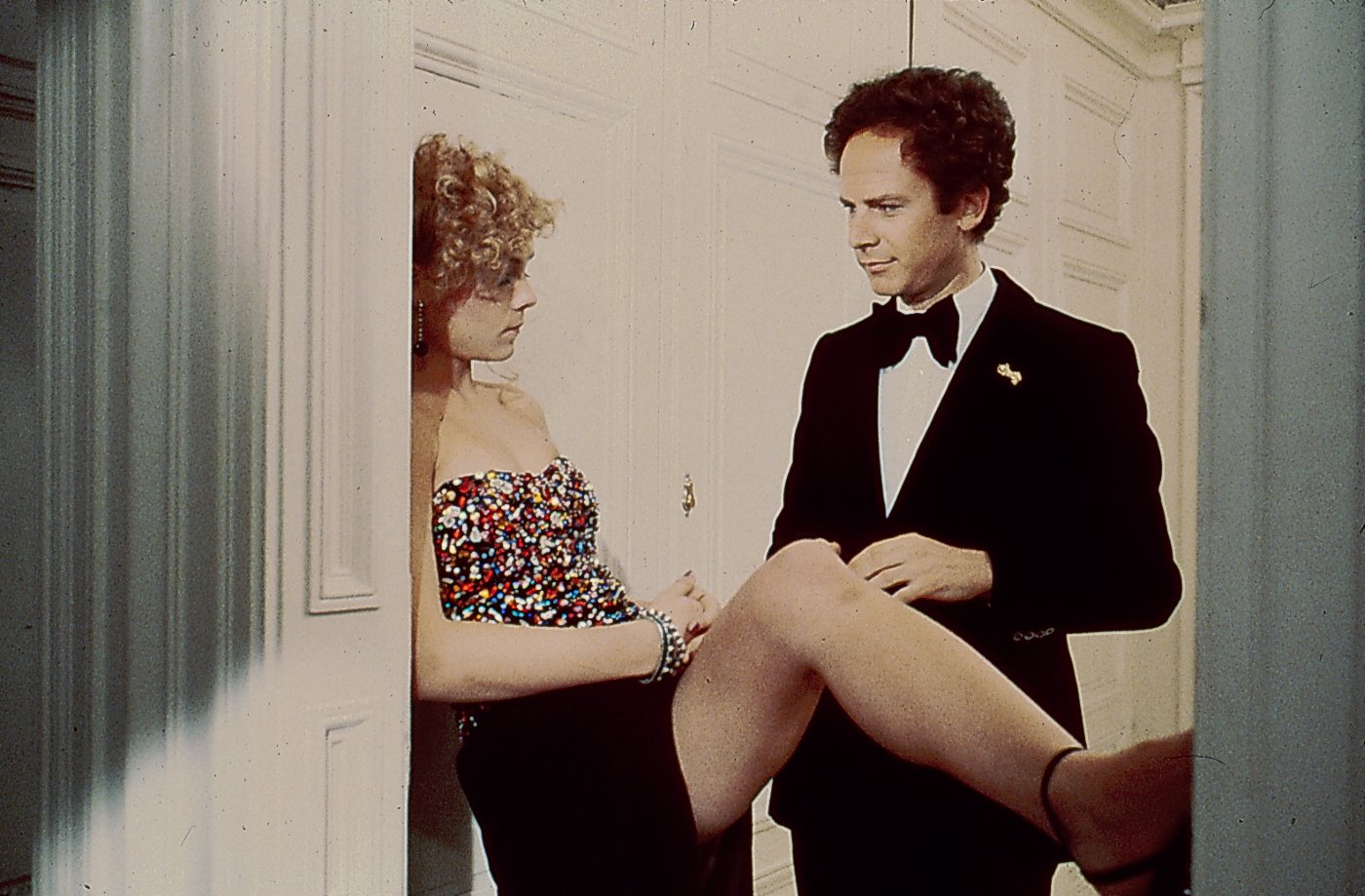
If it’s weird that Eagle’s Wing got all that money, then we have no idea how producer Jeremy Thomas smooth-talked Rank into ponying up $4 million for Bad Timing. This was from director Nic Roeg (who’d just walked away from Flash Gordon) and starred Art Garfunkel and Theresa Russell. It was a very bold artistic swing from Rank, being consistently interesting and thought provoking, if a little pervy (like a lot of Roeg movies).
It was reported that Bad Timing “caused deep contention within the Rank Organisation. The film’s content reportedly appalled certain members of the board, and reactions throughout the company.” George Pines, who booked films for Rank cinemas called it “a sick film made by sick people for sick audiences” and refused to show the film. Tony Williams claimed Pines “had personal vendettas against various filmmakers at times. We think that he probably resented the fact that he was not involved in the production side.”
Bad Timing is an amazing film financed by the wrong company – but as all filmmakers know, you go where you can get the money.
Silver Dream Racer was from David Wickes, director of the 1977 feature version of The Sweeney. It was the sort of movie that sounds good in shorthand – a sports drama about motorbike racing starring pop star David Essex (a big bike fan in real life) – but it’s yet another Rank movie which found a way to drain excitement out of the story. This film needed to be made by people who understood Roger Corman filmmaking – it needed more pace, sex, action, tension. It has its fans.
Incidentally, some films announced by Rank around this time but not made include:
– The Red Hot Ferrari starring Roger Moore and Raquel Welch;
– The Persian Ransom from the team of Betty Box and Ralph Thomas;
– a remake of The Big Sleep (ultimately made by Michael Winner for Lord Grade);
– The Mistress of the Seas, a 17th-century swashbuckler based on the novel by John Carlova (which sounds fun if very expensive)
– Sky Fall, a science fiction movie based on the novel by Harry Harrison.
– Agatha, produced by David Putnam, about the disappearance of Agatha Christie in 1926 – this was totally the sort of movie that Rank should have invested in, but the company pulled out when board members remembered Christie’s husband had been a director on the board of the Rank Organisation.
As mentioned, of the Tony Williams films, only The 39 Steps did well at the British box office. The others flopped, some quite noisily. In the year ended 31 October 1979, Rank’s film division recorded a loss of 1.5 million pounds and its cinemas showed a 42% drop in profit. In February 1980, Rank Organisation reported the losses on Eagle’s Wing, The Lady Vanishes and Riddle of the Sands would be £2-3 million.
For a time, it seemed that Rank might hold the line. At the Cannes Film Festival in May 1980, Rank announced a new slate worth 25 million pounds, including:
– HMS Ulysses (from the novel by Alistair Maclean) to be produced by David Puttnam;
– The Rocking Horse Winner;
– big screen adaptations of the TV shows To the Manor Born and Shoestring.
However, not long after this, the company changed its mind – on 5 June 1980, Rank announced that it was to cease making movies, citing “a combination of economic factors… film production has now become an uneconomic proposition.”
Columnist Keith Waterhouse quipped about this announcement, ‘Ripples of shock ran through Wardour Street on a Richter scale of absolute zero.’
So, what to make of Rank’s return to big budget filmmaking?
First off, it was a shame that they didn’t stick at it. Rank was one of the companies really set up for commercial filmmaking, with vertical integration (cinemas, studio space, distribution chain) and relatively deep pockets. Another few years, they might’ve been more encouraged when the video boom kicked in.
Second, Tony Williams’ slate deserves more respect for its ambition. Critics giggled over two Hitchcock remakes, but there was a definite reason to redo 39 Steps, they could’ve found a better reason to redo The Lady Vanishes (like, set it in the present day behind the iron curtain), it was great that they filmed Riddle of the Sands; Bad Timing and Eagle’s Wing were bold artistic swings and Silver Dream Racer an attempt at a broad commercial local movie. Looking back, we’d argue that it was a mistake to make both Bad Timing and Eagle’s Wing though – they were far too strange for Rank. Red Hot Ferrari would’ve been more in their lane, ditto big screen versions of To the Manor Born and Shoestring. We would’ve loved, most of all, to see a film version of HMS Ulysses, Alistair Maclean’s splendid novel – Rank generally did well with war movies – but it would’ve cost a fortune. (In the end, Puttnam fell out with the person who held the rights to Maclean’s book and wound up making Memphis Belle as his World War Two story instead.)
Still, there were some decent movies from that period. It was an honest attempt on Rank’s behalf to get something going. Many of the movies from this period were clearly made with a lot of love – that counts for something.
Tony Williams started up his own shingle, Sandfire Productions, and tried to get projects happening, but had little luck. Edmund Chilton left Rank in 1981, the same month that Rank recorded a loss of 3.4 million pounds on film production.
This was the last really concerted attempt by Rank to become a major filmmaking player.
However, there was still one last throw of the dice to come.
