



by Stephen Vagg
As discussed in our previous piece in this series, the cinematic output of the Rank Organisation declined in the 1960s. However, in 1964 it was decided that the increasing profits of the organisation (mostly due to the success of Xerox) – plus, one senses, seeing the money that other film producers in Britain (Hammer, Nat Cohen, United Artists, MGM, Columbia) were making – prompted Rank to increase the number of movies it invested in.
The years of 1965 to 1967 would see a (relative) explosion in productivity, in another attempt to establish Rank as a filmmaking powerhouse. They included:
– comedies (The Intelligence Men, They’re a Weird Mob, The Early Bird, Doctor in Clover, That Riviera Touch, Press for Time, The Sandwich Man, Don’t Lose Your Head, The Magnificent Two, Follow the Camel, Carry on Doctor);
– musicals (Be My Guest, Dateline Diamond, Romeo and Juliet);
– thrillers (The Ipcress Files, Deadlier than the Male, The Quiller Memorandum, Maroc 7, Stranger in the House, The Trygon Factor, Hell is Empty);
– war movies (The High Bright Sun, The Heroes of Telemark, The Long Duel);
– dramas (Sky West and Crooked, I Was Happy Here, The Trap, Two Weeks in September).
Most of these movies were co-productions, although some were completely financed by Rank. Incidentally, six of the above films (They’re a Weird Mob, The Sandwich Man, Romeo and Juliet, Maroc 7, I Was Happy Here, Two Weeks in September) were financed by Rank with the assistance of the government’s National Film Finance Corporation, a return to the early 1950s British Film Makers method of financing.
First let’s look at comedies. These included some old familiar faces – to wit, a “doctor” film and two Norman Wisdoms.
Doctor in Clover did not have Dirk Bogarde, but it was made by the regular team of producer Betty Box and director Ralph Thomas, and starred Leslie Phillips and James Robertson Justice, who had appeared together as a duo several times (Very Important Person, Father Came Too, Raising the Wind, Crooks Anonymous, The Fast Lady, Doctor in Love). Doctor in Clover felt different from others in the “doctor” franchise because the main doctor was not a straight man like Dirk Bogarde or Michael Craig but Phillips, who played a broad character type. However, there are genuine funny moments and stunning women and the movie was a big hit in Britain. There would be one more Doctor film, Doctor in Trouble in 1970, which was tired and sad – but the franchise proved it still had life in it by transferring over to television, where it ran for several years. If Rank wanted more “doctor” movies and Thomas and Box were getting sick of them – which is totally understandable – the organisation should have gotten other filmmakers to try their luck.
Norman Wisdom’s two movies were among the biggest hits of the year: The Early Bird and Press for Time, where he played a milkman and journalist respectively. However, by this stage, Wisdom was getting sick of Rank – he went to the US to make Androcles and the Lion for television and The Night They Raided Minsky’s for William Friedkin; both of these were interesting but he never quite took off as a star. He made one more British feature, What’s Good for the Goose, a sex comedy for Tigon, and that was it for Wisdom and movies. His film career had been a remarkable achievement for Rank, although as with the “doctor” films, one cannot help wondering if a more skilled studio might have found a way to reinvent Wisdom’s appeal – in a proper musical for instance.
Rank looked around for possible new comedy stars and found them with the duo of Eric Morecambe and Ernie Wise. They made three films for Rank, all produced by Hugh Stewart (Wisdom’s regular producer); the first was directed by Bob Asher, Wisdom’s regular director, but then Stewart sacked Asher’s DOP brother, Asher sooked off, and the other films were directed by Cliff Owen. Anyway, the movies were: The Intelligence Men, a spy spoof; That Riviera Touch, originally meant to be a vehicle for Leslie Phillips and James Robertson Justice; and The Magnificent Two, a satire of adventure movies. Each movie ranked among the most popular releases of the year in Britain, but the duo’s humour did not travel as well internationally as Wisdom’s did, and rising costs meant that the last movie was not profitable. Wise later claimed in his memoirs that “The scripts were poor, the budget was low and, to take our share of the blame, the medium didn’t really suit us.” Still, they were British hits, a tribute to the skill of Hugh Stewart and the Rank factory. Morecombe and Wise continued their successful career in other mediums. Hugh Stewart tried to get finance for other films at Rank but was unable to and went into making movies at the Children’s Film Finance Corporation.
This might seem bizarre, as Stewart was one of the most significant producers of British comedy films in the twentieth century, until one realises another top level producer had moved to Rank: Peter Rogers, who had run the successful Carry On franchise at Anglo Amalgamated since the late 1950s. Rogers had a falling out with Nat Cohen at Anglo (discussed here), resulting in Cohen sacking him, and Rank immediately offered up an alternative source of finance. Rogers took the Carry On films over to Rank with him, although due to legal uncertainty, the first two didn’t use the words “Carry On” in their titles – Don’t Lose Your Head, and Follow that Camel – before Rogers decided, “stuff it” and reverted to formula with Carry on Doctor.
The movies continued to be consistently popular until the mid 1970s and provided Rank with a nice regular annuity, their new Wisdom/”doctor” franchise. Rogers moved to Rank along with his regular director, Gerald Thomas, who was the brother of Ralph Thomas, whose producer was Betty Box, the wife of Peter Rogers. Not surprisingly, these four were known at Rank as “The Royal Family.”
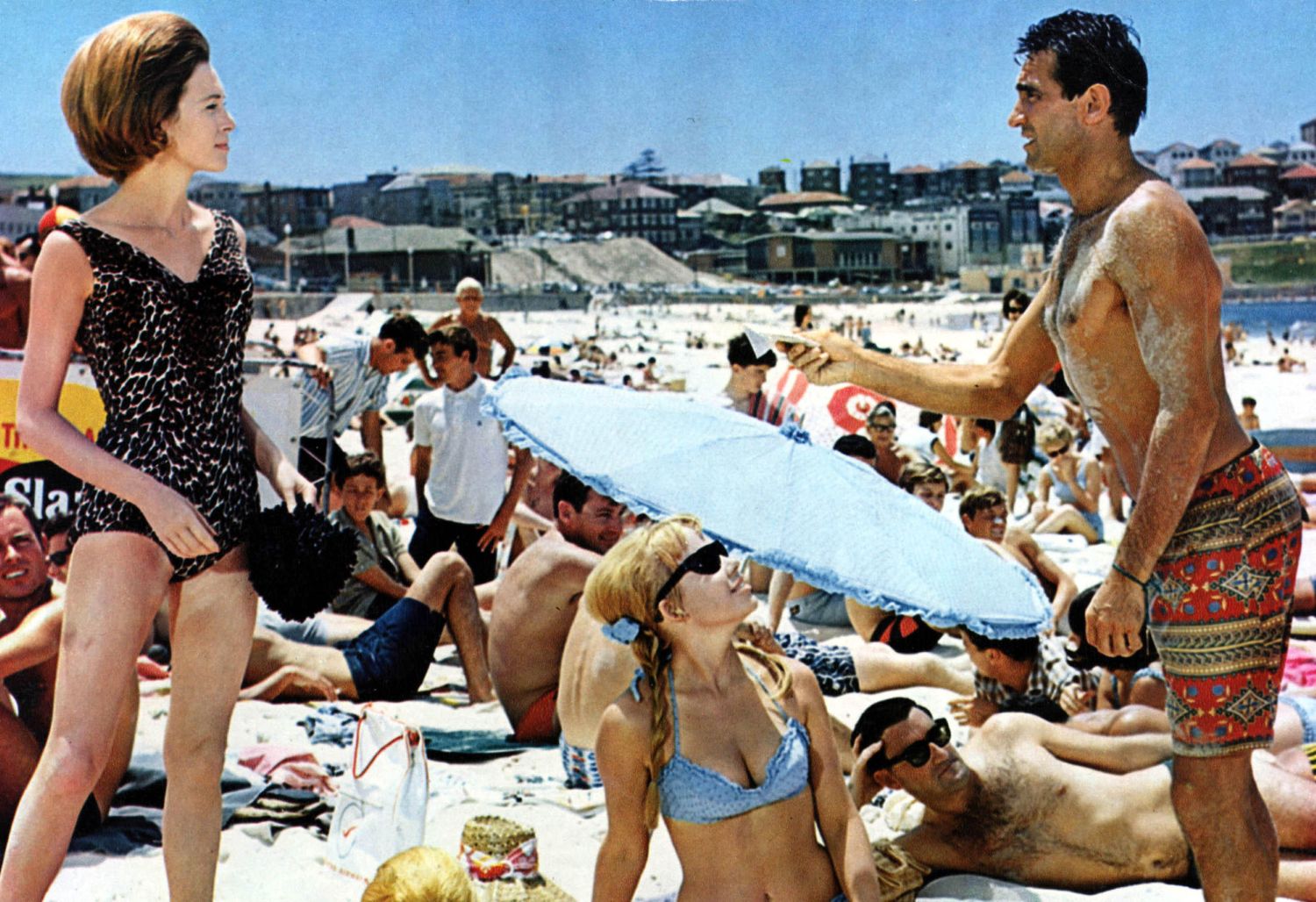
Of interest to Australians was They’re a Weird Mob, one of the six Rank-NFFC co-productions. This was a beautiful little comedy full of heart, from a best-selling book by Nino Culotta about the travails of an Italian immigrant in Sydney, superbly realised by director Michael Powell (returning to the Rank fold after several years away). The movie was a huge hit in Australia but did not “travel” in Britain or Europe and lost money. This was bewildering – perhaps star Walter Chiari was not a draw, or the comedy did not translate, or British audiences simply didn’t care about Italians in Australia. Auterist snobs routinely dismiss They’re a Weird Mob, but it’s one of Powell’s most engaging movies.
Another comedy from Rank-NFFC was The Sandwich Man, starring Michael Bentine, who was involved in creating the Goons. Despite a healthy budget and Bentine co-writing, the movie seemed to make limited impact and lost money as well.
During this period, Rank made two cheap musicals – Be My Guest, a follow-up to Live It Up with David Hemmings, and Dateline Diamonds, featuring the Small Faces. These were cheery, unpretentious efforts, which offer a useful time capsule of the era. There was also Romeo and Juliet, one of Paul Czinner’s filmed ballets (eg The Royal Ballet, The Bolshoi Ballet), another Rank-NFFC co production.
Of far more interest were the thrillers and crime movies. Rank had money in The Ipcress Files, an exciting spy story from Bond producer Harry Saltzman starring Michael Caine. The movie was famous for being “anti-Bond”, which it was to a degree: it was still about a sexy agent who beds women, has sophistication (he’s a cook), outsmarts the bad guys and is cocky to his superiors – but he wears glasses, is unapologetically working class, and has to fill out forms and deal with bureaucracy. Ipcress is terrific fun, one of the best Rank movies of the decade, although one senses its quality came from outside the organisation rather from within.
A more obviously “Rank” film was Deadlier than the Male, an attempt to update the Bulldog Drummond stories for the Bond age, produced by Betty Box and directed by Ralph Thomas. This movie had been in development for a number of years, in part out of difficulties in finding a suitable actor to play Drummond (at one stage, their dream choice was Rod Taylor). Eventually, it was decided to star Richard Johnson, although the movie was stolen by its splendid female villains, Elke Sommer and Sylva Koscina (the opening scene was ripped off for the 2000 Charlie’s Angels). It was popular enough for a sequel, Some Girls Do, but that wasn’t as good, and Richard Johnson never became a star despite producers trying to make him one for a decade.
Deadlier than the Male was one of several thrillers made by Rank that were co-productions partly shot in Europe using international “names” – the organisation never lost its taste for such efforts. Others included The Quiller Memorandum with George Segal, from a series of novels; Maroc 7 with Gene Barry and Elsa Martinelli (co-produced by actor Leslie Phillips!); Stranger in the House with James Mason, Bobby Darin (!) and Geraldine Chaplin, from a French director and novel; The Trygon Factor with Stewart Granger, shot in Germany; and Hell is Empty with Martine Carol and old Rank contract player Anthony Steel (a troubled production during which Carol died). None of these films were blockbusters, but all had a long life on television, especially The Quiller Memorandum.
During 1965-67, Rank returned to war movies, a genre that had been highly lucrative for them in the 1950s, but which they had mysteriously (and foolishly) stopped making. The High Bright Sun was set during the Cyprus Emergency, about a British officer (Dirk Bogarde) falling in love with an American (Susan Strasberg), who has witnessed an assassination by terrorists/freedom fighters (led by George Chakiris). Made by the team of Betty Box and Ralph Thomas, the film was consistently interesting, though it doesn’t quite work – the Cyprus conflict was perhaps too hard for a company like the Rank Organisation to handle (for instance, the script barely mentions the Turks) and it was a box office disappointment, especially considering its cost. During the shoot, Bogarde had a big fight with Box and Thomas, and the movie ended up being their last collaboration; the actor definitely felt that he had out-grown the Rank Organisation, but we feel obliged to add that his performance in The High Bright Sun, as a complex, ruthless intelligence officer, was one of his best.
The Heroes of Telemark was a guys-on-a-mission war film based on the real Norwegian operation to stop German production of an atomic bomb – perhaps the most crucial contribution by an Allied army special operations unit in the history of the war. This was Rank’s attempt at the big time – it had an American star (Kirk Douglas), director (Anthony Mann) and co-financier (Columbia). The resulting movie doesn’t quite work – it gives off the aura of a script that has been changed and re-changed – but is still entertaining with memorable moments, and if it didn’t become a Guns of Navarone type blockbuster that Rank would have hoped for, it did well in Britain and has never stopped playing on television.
The Long Duel was an imperial adventure tale written by Australia’s Peter Yeldham, about the battle of wits between a local rebel (Yul Brynner) and a British officer (Trevor Howard). This was meant to be a co-production between Rank and Indian investors (organised by Sydney Box, who had a heart attack before filming), but when the latter fell over, Rank stepped in and paid for the whole thing, shifting the shoot from India to Spain. It is really weird that Rank made a big imperial adventure so late in the day, and The Long Duel underperformed at the box office – although, like The Heroes of Telemark, it had “legs” internationally, being an action movie with recognised stars.
Rank’s dramas of 1965 to 1967 were a throwback to the organisation’s films of old in that (a) they all had strong roles for a female star and (b) disappointed at the box office. John Mills directed and starred in Sky West and Crooked from a novel by his wife and starring his daughter Hayley. It was not much of a movie: Ian McShane was too old to play Hayley’s love interest, and Mills was a very ordinary director – certainly not as good as Bryan Forbes, who had made an earlier film starring Hayley Mills from a novel by Hayley’s mother, the much better Whistle Down the Wind. The movie was not popular. Neither were two Rank-NFFC co-productions: I Was Happy Here with Sarah Miles from director Desmond Davis, shot in Ireland (this barely made a ripple), and Two Weeks in September with Brigitte Bardot, filmed in England and Scotland with French dialogue. Of the two, the latter is more interesting because of the star power of Bardot – who had appeared for Rank in Doctor at Sea over a decade beforehand; it’s not one of her better movies.
Rank’s other drama was The Trap, a Canadian co-production with Oliver Reed as a trapper who hooks up with mute Rita Tushingham. We think it was an attempt by Rank to repeat the success of The Savage Innocents – it’s another savage-man-melted-by-love story. Unlike many other Rank films set in Canada (The Kidnappers, Campbell’s Kingdom, High Tide at Noon), this was actually shot there. The movie looks gorgeous, has two charismatic stars, and was well directed by Sidney Hayers, perhaps the most under-rated British director of the 1960s. It has flaws, particularly the dubbing of Reed’s voice (why did they do this?). We’re not sure how this movie did commercially – this was before Reed became a star, and Tushingham never quite became a draw.
Incidentally, the Rank Organisation announced several other films during this period that were never made including:
– Show Me a Murder by Janet Green to be directed by John Kirsh;
– The Lonely from novel by Paul Gallico;
– Lion in the Cellar from a novel by Pamela Branch;
– The Diamond Smugglers, based on a non-fiction book by Ian Fleming from a script by Australia’s own Jon Cleary (which we discuss in detail below);
– The Red Hot Ferrari (a Box-Thomas project that was sporadically announced for almost two decades, but never got made)
– Fifth Coin;
– The Battle of Britain (this was made but not by Rank – they pulled out when the budget grew too high).
In 1966, Rank’s production and distribution arm announced a profit of 937,000 pounds, due to the success of the Norman Wisdom, Doctor and Morecambe and Wise productions. However, the following year, the division recorded a loss of 48,000 pounds, including losses of £200,000 on the NFFC films. In October 1968, Rank’s production and distribution arm announced a loss of 583,000 pounds, leading the Organisation to declare: “We reluctantly came to the conclusion that under present conditions, after taking into account the markets available to us, we had materially to curtail our film production programme.”
The Rank Organisation pulled back on film financing, limiting its investment over the next decade to only a few movies per year, mostly Carry On films, movies by Box and Thomas, and the occasional comedy/horror. The organisation would have one last chapter, which we’ll discuss next time, but it was still a crippling blow to the British film industry.
Looking back, the films of the Rank Organisation during 1965-67 were admirably ambitious and varied. The period was a real throwback to “peak Rank” of the 1950s: the six co-productions with the NFFC were reminiscent of the British Film Makers scheme; the production of long-standing comedy franchises (Doctor, Norman Wisdom) and the attempt to find new franchises (Morecombe and Wise, Michael Bentine, Carry On); the making of several female-led melodramas that didn’t quite work, as so many had failed to work in the past (eg Hide Tide at Noon); a sharp increase in stories set in the Commonwealth (Australia, India, Cyprus, Canada), reminiscent of those from years ago; lots of thrillers and crime films, perhaps more than the public actually wanted; international co-productions with foreign “names” that didn’t quite translate at the box office, reminding one of efforts like Ferry to Hong Kong and Whirlpool.
The studio was able to rely on its comedy franchises (Wisdom, doctors) as well as discovering two new ones (Carry On, Morecambe and Wise), but its confidence would have been shaken by unexpected money losers (They’re a Weird Mob, The Magnificent Two, The Sandwich Men). The thrillers produced successes (The Ipcress File, Deadlier Than the Male) though some disappointments (Maroc 7). Its dramas underwhelmed critically and commercially as did the war movies, although many are worth watching. Creatively, Rank continued to be outshone by its rivals in Britain. As usual, it kept doing dumb things like dub Oliver Reed in The Trap.
We should add though, that many of the movies from this time had long lives: The Heroes of Telemark, The Long Duel, The Trap, They’re a Weird Mob, Deadlier Than the Male. It was a respectable legacy and it’s a shame that the results scared Rank off its heavy filmmaking program. The years 1965 to 1967 would be the last time the Rank Organisation would use legendary names like Hugh Stewart, Norman Wisdom, Dirk Bogarde, Ken Annakin, Michael Powell – it was the end of an era. Only a few, like Sir John Davis and Box-Thomas would hang on. The rest will be addressed in the next piece.
Meanwhile, we interviewed Jon Cleary in 2004 about The Diamond Smugglers. This is as good a spot as any to reprint what he said:
In 1964, the Rank Organisation got in touch with me and they had bought a book called The Diamond Smugglers by Ian Fleming. They paid 50,000 pounds for it and sent me a copy and when I looked at it; it was all a grab bag: they were all true stories. But it was something that he’d written one wet Saturday afternoon when he couldn’t play tennis, it really was. I couldn’t understand why they’d bought it, excepting in those days anything with Ian Fleming’s name on it was gold…
Anyhow, they had sent a writer, I forget his name, but he was quite well known. I didn’t know this until later but they sent him to South Africa and he’d come back and hadn’t been able to lick the problem, so now they’ve decided to go again because Richard Todd who’d been a big actor in the 1940s and early ‘50s, he’s now over the hill but he’s still a good looking man and a great womanizer (he had women everywhere), he was out making movies for a South African named Harry Allan Towers. Edgar Wallace, a thriller writer from the 1920s and ‘30s, had written a series called Sanders of the River and they were making these two pictures back-to-back, six weeks each. And they were paying Dickie Todd 25,000 pounds each six weeks. So, the 50,000 pounds went to his bank account in England. He had a small dairy farm down near Henley which his wife ran and they supplied all the cream for Fortnall and Masons and Harrods and he had a very attractive wife. And Miss South Africa from 1961 in Notting Hill Gate and he had them all ‘round South Africa.
Anyhow, he’d come back to Rank and said, ‘There’s so much money out there we can make this, but I want to be in it.’ So, they engaged Robert Parrish, an American director who lived in England and made a couple of successful movies with Irwin Shaw, French Leave [In the French Style] I think it was called with Stanley Baker and Jean Seberg. Bob was very good at handling stuff in the open, he’d done The Purple Plain with Gregory Peck. We were friends, we’d met back in 1957, and so he nominated me as the writer and we had Dickie Todd, and George Willoughby was the producer. So, we fly out to South Africa and I remember we landed at Johannesburg on Sunday afternoon and there are about 3000 people to meet us. There was no television in those days, and Dickie was still a film star and we’re going to make a big film in South Africa, so everyone was there. We booked into the only five-star hotel in Johannesburg in those days and we each had a corner suite. They really laid it on. Then we had our own Cessna, to fly us around.
I’d started to look at it and I knew there was one story I thought I could develop. In South West Africa… the de Beers people owned a huge tract of what is a company town and you had to come in over a bridge. They had an airstrip – the only plane to land there was Oppenheimer’s, he belonged to the de Beers, and that was the only plane landed. But they used to do sand mining for diamonds right up along the coast and they’d have a white man in charge of six or eight blacks. They would mine the diamonds in the sand, and they’d come in once a month and between the beaches and the next province it was 200 miles of semi desert and scrub. Every morning at sun-up, a plane would take off, a Tiger moth from the town, and fly up the beaches and fly back to make sure nobody was getting over. And they’d worked out that nobody could get across the scrub and desert in a night, the tracks would be there so they had it covered that way, but there were two men, whether they were working together or not I don’t know, but they were “two diamonds for de Beers, one for me”, you know, they were putting them into match boxes.
I thought this is the beginning of a story, so I developed it. I said to Dickie, ‘would you mind playing a villain’, and his eyes lit up. Because every actor wants to play a villain. So, I wrote it that way and Steve McQueen was to play the lead, so I’d written it as an American.
And we got lots of advice. I remember we were in the dining room of the hotel in Johannesburg and this very attractive woman in her mid 40s she was Baroness somebody, she was one of those fugitive European aristocrats. She was in the diamond business, and she came in and she had a very small briefcase, and she was going to be the one who was going to educate me in blue, yellow, pink and the rest of the diamonds. And she took out these three or four shammy bags and just up emptied them and diamonds were spread all over the table. I said ‘how much are these?’ She said ‘oh about two million rand’, which was about a million pounds at that time. Nobody in the place takes any notice!
I remember we were on a commercial airline flying down to Durban and Bob’s sitting over there and I’m here and there’s an empty seat and a bloke comes and sits alongside me and says, ‘I believe you’re going to make a picture about diamond smuggling?’ I said ‘yes’. He said, ‘I’d be interested whom could I talk to about putting money into it.’ It was like that. Dickie knew that, that was how he’d sold it.
Anyhow, I’d finished the script and we get back to England and old Earl St John who was a very nice old American everybody liked, his health went and he resigned and it was taken over by, I’ve forgotten the name, it was a lawyer, he was married to a prominent British film actress, and he just said ‘I’m not making anything that was started by Mr. Earl St John’ and that was it, it went on to the shelves. Bob was paid off for his time, I was paid for the script.
I found out later that the previous writer plus our thing and the rest of it had cost 140,000 pounds. I’m talking 1964, so what would that be today? Well over a million and a half to two million.
