


by Gill Pringle in LA
In bringing the 46-year-old Alien film saga to television for the first time, showrunner Noah Hawley expands the franchise with a prequel set two years before the events in Ridley Scott’s original 1979 film.
Under Hawley’s stewardship, Alien: Earth tells the story of a space vessel that crash-lands on earth, setting loose the collected samples of several different alien life forms – and not just the familiar teeth-baring, drooling, acid oozing and egg-laying one.
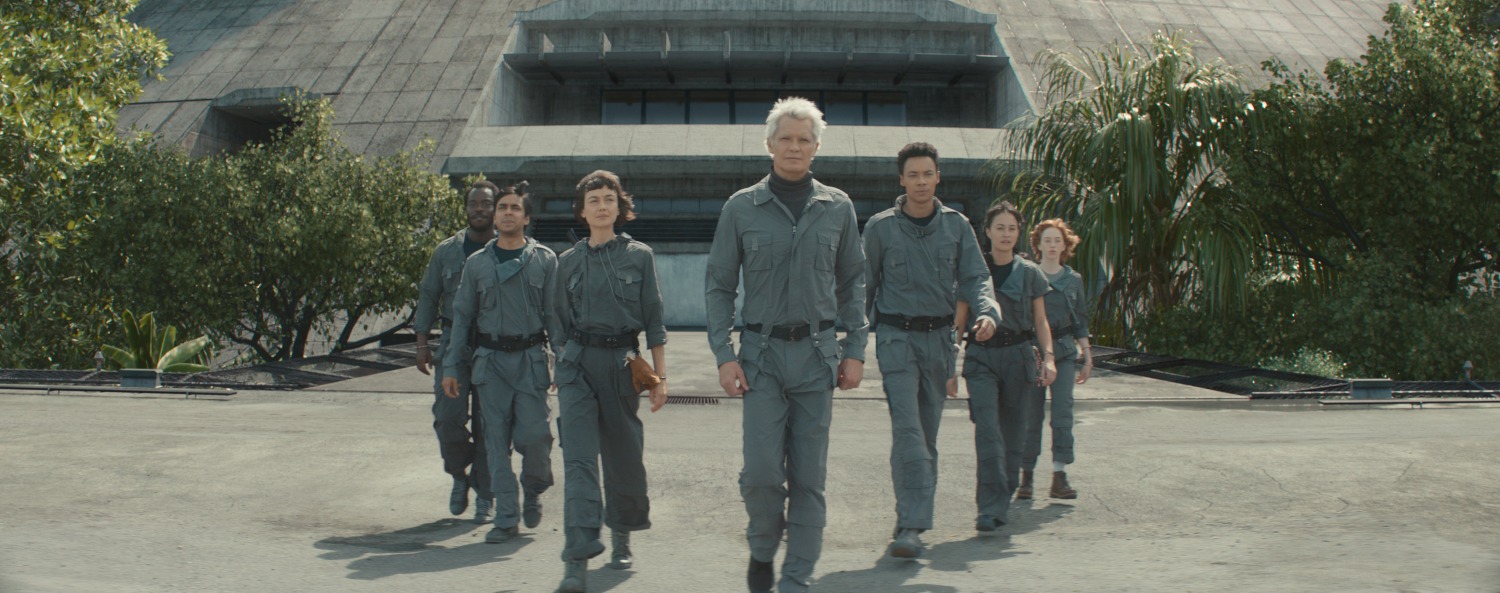
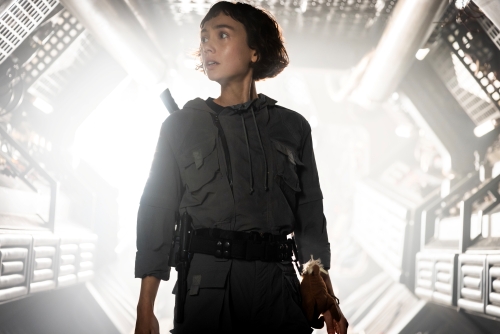
A human-synthetic hybrid known as Wendy – portrayed by Sydney Chandler – and a ragtag group of tactical soldiers race to contain the crisis, making a fateful discovery that puts them face-to-face with the planet’s greatest threat.
 It’s the year 2120, and the Earth is governed by five corporations: Prodigy, Weyland-Yutani, Lynch, Dynamic and Threshold. In this Corporate Era, cyborgs (humans with both biological and artificial parts) and synthetics (humanoid robots with artificial intelligence) exist alongside humans. But the real game changer begins when the wunderkind Founder and CEO of Prodigy Corporation unlocks a revolutionary new technological advancement: hybrids (humanoid robots infused with human consciousness).
As the first hybrid prototype, Wendy marks a new dawn in the race for immortality. And after Weyland-Yutani’s spaceship collides into Prodigy City, Wendy and the other hybrids encounter mysterious life forms more terrifying than anyone could have ever imagined.
Some eight years in the making, Hawley knew that he had something to say about the future co-existence of mankind and technology – even before Chat GPT existed.
“For me, it started with the fact that I’m raising kids in this world in which the natural world is starting to turn on us and the technology we’ve created – and the jury’s out on whether that’s going to turn on us,” says the Emmy-winning director/writer/producer and screenwriter celebrated for Fargo and Legion.
“When they asked me if I had any ideas for Alien, I thought, ‘well, that’s what Alien is about. It’s about these primordial monsters of our past that are trying to kill Sigourney.’ And then the AI future, we realise, is also trying to kill her. So, humanity is trapped between the AI future and the monsters of the past.
“Once I started with this idea of bringing children into this story – the human minds transferred into synthetic bodies – then the Peter Pan analogy came pretty quickly after that,” says Hawley, 58, talking about Alien: Earth’s synthetic ‘Lost Boys’.
The twist, of course, is that the Peter Pan in all of this – Wendy’s creator – is petulantly human as portrayed by Samuel Blenkin’s Boy Kavalier, CEO of the Prodigy Corporation.
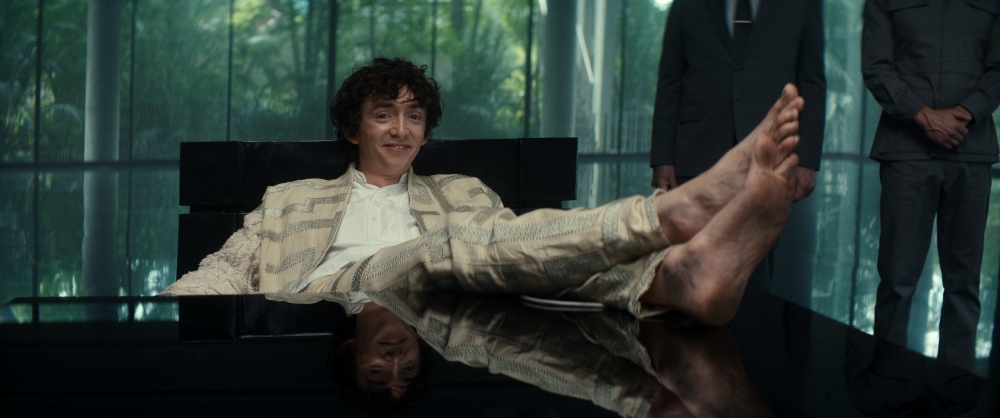
In a nuanced performance from the Brit Black Mirror actor, Blenkin plays Boy Kavalier as an Elon Musk-esque genius, a bare-footed, bathrobe-wearing egomaniac.
Of course, he leaves all the hard work to his trusty sidekicks, Timothy Olyphant’s Kirsh, a synthetic mentor and trainer, and Australia’s own Essie Davies who takes care of the emotional needs of Wendy and her Lost Boys.
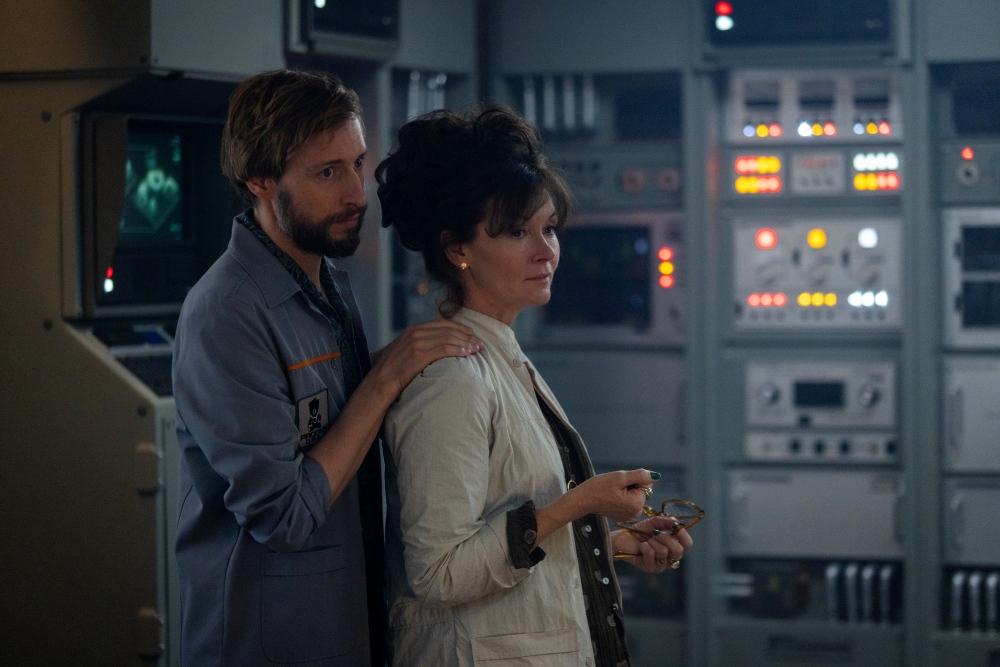
Hawley faced many challenges in re-imagining Alien for a new TV generation, not least in length and scope: “An Alien movie is a two-hour survival story, and a television show is long form in which you have to invest in a lot of characters who don’t die and explore these characters and the themes that were introduced in the Alien franchise. So, the challenges are, for me, let’s take the monsters out of it for a minute and think about what the show is? Where’s the drama that we’re investing in week to week? I’m not worried about the monsters. When we put the monsters in, that’s the money-back guarantee, right?” he argues.
“We had to create this human drama in which you have a lot of human monsters as well and explore a lot of issues about the world that we’re living in, just projected into the future. I also tried to figure out what the first two films [Alien and Aliens] made me feel and why. How can I create those feelings in an audience by telling a totally different story?” he asked himself.
If Chandler isn’t exactly a household name, then the weight of this expensive, special effects laden, sci-fi series lands almost entirely on her petite shoulders – contracted to portray Wendy for all future seasons.
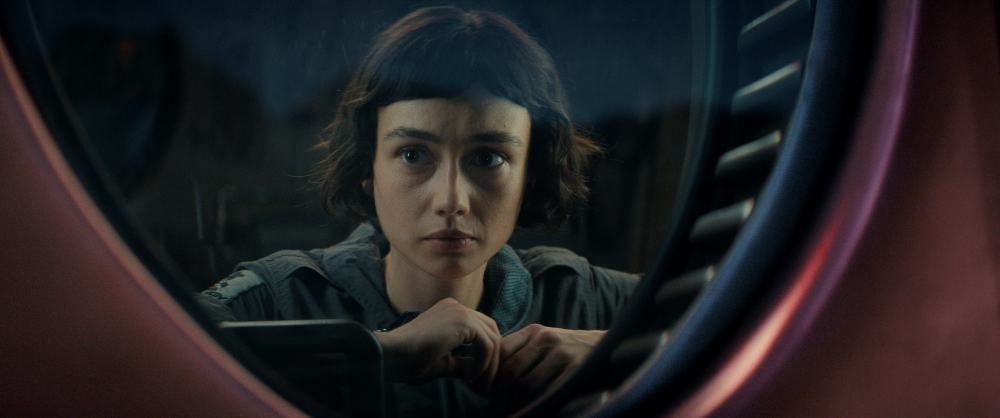
Shot over a year in Bangkok and other locations in Thailand, she says that she didn’t have to think too deeply about portraying a child’s consciousness within an adult body.
“Wendy is very much a blank page. You can’t research a hybrid. I feel like Noah was able to create a very layered, grounded character. As far as balancing the two, it really depended on who I was acting with on the day and in what scene?” says the actress, daughter of actor Kyle Chandler.
“Every actor would bring a different colour to the work, which would give me more information of who I am playing. It was kind of a collaboration of finding Wendy that way,” says the Don’t Worry Darling actress.
“I would have this image of two magnets kind of pressing up against each other, and you just can’t get them to touch as far as the mind, which is known, and this body, which is unknown territory. It’s kind of like what’s in the middle – what’s that void? – is what she’s seeking. And a lot of that has to do with Alex Lawther,” she says referring to the Star Wars: Andor actor who portrays her human brother, CJ.

For Hawley, the new series presented a great opportunity to further explore a narrative about capitalism and corporate overlords.
“So much of what defines Alien and Aliens is this nameless, faceless Weyland-Yutani corporation and these individuals – the space truckers or the soldiers – they’re really at the mercy of this nameless, faceless corporation. In our day and age, our corporations have faces and the faces of these young technocrats, who are celebrity CEO billionaires.
“So, if I had done the 1970s version of capitalism, it wouldn’t have felt right for the world that we live in today. And so, once the Peter Pan analogy emerged in the storytelling, then it became clear that the CEO who invents this hybrid technology should be the Peter Pan character himself in Boy Kavalier. What you see is that it always felt to Yaphet Kotto and Harry Dean Stanton that they were at the whim of this larger corporation. But here, we feel like it really is all about the whim of Boy Kavalier, how he feels from moment to moment. Yeah, let’s send these billion-dollar prototypes to a crash site. That sounds like a good idea, right? So, we’re in a different sort of state where the individual is at the mercy now, not just of this nameless, faceless corporation, but of these sort of boy geniuses,” he says.
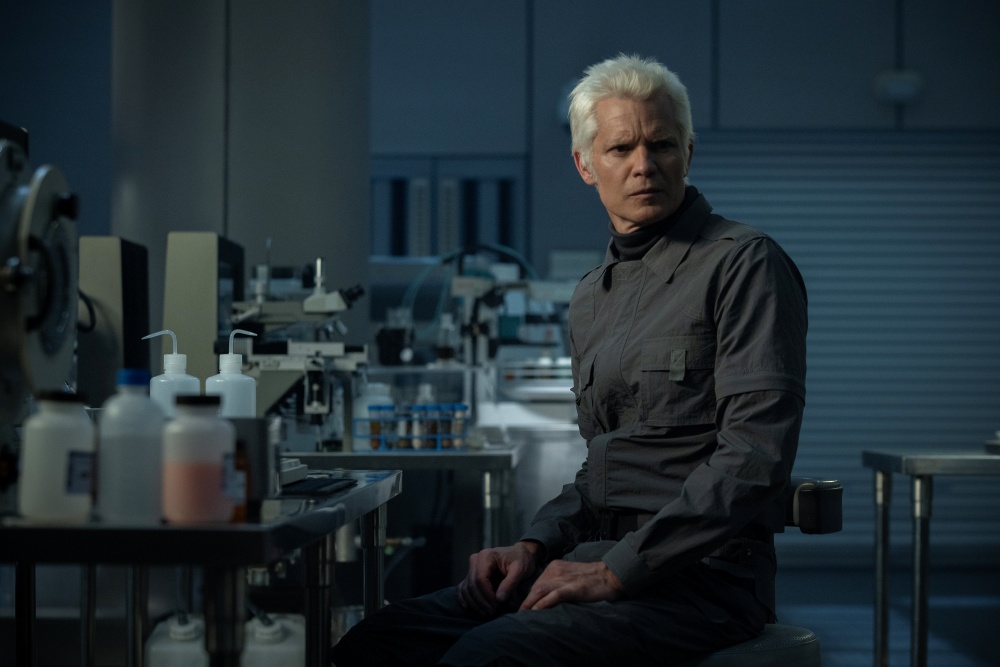
If audiences have seen prior iterations of cybernetic-adjacent characters in this franchise – whether it’s Ian Holm’s “Ash” or Lance Henriksen’s “Bishop” – then this territory today falls to Olyphant with whom Hawley had previously collaborated on Fargo.
To this end, Olyphant sports bleached blonde hair and moves rather stiffly.
Ask the actor if he felt anything else was required, he smiles, “I thought the hair was enough. I thought if we bleach the hair… there you go. He’s his own thing now. We can stop with the comparisons. I’m a huge fan of those gentlemen and their work. I’ve watched that performance by Ian Holm god knows how many times. It’s so beautiful and subtle. It was great the first time, when he was hiding the ball, and then the second time, when you knew the joke. If I thought of those guys at all, it was simply because I was inspired by them and their work. Mostly, I just showed up to do a Noah Hawley project,” he says.
For Hawley’s part, he says, “We talked a little bit about the programing that goes into a Kirsh; and this idea that maybe, not only is he programmed not to harm his boss in any way, but disagreeing with the boss is also discouraged. And getting angry at the boss is verboten. And so, potentially, if you don’t seem to see eye-to-eye with him, maybe just give him a little smile and tell him, ‘fuck you’ with your eyes.”
Alien: Earth is streaming now
