


by Ali Mozaffari
MIFF’s Bright Horizons Award Winner is Hybrid Cinema – a Canadian film in love with Persian cinema, which offers a whole new approach to filmmaking diaspora.
We need to use the term ‘Hybrid Cinema’ for films like Universal Language. Imagine you are inspired and infatuated by a country and culture and yet you want to connect it somehow to your own hometown and pay homage to that foreign country’s culture; using your hometown as the location and backdrop for this cinematic infatuation. Such is the case for Matthew Rankin’s film Universal Language; made as a personal homage to Iran and Iranian cinema, set in the Canadian city of Winnipeg.
This is a film that needs to be understood through its style and its many cinematic references.
Universal Language uses an absurdist and surreal style to create its world. It opens with a logo that is instantly recognisable to the majority of Iranians who have watched films between 1960 and 1980, the logo of Kanoon (a government owned cultural centre that funded and supported independent Iranian filmmakers mainly focusing on films for children). It even uses film stock with a high ISO/sensitivity to mimic the look of films made in that era. But in its style, Rankin’s film is more influenced by the great absurdity of modern cinema, Roy Andersson and Aki Kaurismaki.
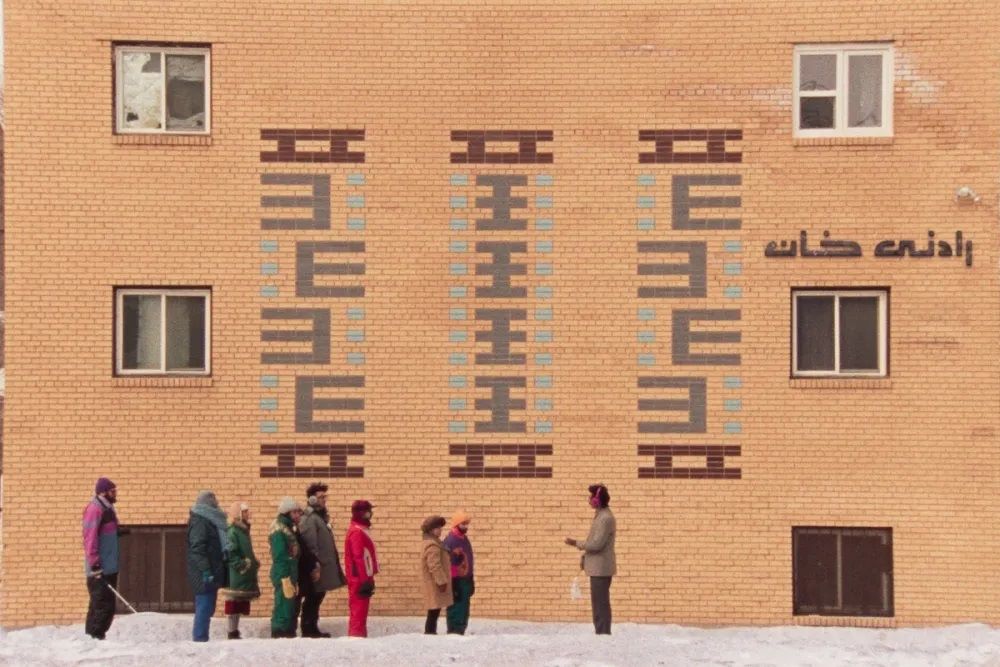
Rankin make an unusual and impressive effort to create parallels between Canda’s Winnipeg and Tehran (the capital of Iran) through finding similar architecture, colours and textures between streets and landscapes of Tehran and Winnipeg. The result feels like the protagonist and other characters are passing through a subjective world in their hometown but living with a memory of Iran. To that effect, there are Persian signs all over Winnipeg, street vendors selling Iranian street food, and even an Iranian style café (Chai-khaneh), albeit with an absurdist twist. Though the film has a disjointed, episodic structure, it still centres around a main plot, following a guy returning to his hometown of Winnipeg (where people talk in Persian!) looking for his mother’s house and coming across a variety of bizarre and eccentric characters with their own subplots which are also full of nods to other famous Iranian films made by or in the style of Kanoon films.
The tone of the first half of the film is comedic, full of absurd references to the everyday life in Winnipeg or the stereotypical cultural elements of Iran or at least the Iranian diaspora. The second half of the film shifts to a melancholic tone and remains that way till the end.
There are several ways that the audience can arrive at and connect with this unique and somewhat experimental film; either through their familiarity with absurdist surreal cinema, their knowledge or interest in Iranian cinema and/or their connection to the Canadian bleak landscape and lifestyle in this albeit ‘imagined’ Winnipeg. That is to say that the film walks a very thin line of brining these different and separate worlds together and it often succeeds at it, especially when it lets the absurdist tone take over. Not to mention that to show how a ghost-like image of Tehran is recreated through locations and architecture of Winnipeg is the most remarkable stylistic achievement of the film; offering a whole new approach to filmmaking diaspora.
Universal Language is in cinemas 22 May 2025
